


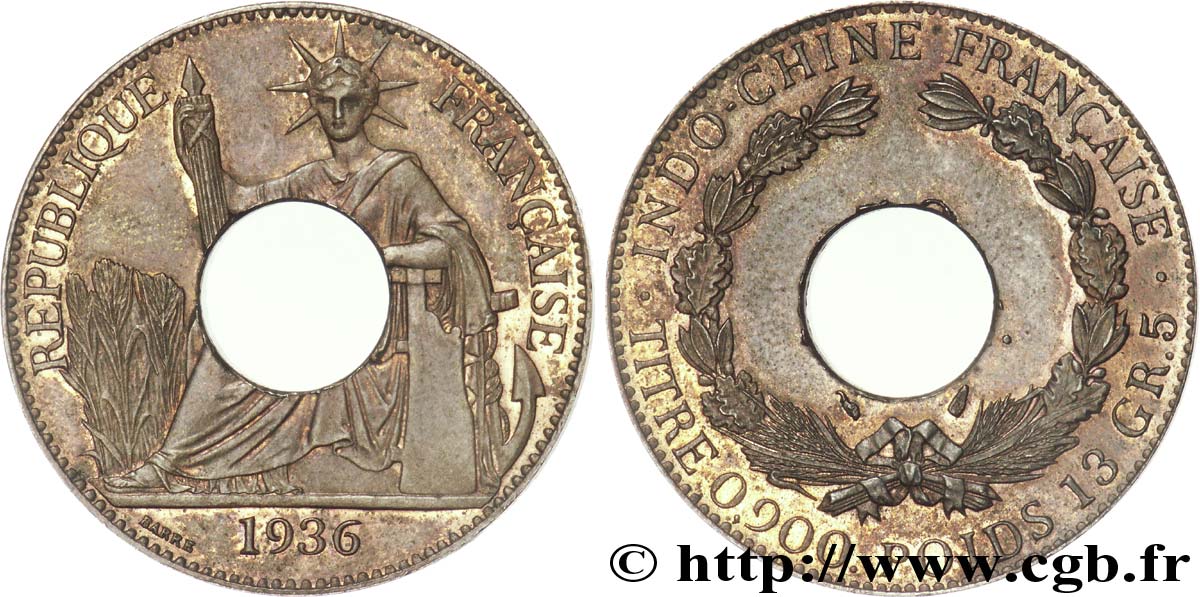
v30_1111 - III REPUBLIC - INDOCHINA Essai de 1 cent (?) en bronze, sans le mot ESSAI, aux coins de la 50 cent 1936 Paris
MONNAIES 30 (2007)
Starting price : 200.00 €
Estimate : 800.00 €
Realised price : 755.00 €
Number of bids : 5
Maximum bid : 755.00 €
Starting price : 200.00 €
Estimate : 800.00 €
Realised price : 755.00 €
Number of bids : 5
Maximum bid : 755.00 €
Type : Essai de 1 cent (?) en bronze, sans le mot ESSAI, aux coins de la 50 cent
Date: 1936
Mint name / Town : Paris
Metal : copper
Diameter : 27,77 mm
Orientation dies : 6 h.
Weight : 7,26 g.
Edge : lisse
Rarity : UNIQUE
Coments on the condition:
La monnaie n’a pas circulé mais le brillant de frappe et la couleur d’origine sont largement partis
Catalogue references :
Obverse
Obverse legend : REPUBLIQUE - FRANÇAISE// (1936) À L'EXERGUE ET BARRE.
Obverse description : La République assise à gauche de trois quarts de face, radiée et drapée tenant un faisceau de licteur, appuyée sur un gouvernail et une ancre ; devant elle une rizière ; signé BARRE à l'exergue.
Reverse
Reverse legend : INDO-CHINE - FRANÇAISE / TITRE 0,900 POIDS 13 GR 5.
Reverse description : en légendes circulaires, au centre en deux lignes : [50/ CENT.].
Commentary
L’exemplaire a été percé pour offrir l’aspect standard, dans le monde indochinois, de la sapèque, bien que la perforation soit très importante et se retrouve sur d’autres exemples de frappes métropolitaine. On reconnaît au bord du trou le reste du 0 de 50. Les coins de la 50 cent ont été utilisé par convenance, leur diamètre correspondant approximativement à celui du cent frappé jusqu’à 1939. Le plus étonnant est qu’il ne semble pas exister d’essai ou de pré-série à ce type en cuivre et que l’on comprend mal l’intérêt en 1936 de faire un essai de percement sur un coin non approprié alors que la série des cents se poursuit. Cet essai ne correspond à rien de connu et date peut-être de l’immédiat après-guerre, mais sans certitude car la date de 1936 peut être valide.
The specimen was pierced to provide the standard appearance, in the Indochinese world, of the sapèque, although the perforation is very significant and is found on other examples of metropolitan strikes. The rest of the 0 of 50 can be seen at the edge of the hole. The dies of the 50 cent were used for convenience, their diameter corresponding approximately to that of the cent struck until 1939. The most surprising thing is that there does not seem to be a test or pre-series of this type in copper and that it is difficult to understand the interest in 1936 of carrying out a piercing test on an unsuitable die while the series of cents continues. This test does not correspond to anything known and perhaps dates from the immediate post-war period, but without certainty because the date of 1936 may be valid.
The specimen was pierced to provide the standard appearance, in the Indochinese world, of the sapèque, although the perforation is very significant and is found on other examples of metropolitan strikes. The rest of the 0 of 50 can be seen at the edge of the hole. The dies of the 50 cent were used for convenience, their diameter corresponding approximately to that of the cent struck until 1939. The most surprising thing is that there does not seem to be a test or pre-series of this type in copper and that it is difficult to understand the interest in 1936 of carrying out a piercing test on an unsuitable die while the series of cents continues. This test does not correspond to anything known and perhaps dates from the immediate post-war period, but without certainty because the date of 1936 may be valid.
Historical background
III REPUBLIC - INDOCHINA
(4/09/1870-10/07/1940)
Paul Doumer (1857-1932) was appointed governor of Indochina in 1897. He undertook major works and created, in 1898, the French School in the Far East. He reorganized the following year the opium trade, which represented a third of the colony's income. Doumer remains in place until 1911. He is then replaced by Albert Sarraut.
 Report a mistake
 Print the page
 Share my selection
 Ask a question
 Consign / sell
Related articles

 Full data


cgbfr.com numismatists


