


E-auction 702-767743 - PONTS ET CHAUSSÉES / BRIDGES AND ROADS PONT DE TOMBLAINE n.d.
You must signin and be an approved bidder to bid, LOGIN TO BID. Accounts are subject to approval and the approval process takes place within 48 hours. Do not wait until the day a sale closes to register. Clicking on « bid » constitutes acceptance of the terms of use of cgb.fr private e-auctions.
Bids must be placed in whole Euro amounts only. The sale will start closing at the time stated on the item description; any bids received at the site after the closing time will not be executed. Transmission times may vary and bids could be rejected if you wait until the last second. For further information ckeck the E-auctions F.A.Q.
NO BUYER'S FEE.
NO BUYER'S FEE.
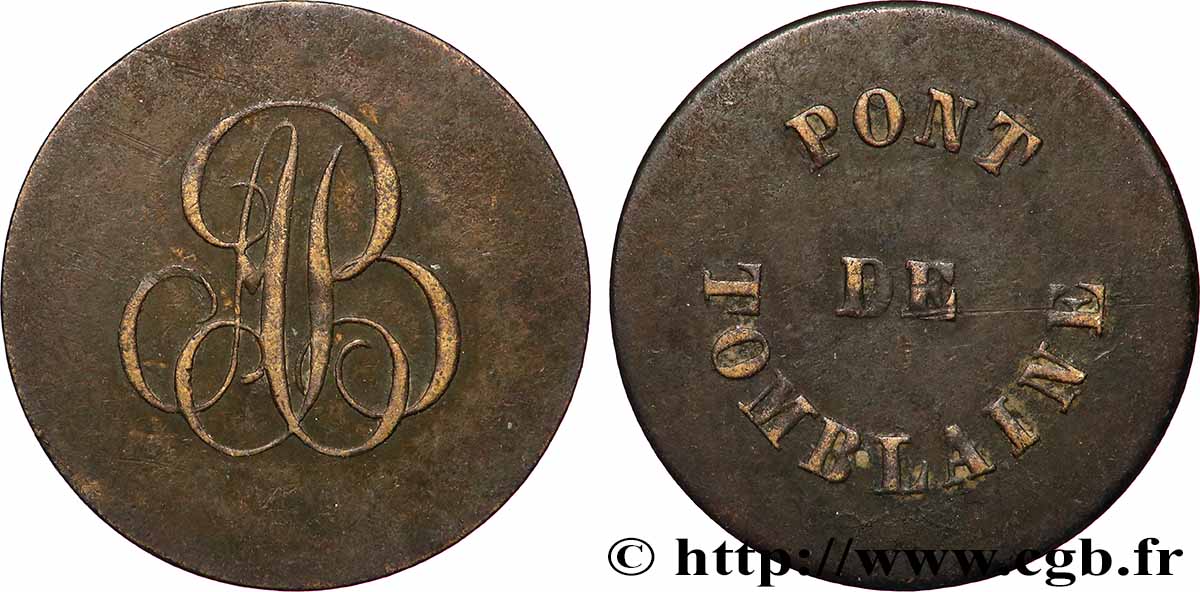
Type : PONT DE TOMBLAINE
Date: n.d.
Metal : brass
Diameter : 22 mm
Orientation dies : 6 h.
Weight : 1,96 g.
Edge : lisse
Puncheon : sans poinçon
Rarity : R1
Coments on the condition:
Patine hétérogène. Usure régulière
Catalogue references :
Obverse
Obverse legend : PONT DE TOMBLAINE.
Obverse description : En trois lignes.
Reverse
Reverse legend : AB EN MONOGRAMME.
Commentary
Le pont de Tomblaine
Depuis 1540 environ, un bac assurait la traversée de Tomblaine à Nancy. Au début du XIXe siècle, celui-ci franchissait la rivière en amont d'une baignade fort prisée des Nancéiens. Le nombre restreint de ponts sur la Meurthe se faisant sentir, Monsieur le Baron Buquet, qui deviendra maire de Nancy sous le second Empire, entreprend à ses frais la construction du pont de Tomblaine. Les travaux commencent le 1er février 1842 et la première pierre est posée par Mlle Marie Buquet le 2 juillet 1842. Les travaux furent conduits par A.-F. Solet, entrepreneur à Nancy, et les ingénieurs J. Jaquiné et Charles Duhoux. Le pont est ouvert en octobre de la même année et sera à péage jusqu'en 1896, date à laquelle il est racheté par la ville de Nancy.
Notre jeton est certainement celui qui servait au péage de ce pont voir http://fr.wikipedia.org/wiki/Tomblaine .
The Tomblaine Bridge Since around 1540, a ferry provided the crossing from Tomblaine to Nancy. At the beginning of the 19th century, it crossed the river upstream from a bathing spot very popular with the people of Nancy. The limited number of bridges over the Meurthe being felt, Mr. Baron Buquet, who would become mayor of Nancy under the Second Empire, undertook the construction of the Tomblaine Bridge at his own expense. Work began on February 1, 1842, and the first stone was laid by Miss Marie Buquet on July 2, 1842. The work was led by A.-F. Solet, a contractor in Nancy, and the engineers J. Jaquiné and Charles Duhoux. The bridge opened in October of the same year and was a toll bridge until 1896, when it was purchased by the city of Nancy. Our token is certainly the one used for the toll on this bridge. See http://fr.wikipedia.org/wiki/Tomblaine
Depuis 1540 environ, un bac assurait la traversée de Tomblaine à Nancy. Au début du XIXe siècle, celui-ci franchissait la rivière en amont d'une baignade fort prisée des Nancéiens. Le nombre restreint de ponts sur la Meurthe se faisant sentir, Monsieur le Baron Buquet, qui deviendra maire de Nancy sous le second Empire, entreprend à ses frais la construction du pont de Tomblaine. Les travaux commencent le 1er février 1842 et la première pierre est posée par Mlle Marie Buquet le 2 juillet 1842. Les travaux furent conduits par A.-F. Solet, entrepreneur à Nancy, et les ingénieurs J. Jaquiné et Charles Duhoux. Le pont est ouvert en octobre de la même année et sera à péage jusqu'en 1896, date à laquelle il est racheté par la ville de Nancy.
Notre jeton est certainement celui qui servait au péage de ce pont voir http://fr.wikipedia.org/wiki/Tomblaine .
The Tomblaine Bridge Since around 1540, a ferry provided the crossing from Tomblaine to Nancy. At the beginning of the 19th century, it crossed the river upstream from a bathing spot very popular with the people of Nancy. The limited number of bridges over the Meurthe being felt, Mr. Baron Buquet, who would become mayor of Nancy under the Second Empire, undertook the construction of the Tomblaine Bridge at his own expense. Work began on February 1, 1842, and the first stone was laid by Miss Marie Buquet on July 2, 1842. The work was led by A.-F. Solet, a contractor in Nancy, and the engineers J. Jaquiné and Charles Duhoux. The bridge opened in October of the same year and was a toll bridge until 1896, when it was purchased by the city of Nancy. Our token is certainly the one used for the toll on this bridge. See http://fr.wikipedia.org/wiki/Tomblaine
Historical background
PONTS ET CHAUSSÉES / BRIDGES AND ROADS
The French Monarchy had long cherished the project of ensuring the construction of thoroughfares which usually fell within the competence of local authorities, provinces, lords or communities.. For essentially financial reasons, the project only really came to fruition in 1716 with the creation of a hierarchical corps, on the model of the corps of military engineers, responsible for the fortifications, which had been organized some twenty-five years earlier.. Initially, the corps des Ponts et Chaussées comprised an inspector general, an architect first engineer, three inspectors general and twenty-one engineers, who had to design and build roads and engineering structures with sub-engineers recruited by their care. The task entrusted to them corresponds to a significant shift in the priorities of the State. In 1716, Louis XIV had been dead for almost a year, leaving France exhausted from long years of war. Concerns of military grandeur are almost immediately followed by the pursuit of economic power which must be achieved by facilitating trade through more and safer transportation infrastructure.. Offering more ramified service possibilities than rivers and canals, roads will be the subject of repeated investments by the State, allowing bridge engineers to appear as the privileged servants of its economic plans.. Text taken from the excellent: http://www. enpc. fr/teachings/Picon/CorpsPC. html.
 Report a mistake
 Print the page
 Share my selection
 Ask a question
 Consign / sell
Related articles
 Full data


Your Recently Viewed Items

NEMAUSUS - NIMES - AUGUSTUS and AGRIPPA Dupondius COL NEM (as) VG
50.00 €

MOROCCO 2 1/2 Dirhams (1/4 Rial) Moulay Youssef an 1331 (1912) Paris XF
50.00 €

PONTS ET CHAUSSÉES / BRIDGES AND ROADS PONT DE TOMBLAINE XF
75.00 €

10 francs Turin, petite tête 1948 F.362/3 AU
8.00 €

FIJI 50 Cents 50 ans de l’idépendance 2020 MRC, Winnipeg MS
10.00 €
cgbfr.com numismatists


