


fme_387911 - POLAND Médaille, Massacres de Galicie
135.00 €(Approx. 160.65$ | 117.45£)
Quantity
Add to your cart

Type : Médaille, Massacres de Galicie
Date: 1846
Mint name / Town : Pologne, Cracovie
Diameter : 40,5 mm
Orientation dies : 12 h.
Engraver David d’Angers (1788-1856)
Weight : 17,7 g.
Edge : lisse
Coments on the condition:
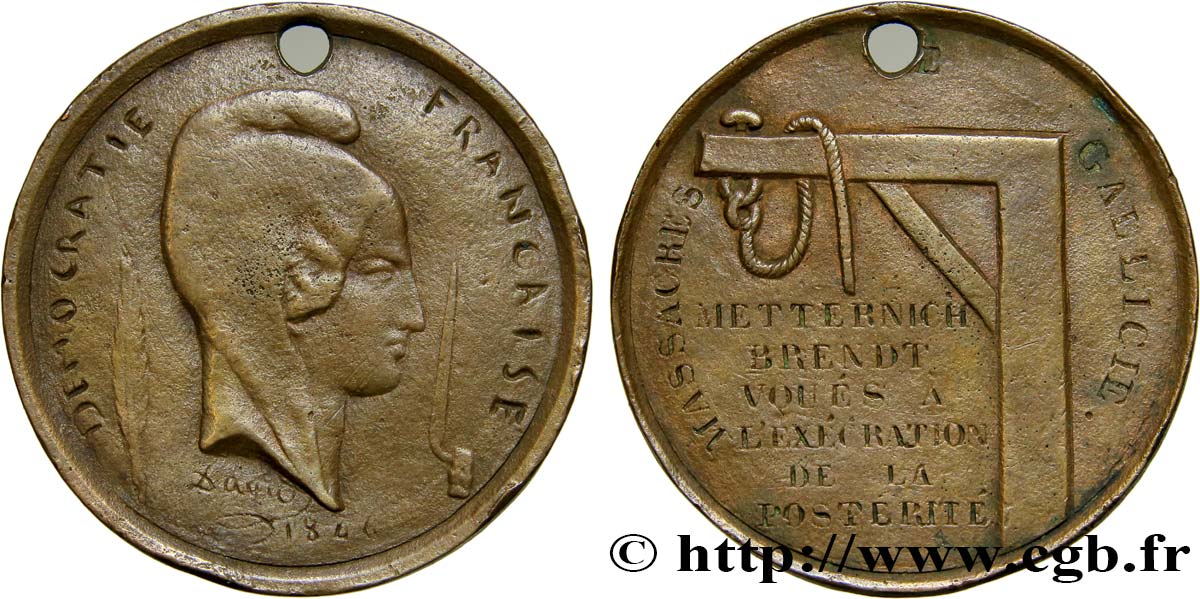
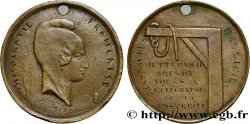
Intéressante médaille avec des types bien venus et une agréable patine mais perforée à midi
Predigree :
Cet exemplaire provient de la vente ELSEN 126, n° 1668
Obverse
Obverse legend : DÉMOCRATIE FRANÇAISE.
Obverse description : Tête de Marianne à droite, coiffée du bonnet phrygien.
Reverse
Reverse legend : MASSACRES GALLICIE // METTERNICH / BRENDT / VOUÉS À / L’ÉXÉCRATION / DE LA / POSTÉRITÉ.
Reverse description : Corde nouée sur une potence, légende circulaire autour et en 6 lignes sous la potence.
Commentary
Médaille signée DAVID 1846 (Collignon 1427).
Le Soulèvement de Cracovie, qui eut lieu le 18 février 1846, était censé, conjointement avec une future insurrection du Grand-duché de Posen, déclencher une guerre de libération des territoires autrefois polonais ; promptement réprimé, il se solda en fait par la confiscation des terres des aristocrates polonais de Galicie au profit des paysans ukrainiens et par l’annexion de la République de Cracovie à l’Empire d'Autriche.
Le Manifeste de Cracovie, proclamé le 22 février 1846 par Karol Libelt affirme notamment l’abolition du servage, l'assistance aux pauvres et l’égalité de droit pour les juifs.
Le gouvernement provisoire met sur pied une petite armée et exhorte les paysans à se joindre au soulèvement. De leur côté, les Autrichiens s'appuient sur la paysannerie ukrainienne, majoritaire, en évoquant les risques de laisser les aristocrates polonais retrouver leurs droits primitifs.
Les troupes polonaises ne parviennent pas à s'opposer à l’armée autrichienne. L'un des chefs de l'insurrection, le philosophe Édouard Dembowski, tombe l'un des premiers sous les balles de la répression ; quant aux survivants, ils sont persécutés par les paysans ukrainiens. Jan Tyssowski, qui le 24 février s'est proclamé « dictateur », capitule le 2 mars et avec les 1 500 hommes qui lui restaient, gagne la Prusse voisine, où lui et ses soldats sont désarmés et internés.
En Galicie occidentale, plusieurs grandes propriétés polonaises furent détruites et les aristocrates massacrés. C'est finalement l'armée autrichienne qui mit un terme à ces troubles. En exploitant la haine des serfs ukrainiens contre leurs maîtres, le gouvernement de Vienne était déjà parvenu à ses fins.
.
Medal signed DAVID 1846 (Collignon 1427).
The Krakow Uprising, which took place on 18 February 1846, was intended, together with a future insurrection in the Grand Duchy of Posen, to trigger a war of liberation of the formerly Polish territories; promptly suppressed, it actually resulted in the confiscation of the lands of the Polish aristocrats of Galicia in favour of the Ukrainian peasants and in the annexation of the Krakow Republic to the Austrian Empire..
The Krakow Manifesto, proclaimed on February 22, 1846 by Karol Libelt, notably affirmed the abolition of serfdom, assistance to the poor and equality of rights for Jews..
The provisional government raises a small army and urges peasants to join the uprising.. For their part, the Austrians relied on the Ukrainian peasantry, the majority, citing the risks of allowing the Polish aristocrats to regain their original rights..
Polish troops fail to oppose the Austrian army. One of the leaders of the uprising, the philosopher Édouard Dembowski, was one of the first to fall under the bullets of the repression; as for the survivors, they were persecuted by the Ukrainian peasants.. Jan Tyssowski, who on February 24 proclaimed himself \\\"dictator,\\\" capitulated on March 2 and, with his remaining 1,500 men, reached neighboring Prussia, where he and his soldiers were disarmed and interned..
In Western Galicia, several large Polish estates were destroyed and the aristocrats massacred.. It was finally the Austrian army that put an end to these troubles.. By exploiting the hatred of the Ukrainian serfs against their masters, the government in Vienna had already achieved its ends..
Le Soulèvement de Cracovie, qui eut lieu le 18 février 1846, était censé, conjointement avec une future insurrection du Grand-duché de Posen, déclencher une guerre de libération des territoires autrefois polonais ; promptement réprimé, il se solda en fait par la confiscation des terres des aristocrates polonais de Galicie au profit des paysans ukrainiens et par l’annexion de la République de Cracovie à l’Empire d'Autriche.
Le Manifeste de Cracovie, proclamé le 22 février 1846 par Karol Libelt affirme notamment l’abolition du servage, l'assistance aux pauvres et l’égalité de droit pour les juifs.
Le gouvernement provisoire met sur pied une petite armée et exhorte les paysans à se joindre au soulèvement. De leur côté, les Autrichiens s'appuient sur la paysannerie ukrainienne, majoritaire, en évoquant les risques de laisser les aristocrates polonais retrouver leurs droits primitifs.
Les troupes polonaises ne parviennent pas à s'opposer à l’armée autrichienne. L'un des chefs de l'insurrection, le philosophe Édouard Dembowski, tombe l'un des premiers sous les balles de la répression ; quant aux survivants, ils sont persécutés par les paysans ukrainiens. Jan Tyssowski, qui le 24 février s'est proclamé « dictateur », capitule le 2 mars et avec les 1 500 hommes qui lui restaient, gagne la Prusse voisine, où lui et ses soldats sont désarmés et internés.
En Galicie occidentale, plusieurs grandes propriétés polonaises furent détruites et les aristocrates massacrés. C'est finalement l'armée autrichienne qui mit un terme à ces troubles. En exploitant la haine des serfs ukrainiens contre leurs maîtres, le gouvernement de Vienne était déjà parvenu à ses fins.
.
Medal signed DAVID 1846 (Collignon 1427).
The Krakow Uprising, which took place on 18 February 1846, was intended, together with a future insurrection in the Grand Duchy of Posen, to trigger a war of liberation of the formerly Polish territories; promptly suppressed, it actually resulted in the confiscation of the lands of the Polish aristocrats of Galicia in favour of the Ukrainian peasants and in the annexation of the Krakow Republic to the Austrian Empire..
The Krakow Manifesto, proclaimed on February 22, 1846 by Karol Libelt, notably affirmed the abolition of serfdom, assistance to the poor and equality of rights for Jews..
The provisional government raises a small army and urges peasants to join the uprising.. For their part, the Austrians relied on the Ukrainian peasantry, the majority, citing the risks of allowing the Polish aristocrats to regain their original rights..
Polish troops fail to oppose the Austrian army. One of the leaders of the uprising, the philosopher Édouard Dembowski, was one of the first to fall under the bullets of the repression; as for the survivors, they were persecuted by the Ukrainian peasants.. Jan Tyssowski, who on February 24 proclaimed himself \\\"dictator,\\\" capitulated on March 2 and, with his remaining 1,500 men, reached neighboring Prussia, where he and his soldiers were disarmed and interned..
In Western Galicia, several large Polish estates were destroyed and the aristocrats massacred.. It was finally the Austrian army that put an end to these troubles.. By exploiting the hatred of the Ukrainian serfs against their masters, the government in Vienna had already achieved its ends..
Historical background
POLAND
 Report a mistake
 Print the page
 Share my selection
 Ask a question
 Consign / sell
Related articles
 Full data

Your Recently Viewed Items

50 Tyiyn KYRGYZSTAN 1993 P.03a UNC
4.00 €
1 Naira Consécutifs NIGERIA 1984 P.23b VF - XF
40.00 €

DUCHY OF LORRAINE - CHARLES IV Teston VF/XF
94.00 €
LEMOVECAS - LIMOGES (Haute-Vienne) Denier VF/XF
400.00 €
LOUIS VI "THE FAT" Denier, 6e type n.d. Étampes XF/VF
97.00 €
POLAND Médaille, Massacres de Galicie XF
135.00 €
cgbfr.com numismatists


