


E-auction 701-765987 - PARIS - LOCAL ADMINISTRATION n.d.
You must signin and be an approved bidder to bid, LOGIN TO BID. Accounts are subject to approval and the approval process takes place within 48 hours. Do not wait until the day a sale closes to register. Clicking on « bid » constitutes acceptance of the terms of use of cgb.fr private e-auctions.
Bids must be placed in whole Euro amounts only. The sale will start closing at the time stated on the item description; any bids received at the site after the closing time will not be executed. Transmission times may vary and bids could be rejected if you wait until the last second. For further information ckeck the E-auctions F.A.Q.
NO BUYER'S FEE.
NO BUYER'S FEE.
Date: n.d.
Mint name / Town : Nuremberg
Metal : brass
Diameter : 27 mm
Orientation dies : 12 h.
Weight : 5,16 g.
Edge : lisse
Puncheon : sans poinçon
Rarity : R1
Coments on the condition:
Flan voilé. Patine hétérogène avec des traces d’usure, rayures et taches d’oxydation
Obverse
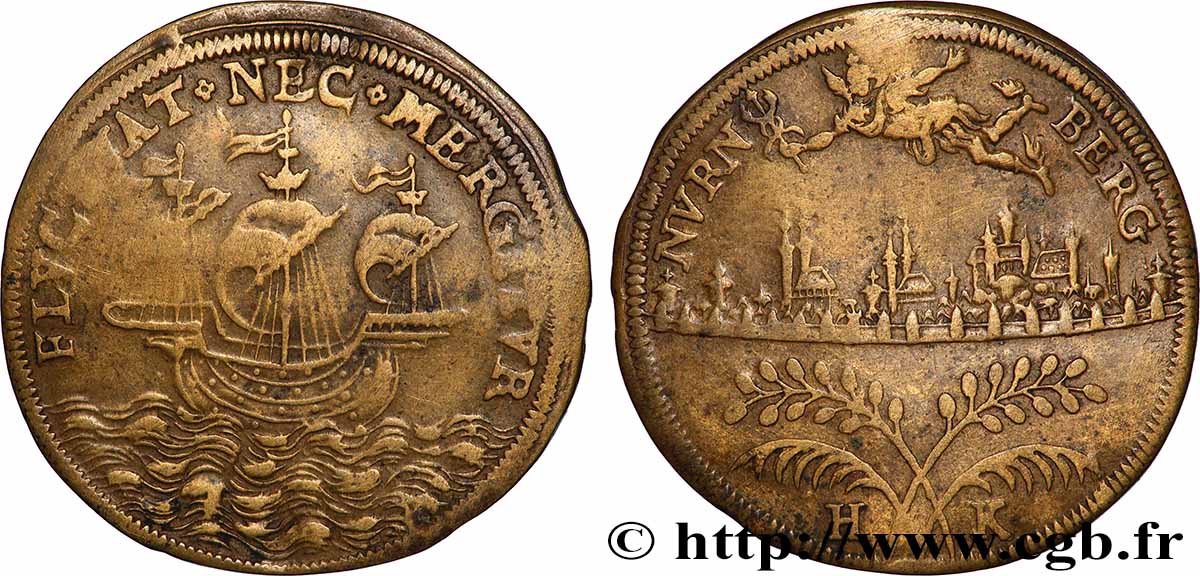
Obverse legend : FLVCTVAT. NEC. MERGITVR.
Obverse description : Le vaisseau de Paris allant à gauche.
Obverse translation : Elle flotte et ne coule pas.
Reverse
Reverse legend : NVRN - BERG .
Reverse description : Vue sur la ville de Nuremberg, Mercure volant au-dessus. Signé : H K.
Reverse translation : Entre ses mains, l' œuvre de la ville a été couronnée de succès.
Commentary
Ce jeton a très probablement été frappé vers 1584. On doit noter que les deux couleurs de métal qui ont été frappées, cuivre rouge et cuivre jaune, ont utilisé la même paire de coins indiscutablement repérable aux cassures qui évoluent selon les exemplaires. On doit également noter que les deux métaux partagent une frappe en médaille.
This token was most likely struck around 1584. It should be noted that both colors of metal that were struck, red copper and yellow copper, used the same pair of dies, which is clearly identifiable by the breaks that vary from one example to another. It should also be noted that both metals share a medal strike.
This token was most likely struck around 1584. It should be noted that both colors of metal that were struck, red copper and yellow copper, used the same pair of dies, which is clearly identifiable by the breaks that vary from one example to another. It should also be noted that both metals share a medal strike.
Historical background
PARIS - LOCAL ADMINISTRATION
The municipal administration of Paris used tokens for its accounts, like all administrations. Over time, the account token function gave way to the social representation function..
 Report a mistake
 Print the page
 Share my selection
 Ask a question
 Consign / sell
Related articles

 Full data


Your Recently Viewed Items

10 Sen JAPAN 1947 P.084 UNC-
10.00 €

TETRICUS I Antoninien AU/VF
30.00 €

TETRICUS I Antoninien XF
30.00 €

PARIS - LOCAL ADMINISTRATION XF
30.00 €

CHARLES IX VF
15.00 €

TOURISTIC MEDALS Médaille touristique, Pérouges, cité médiévale AU
5.00 €
cgbfr.com numismatists


