


E-auction 164-100522 - bpv_141558 - NERO Didrachme
You must signin and be an approved bidder to bid, LOGIN TO BID. Accounts are subject to approval and the approval process takes place within 48 hours. Do not wait until the day a sale closes to register. Clicking on « bid » constitutes acceptance of the terms of use of cgb.fr private e-auctions.
Bids must be placed in whole Euro amounts only. The sale will start closing at the time stated on the item description; any bids received at the site after the closing time will not be executed. Transmission times may vary and bids could be rejected if you wait until the last second. For further information ckeck the E-auctions F.A.Q.
NO BUYER'S FEE.
NO BUYER'S FEE.
| Estimate : | 240 € |
| Price : | 46 € |
| Maximum bid : | 51 € |
| End of the sale : | 06 June 2016 15:12:30 |
| bidders : | 9 bidders |
Type : Didrachme
Date: 52
Mint name / Town : Antioche, Syrie, Séleucie et Piérie
Metal : silver
Diameter : 19 mm
Orientation dies : 12 h.
Weight : 06,90 g.
Rarity : R1
Coments on the condition:
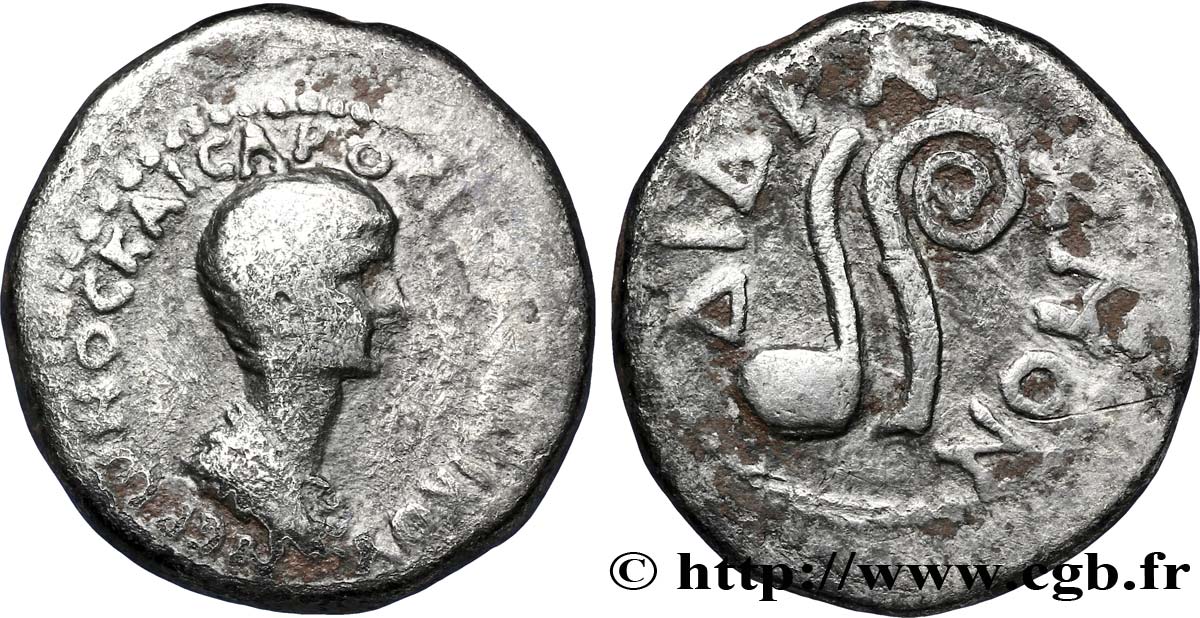
Forte usure mais type complet et portrait typique du césar enfant
Catalogue references :
Predigree :
Cet exemplaire est le 0070_014, il provient des doubles de la collection McAlee, par le truchement de l’e-auction CNG 71, lot 64
Obverse
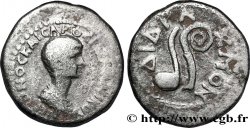
Obverse description : Buste drapé, tête nue de Néron enfant à droite (A°01).
Obverse legend : NERwNOS KAISAROS GERMANIKOU
Obverse translation : (Néron césar germanique).
Reverse
Reverse description : Lituus et simpulum dans le champ.
Reverse legend : DIDRACMON
Reverse translation : (Didrachme).
Commentary
Cette émission est bien entendu de toute première importance historique et monétaire. Tout d’abord, on constate une intention politique de présenter le César Néron comme héritier naturel de l’empereur Claude avec une référence religieuse directe : le lituus et le simpulum, attribut des prêtres de Rome. On remarque d’ailleurs que le lituus a survécu jusqu’à nos jours sous la forme de la crosse des évêques catholiques.
Par ailleurs, il s’agit de l’une des très rares émissions qui porte effectivement une valeur monétaire. On ignore, dans l’état actuel de la recherche, les motivations de cette émission : s’agissait-il de l’introduction dans le système monétaire de divisionnaires, dont le manque se faisait probablement sentir, ou d’une tentative de modification de ce système, laquelle aurait échoué, puisque l’on ne verra plus de divisionnaires ultérieurement ?
Jusqu’à récemment, cette émission était attribuée à l’Asie Mineure, parfois à Ephèse (cf BMC). L’importance historique de cette série fut telle, à sa découverte, qu’elle bénéficia si l’on peut dire, de l’attention des faussaires qui en réalisèrent une dangereuse copie au XIXe siècle. Le danger de ce faux est tel que Egger 05 1914 = Collection Prove 863 = Oxford = Sear III, 566 (illustré) et Walter Metrology I page 61 est un faux.
On en connaît également un exemplaire fourré, donc un faux d’époque, sans que l’on puisse déterminer, compte tenu de l’état de l’exemplaire, si des coins officiels ont été utilisés.
Dans la base TSP maintenue par Michel Prieur, quarante exemplaires sont maintenant répertoriés, dont un faux d’époque,à première vue six faux modernes et neuf exemplaires en musées ou collections publiques (Berlin, trois exemplaires, Yale, British Museum, Copenhague, Vienne, deux exemplaires, et Cambridge.
This issue is of course of the utmost historical and monetary importance.. First of all, there is a political intention to present Caesar Nero as the natural heir of the Emperor Claudius with a direct religious reference: the lituus and the simpulum, attributes of the priests of Rome. It is also noted that the lituus has survived to this day in the form of the crosier of Catholic bishops..
Furthermore, it is one of the very few issues that actually carries a monetary value.. At the current stage of research, the motives for this issue are unknown: was it the introduction of fractional coins into the monetary system, the lack of which was probably felt, or an attempt to modify this system, which would have failed, since we would not see any more fractional coins later? Until recently, this issue was attributed to Asia Minor, sometimes to Ephesus (see BMC). The historical importance of this series was such, upon its discovery, that it benefited, so to speak, from the attention of forgers who made a dangerous example in the 19th century.. The danger of this fake is such that Egger 05 1914 = Collection Prove 863 = Oxford = Sear III, 566 (illustrated) and Walter Metrology I page 61 is a fake.
We also know of a filled example, therefore a period fake, without it being possible to determine, given the condition of the example, whether official dies were used..
In the TSP database maintained by Michel Prieur, forty examples are now listed, including one period fake, at first glance six modern fakes and nine examples in museums or public collections (Berlin, three examples, Yale, British Museum, Copenhagen, Vienna, two examples, and Cambridge
Par ailleurs, il s’agit de l’une des très rares émissions qui porte effectivement une valeur monétaire. On ignore, dans l’état actuel de la recherche, les motivations de cette émission : s’agissait-il de l’introduction dans le système monétaire de divisionnaires, dont le manque se faisait probablement sentir, ou d’une tentative de modification de ce système, laquelle aurait échoué, puisque l’on ne verra plus de divisionnaires ultérieurement ?
Jusqu’à récemment, cette émission était attribuée à l’Asie Mineure, parfois à Ephèse (cf BMC). L’importance historique de cette série fut telle, à sa découverte, qu’elle bénéficia si l’on peut dire, de l’attention des faussaires qui en réalisèrent une dangereuse copie au XIXe siècle. Le danger de ce faux est tel que Egger 05 1914 = Collection Prove 863 = Oxford = Sear III, 566 (illustré) et Walter Metrology I page 61 est un faux.
On en connaît également un exemplaire fourré, donc un faux d’époque, sans que l’on puisse déterminer, compte tenu de l’état de l’exemplaire, si des coins officiels ont été utilisés.
Dans la base TSP maintenue par Michel Prieur, quarante exemplaires sont maintenant répertoriés, dont un faux d’époque,à première vue six faux modernes et neuf exemplaires en musées ou collections publiques (Berlin, trois exemplaires, Yale, British Museum, Copenhague, Vienne, deux exemplaires, et Cambridge.
This issue is of course of the utmost historical and monetary importance.. First of all, there is a political intention to present Caesar Nero as the natural heir of the Emperor Claudius with a direct religious reference: the lituus and the simpulum, attributes of the priests of Rome. It is also noted that the lituus has survived to this day in the form of the crosier of Catholic bishops..
Furthermore, it is one of the very few issues that actually carries a monetary value.. At the current stage of research, the motives for this issue are unknown: was it the introduction of fractional coins into the monetary system, the lack of which was probably felt, or an attempt to modify this system, which would have failed, since we would not see any more fractional coins later? Until recently, this issue was attributed to Asia Minor, sometimes to Ephesus (see BMC). The historical importance of this series was such, upon its discovery, that it benefited, so to speak, from the attention of forgers who made a dangerous example in the 19th century.. The danger of this fake is such that Egger 05 1914 = Collection Prove 863 = Oxford = Sear III, 566 (illustrated) and Walter Metrology I page 61 is a fake.
We also know of a filled example, therefore a period fake, without it being possible to determine, given the condition of the example, whether official dies were used..
In the TSP database maintained by Michel Prieur, forty examples are now listed, including one period fake, at first glance six modern fakes and nine examples in museums or public collections (Berlin, three examples, Yale, British Museum, Copenhagen, Vienna, two examples, and Cambridge
Historical background
NERO
(13/10/54-9/06/68)
Augustus
Nero is certainly one of the best-known emperors, thanks to Tacitus and Suetonius, but also one of the most decried. He is the last representative of the Julio-Claudian dynasty. Son of Agrippina, Claudius' second wife, and Cneius Domitius Ahenobarbus, he was born in 37. He descends from both Augustus through his mother and Julie through his maternal grandfather, Germanicus. After the assassination of Claude by Agrippina with the help of Locuste in 54, aged 17, he began his reign under good auspices. Aided by Seneca, his tutor, and Burrus, prefect of the Praetorium, he governed intelligently with the Senate. He married Octavie, daughter of Claudius and Messalina. Octavie's brother, Britannicus, dies under mysterious conditions in AD 55 (poisoned?). After the "quinquennum aureum" (54-59), the emperor had or allowed his mother to be murdered. The last nine years of the reign will destabilize the principate.
 Report a mistake
 Print the page
 Share my selection
 Ask a question
 Consign / sell
Related articles

 Full data
Your Recently Viewed Items

100 Mark GERMANY 1944 P.197d UNC-
40.00 €

CILICIA - TARSUS Unité VF
60.00 €

ANTONINUS PIUS As VF
90.00 €
NERO Didrachme VF
46.00 €

MYSIA - PERGAMON Unité VF
11.00 €

JULIA MAMAEA Denier AU
140.00 €
cgbfr.com numismatists


