


E-auction 497-407329 - brm_764950 - LICINIA Denier
You must signin and be an approved bidder to bid, LOGIN TO BID. Accounts are subject to approval and the approval process takes place within 48 hours. Do not wait until the day a sale closes to register. Clicking on « bid » constitutes acceptance of the terms of use of cgb.fr private e-auctions.
Bids must be placed in whole Euro amounts only. The sale will start closing at the time stated on the item description; any bids received at the site after the closing time will not be executed. Transmission times may vary and bids could be rejected if you wait until the last second. For further information ckeck the E-auctions F.A.Q.
NO BUYER'S FEE.
NO BUYER'S FEE.
| Estimate : | 120 € |
| Price : | 52 € |
| Maximum bid : | no bid |
| End of the sale : | 24 October 2022 14:47:30 |
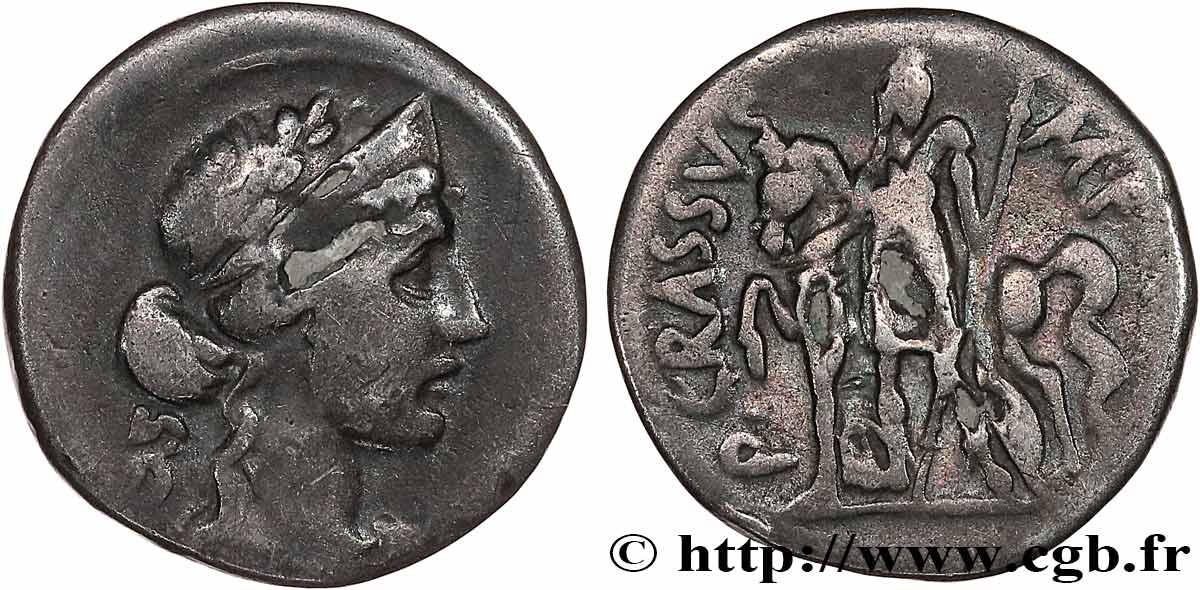
Type : Denier
Date: 55 AC.
Mint name / Town : Roma
Metal : silver
Millesimal fineness : 950 ‰
Diameter : 17 mm
Orientation dies : 12 h.
Weight : 2,29 g.
Rarity : R1
Coments on the condition:
Exemplaire sur un petit flan à l’usure importante, lisible et identifiable. Patine gris foncé. Fourré
Catalogue references :
B.18 (Licinia) - BMC/RR.3901 - CRR.929 (4) - RRC.430 /1 - RSC.18 - RCV.394 (400$) - RRM.19 /1-2 - CMDRR.804 - MRR.1358
Obverse
Obverse legend : S. C.
Obverse description : Buste diadémé, lauré et drapé de Vénus à droite avec boucle d’oreille et collier.
Obverse translation : “Senatus Consulto”, (avec l’accord du Sénat).
Reverse
Reverse legend : P. CRASSVS - M. - F..
Reverse description : La Gaule debout de face devant son cheval qu’elle tient par la bride de la main droite et une longue javeline de la main gauche ; bouclier et cuirasse à ses pieds.
Reverse translation : “Publius Crassus Marci Filius”, (Publius Crassus fils de Marcus).
Commentary
Poids extrêmement léger. Fourré. Pour ce type, M. Crawford a relevé une estimation de 63 coins de droit et de 70 coins de revers. Ce denier n'a pas été copié ou imité par les Gaulois. Il se rapporte néanmoins à la Guerre des Gaules et à l'un de ses acteurs. Publius est le fils cadet de Crassus et le frère de Marcus Licinius Crassus qui succéda à Publius, comme lieutenant de César, en tant que questeur. Publius Licinius Crassus avait participé à la campagne contre les Germains d'Arioviste en 58 avant J.-C. et à la soumission des tribus de l'Armorique l'année suivante avant de mener une brillante campagne en Aquitaine. Rentré à Rome en 56 avant J.-C., il trouva la mort en combattant les Parthes avec son père. Il est plusieurs fois cité dans le De Bello Gallico, dans les trois premiers livres : I, 52 ; II, 34 ; III, 7, 8, 9, 11, 20 à 27.
Extremely light weight. Furred. For this type, Mr. Crawford noted an estimate of 63 obverse dies and 70 reverse dies. This denarius was not copied or imitated by the Gauls. It nevertheless relates to the Gallic Wars and one of its actors. Publius is the younger son of Crassus and the brother of Marcus Licinius Crassus who succeeded Publius, as Caesar's lieutenant, as quaestor. Publius Licinius Crassus had participated in the campaign against the Germans of Ariovistus in 58 BC and in the subjugation of the tribes of Armorica the following year before leading a brilliant campaign in Aquitaine. Returning to Rome in 56 BC, he met his death fighting the Parthians with his father. He is mentioned several times in De Bello Gallico, in the first three books: I, 52; II, 34; III, 7, 8, 9, 11, 20 to 27
Extremely light weight. Furred. For this type, Mr. Crawford noted an estimate of 63 obverse dies and 70 reverse dies. This denarius was not copied or imitated by the Gauls. It nevertheless relates to the Gallic Wars and one of its actors. Publius is the younger son of Crassus and the brother of Marcus Licinius Crassus who succeeded Publius, as Caesar's lieutenant, as quaestor. Publius Licinius Crassus had participated in the campaign against the Germans of Ariovistus in 58 BC and in the subjugation of the tribes of Armorica the following year before leading a brilliant campaign in Aquitaine. Returning to Rome in 56 BC, he met his death fighting the Parthians with his father. He is mentioned several times in De Bello Gallico, in the first three books: I, 52; II, 34; III, 7, 8, 9, 11, 20 to 27
Historical background
LICINIA
(55 BC)
The gens Licinia is a plebeian family of Rome whose members held high office during the Republic. This same year the "lex Trebonia and Pompeia Licinia" consecrate the powers of the triumvirate formed in 59 BC by Caesar and the two above-named. Caesar undertakes his first campaign in Brittany.
 Report a mistake
 Print the page
 Share my selection
 Ask a question
 Consign / sell
Your Recently Viewed Items
TRAJANUS Denier AU
191.00 €
TRAJANUS Denier AU
540.00 €
MAXIMINUS I Sesterce VF
44.00 €
LUCILLA Denier AU/XF
87.00 €
LICINIA Denier AU
130.00 €

LICINIA Denier VF
52.00 €
cgbfr.com numismatists


