


E-auction 709-783945 - LANGUEDOC TOWNS AND GENTRY Charles de Montchal, archevêque de Toulouse 1647
You must signin and be an approved bidder to bid, LOGIN TO BID. Accounts are subject to approval and the approval process takes place within 48 hours. Do not wait until the day a sale closes to register. Clicking on « bid » constitutes acceptance of the terms of use of cgb.fr private e-auctions.
Bids must be placed in whole Euro amounts only. The sale will start closing at the time stated on the item description; any bids received at the site after the closing time will not be executed. Transmission times may vary and bids could be rejected if you wait until the last second. For further information ckeck the E-auctions F.A.Q.
NO BUYER'S FEE.
NO BUYER'S FEE.
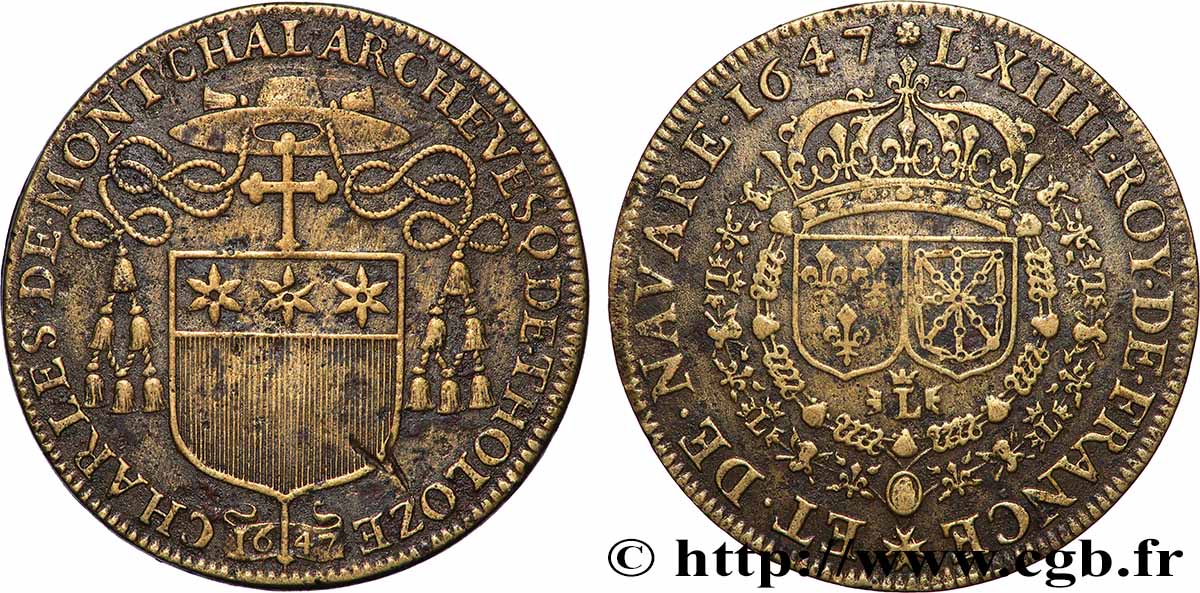
Type : Charles de Montchal, archevêque de Toulouse
Date: 1647
Metal : brass
Diameter : 31 mm
Orientation dies : 6 h.
Weight : 9,56 g.
Edge : lisse
Puncheon : sans poinçon
Rarity : R2
Coments on the condition:
Patine hétérogène avec des traces d’usure, rayures et taches d’oxydation. Quelques coups sur la tranche. Cassure du coin de frappe visible à l’avers
Catalogue references :
Obverse
Obverse legend : CHARLES DE MONTCHAL ARCHEVESQ DE THOLOZE 1647.
Obverse description : Armes de Charles de Montchal avec ses attributs.
Reverse
Reverse legend : L. XIIII ROY DE FRANCE ET DE NAVARE 1647.
Reverse description : Armes de France.
Commentary
Charles de Montchal, né en 1589 à Annonay et décédé le 22 août 1651 à Carcassonne, archevêque de Toulouse, est l'un des plus savants prélats qui aient occupé ce siège épiscopal français.
Né en 1589 à Annonay, d'un apothicaire de cette ville, il obtint une bourse à Paris au collège d'Autun, dont il devint dans la suite le principal, et y fit ses études avec une rare distinction. Ayant embrassé l'état ecclésiastique, il fut pourvu d'un canonicat du chapitre d'Angoulême, et succéda en 1628 sur le siège de Toulouse au cardinal de la Valette, qui donna sa démission en faveur de son ancien maître. Il s'appliqua avec zèle à l'administration de son diocèse, plaça des pasteurs instruits à la tète des paroisses, et distribua souvent lui-même au peuple le pain de la parole.
Député aux assemblées générales du clergé, il fut exclu en 1641 de celle de Mantes, pour s'être opposé aux volontés du cardinal de Richelieu : cette disgrâce lui mérita l'honneur d'être élu président de l'assemblée de 1645 où il prit encore la défense des immunités ecclésiastiques. Il fonda dans sa ville épiscopale un séminaire pour les jeunes clercs et une maison de secours pour les pauvres valides, et contribua à former divers autres établissements pieux.
Ce prélat avait la réputation d'un des bons hellénistes de son temps : il s'était attaché particulièrement à l'étude des historiens ecclésiastiques, et ses confrères l'avaient engagé à s'occuper d'une nouvelle édition de l'Histoire d'Eusèbe, dont il avait rétabli le texte et corrigé la version latine dans une infinité d'endroits. Il possédait une riche bibliothèque, remarquable surtout par le nombre de manuscrits grecs, arabes et hébreux qu'il avait recueillis à grands frais dans toute l'Europe : il se faisait un plaisir de les communiquer aux savants, dont il était l'un des plus zélés protecteurs ; et il y en eut quelques-uns de publiés par ses soins.
Sa biographie complète à http://fr.wikipedia.org/wiki/Charles_de_Montchal .
Charles de Montchal, born in 1589 in Annonay and died on August 22, 1651 in Carcassonne, Archbishop of Toulouse, is one of the most learned prelates who occupied this French episcopal seat..
Born in 1589 in Annonay, to an apothecary of this town, he obtained a scholarship to Paris at the college of Autun, of which he later became the principal, and studied there with rare distinction.. Having embraced the ecclesiastical state, he was provided with a canonry of the chapter of Angoulême, and succeeded in 1628 on the seat of Toulouse to Cardinal de la Valette, who resigned in favor of his former master.. He applied himself with zeal to the administration of his diocese, placed educated pastors at the head of the parishes, and often distributed the bread of the word to the people himself..
A deputy to the general assemblies of the clergy, he was excluded in 1641 from that of Mantes, for having opposed the wishes of Cardinal Richelieu: this disgrace earned him the honor of being elected president of the assembly of 1645 where he again took up the defense of ecclesiastical immunities.. He founded in his episcopal city a seminary for young clerics and a relief house for the able-bodied poor, and contributed to the formation of various other pious establishments..
This prelate had the reputation of one of the best Hellenists of his time: he had devoted himself particularly to the study of ecclesiastical historians, and his colleagues had engaged him to take care of a new edition of the History of Eusebius, of which he had restored the text and corrected the Latin version in an infinite number of places.. He possessed a rich library, remarkable above all for the number of Greek, Arabic and Hebrew manuscripts that he had collected at great expense throughout Europe: he took pleasure in communicating them to scholars, of whom he was one of the most zealous protectors; and some of them were published by him.
His full biography at http://fr. Wikipedia. org/wiki/Charles_de_Montchal
Historical background
LANGUEDOC TOWNS AND GENTRY
 Report a mistake
 Print the page
 Share my selection
 Ask a question
 Consign / sell
Related articles

 Full data

Your Recently Viewed Items

SAVOY - DUCHY OF SAVOY - EMMANUEL-PHILIBERT Parpaiolle (parpagliola) AU
200.00 €

LANGUEDOC TOWNS AND GENTRY Charles de Montchal, archevêque de Toulouse AU
30.00 €

EGYPT 1 Pound (Livre) commémoration de la Révolution Corrective de 1971 AH 139
11.00 €

BELGIUM 2 Francs Léopold II légende française 1867 VF
3.00 €

JAPAN Lot 4 x 100 Yen 50e anniversaire du Shinkansen 2016 MS
10.00 €

OMAN 100 Baisa Centenaire des frappes de monnaie à Mascate ah1411 1991 MS
4.00 €
cgbfr.com numismatists


