


You must signin and be an approved bidder to bid, LOGIN TO BID. Accounts are subject to approval and the approval process takes place within 48 hours. Do not wait until the day a sale closes to register. Clicking on "BID" constitutes acceptance of the terms of use of cgb.fr private live auctions.
Bids must be placed in whole Euro amounts only. The sale will start closing at the time stated on the item description; any bids received at the site after the closing time will not be executed. Transmission times may vary and bids could be rejected if you wait until the last second. For further information check the Live auction FAQ
All winning bids are subject to a 18% buyer’s fee.
All winning bids are subject to a 18% buyer’s fee.
 Live starting :
 Type : Denier
Date: 49 AC.
Mint name / Town : Gaule ou Italie
Metal : fourré silver
Millesimal fineness : 950 ‰
Diameter : 17,5 mm
Orientation dies : 8 h.
Weight : 3,47 g.
Rarity : R1
Coments on the condition:
Joli denier sur flan très légèrement décentré, à l’usure régulière. Patine grise
Catalogue references :
Obverse
Obverse legend : CAESAR À L'EXERGUE.
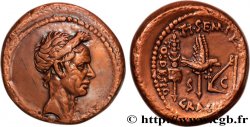
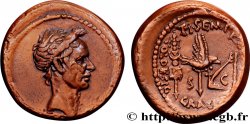
Obverse description : Éléphant passant à droite ; à ses pieds, un serpent (ou carnyx, trompette gauloise).
Obverse translation : “Cæsar”, (César).
Reverse
Reverse legend : ANÉPIGRAPHE.
Reverse description : Instruments pontificaux : simpulum, aspersoir, hache à sacrifice, chapeau à sacrifice.
Commentary
Monnaie fourrée. Contremarques au revers. Pour ce type, M. Crawford a relevé une estimation de 750 coins de droit et de 833 coins de revers, représentant une production qui pourrait avoisiner les deux à quatre millions de deniers. Pendant très longtemps, on pensa que ce denier avait été frappé par César pendant la Guerre des Gaules entre 58 et 52 avant J.-C., en Gaule même. En fait, il fut fabriqué au début des Guerres Civiles. Il a été imité servilement par les Trévires avec le bronze HIRTIVS (LT. 9235), fortement romanisé.
Plated coin. Countermarks on the reverse. For this type, Mr. Crawford recorded an estimate of 750 obverse dies and 833 reverse dies, representing a production that could be close to two to four million denarii. For a very long time, it was thought that this denarius had been struck by Caesar during the Gallic Wars between 58 and 52 BC, in Gaul itself. In fact, it was produced at the beginning of the Civil Wars. It was slavishly imitated by the Treveri with the bronze HIRTIVS (LT. 9235), which was heavily Romanized.
Plated coin. Countermarks on the reverse. For this type, Mr. Crawford recorded an estimate of 750 obverse dies and 833 reverse dies, representing a production that could be close to two to four million denarii. For a very long time, it was thought that this denarius had been struck by Caesar during the Gallic Wars between 58 and 52 BC, in Gaul itself. In fact, it was produced at the beginning of the Civil Wars. It was slavishly imitated by the Treveri with the bronze HIRTIVS (LT. 9235), which was heavily Romanized.
Historical background
JULIUS CAESAR
(07/13/100-03/15/44 BC)
Julius Caesar, born in 100 BC, belongs to the party of Marius and opposes Sylla at a very young age. He was praetor in 62 BC, before forming with Pompey and Crassus the first triumvirate in 59 BC, the year of his consulship. He then receives a proconsular imperium on Gaul, renewed in 54. He fights Vercingétorix in Gergovie then in Alesia. Besieged, the Gallic leader must surrender. Crassus having been killed at Carrhae, in Mesopotamia, in 53 BC, Caesar got angry with Pompey and marched on Rome in 49 BC. In 48 BC, at Pharsalus, he crushed Pompey who fled to Egypt where he was assassinated. Caesar must then face the sons of Pompey and the Pompeian party. He defeated them at Thapsus (Africa, death of Cato of Utica) in 46 BC and at Munda (Spain, death of Cneius Pompey). Caesar was assassinated on the Ides of March (March 15, 44 BC) by Cassius and Brutus. He was deified after his death in 42 BC..
 Report a mistake
 Print the page
 Share my selection
 Ask a question
 Consign / sell
Related articles
 Full data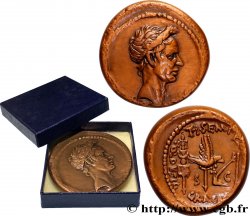


Your Recently Viewed Items

THRACE - MESEMBRIA Unité VF
60.00 €

MYSIA - PERGAMON Unité VF
50.00 €
MAXIMINUS I Sesterce XF
110.00 €

JULIUS CAESAR Denier XF
250.00 €

NERO As VF/VF
70.00 €

PHILIPPUS Sesterce AU/XF
200.00 €
cgbfr.com numismatists


