


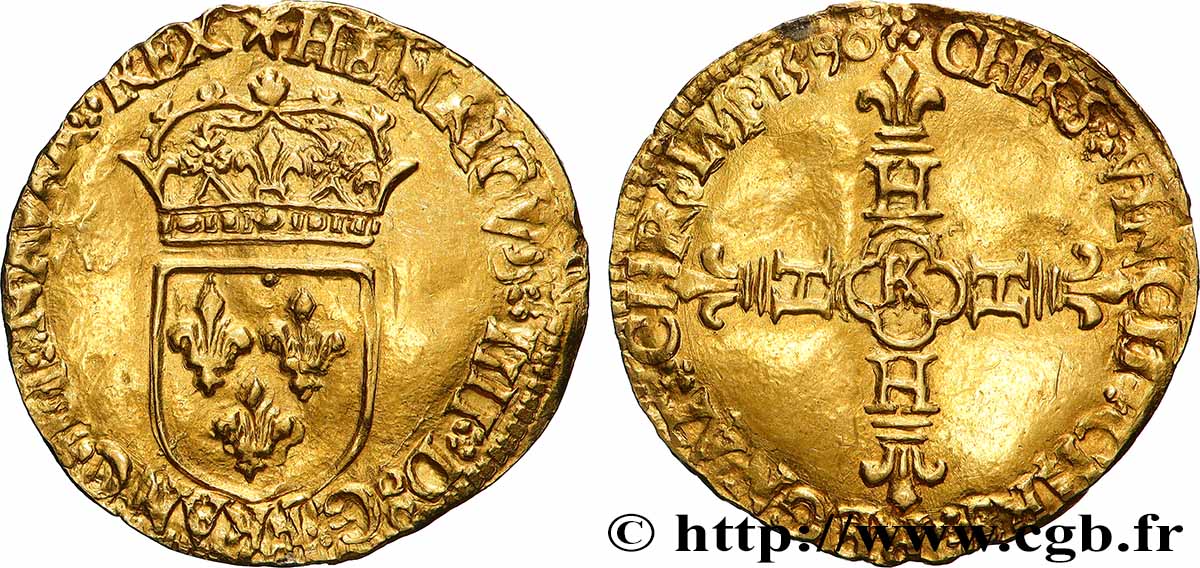
Live auction - bry_1087426 - HENRY IV Écu d'or au soleil, 2e type 1590 Bordeaux
You must signin and be an approved bidder to bid, LOGIN TO BID. Accounts are subject to approval and the approval process takes place within 48 hours. Do not wait until the day a sale closes to register. Clicking on "BID" constitutes acceptance of the terms of use of cgb.fr private live auctions.
Bids must be placed in whole Euro amounts only. The sale will start closing at the time stated on the item description; any bids received at the site after the closing time will not be executed. Transmission times may vary and bids could be rejected if you wait until the last second. For further information check the Live auction FAQ
All winning bids are subject to a 18% buyer’s fee.
All winning bids are subject to a 18% buyer’s fee.
| Estimate : | 12 000 € |
| Price : | no bid |
| Maximum bid : | no bid |
| End of the sale : | 03 March 2026 16:02:46 |
Type : Écu d'or au soleil, 2e type
Date: 1590
Mint name / Town : Bordeaux
Quantity minted : 1410
Metal : gold
Millesimal fineness : 958 ‰
Diameter : 25 mm
Orientation dies : 6 h.
Weight : 3,35 g.
Rarity : INÉDIT
Coments on the condition:
Écu d’or frappé sur un flan large et légèrement irrégulier. Léger tréflage sur les légendes ainsi que sur les lis de l’écu et faiblesses de frappe. Hairlines dans les champs suite à un nettoyage. Hauts reliefs au niveau de la couronne sommant l’écu de France et la croix du revers
Catalogue references :
Obverse
Obverse legend : (SOLEIL) HENRICVS+ IIII+ D (MG) G+ FRANC+ ET+ NAVAR+ REX, (LÉGENDE COMMENÇANT À 12 HEURES).
Obverse description : Écu de France couronné.
Obverse translation : (Henri III, par la grâce de Dieu, roi de France et de Navarre).
Reverse
Reverse legend : (MG) CHRS+ VINCIT+ CHRS+ REGNAT+ CHR (MM) IMP 1590.
Reverse description : Croix formée de quatre H fleurdelisées, avec un K dans un quadrilobe en cœur.
Reverse translation : (Le Christ vainc, règne et commande).
Commentary
Monnaie absente de tous les ouvrages de référence pour Bordeaux et le millésime 1590. D’après nos recherches inédites en archives, 1.410 écus d’or furent mis en circulation suite à trois délivrances des 3 juillet (805 ex.), 9 août (280 ex.) et 29 décembre 1590 (325 ex.). Pour cette production huit écus d’or ont été mis en boîte. Monnaie publiée dans le Bulletin numismatique de février 2026 dont nous donnons ci-dessous la transcription du registre des délivrances (AN, Z1b 837) :
« Délivrances des deniers escus d’or faites en ladite année 1590.
Le IIIe de juilhet audit an a esté délivré audit maistre pour icelluy jour huit cens cinq pièces de deniers apellés escus sol qui ont cours pour soixante sous tournois pièce revenant à soixante-douze pièces et demie au marc et d’aloy au raport de l’essayeur à vingt-deulx caratz trois quartz et ung sezeiesme de carat fin et a esté mis en boete quatre desdits deniers. Boete IIII deniers.
J. Faure. P. Branne. Jehan Gaussan. De Malus. E. Maurian.
Le IXe aoust audit an a esté délivré audit maistre pour icelluy jour deulx cens quatre vins deniers apellés escus sol qui ont cours pour soixante sous tournois pièce, revenant à soixante-douze pièces et demie au marc et d’aloy au raport de l’essayeur a vingt-deulx caratz trois quarts et demi fin et a esté mis en boete deux deniers. Boete II deniers.
J. Faure. P. Branne. Jehan Gaussan. De Malus. E. Maurian.
Le XXIXe de décembre audit an, a esté délivré audit maistre pour icelluy jour trois cens vingt-cinq pièces de deniers apellés escus d’or sol qui ont cours pour soixante sous tournois pièce, revenant à soixante-douze pièces et demie au marc et d’aloy au raport de l’esseyeur commis à vingt-trois quaratz moins ung trante deulxiesme d’or fin et a esté mis en boete deulx deniers. Boete II deniers.
J. Faure. P. Branne. Jehan Gaussan. De Malus. E. Maurian. ».
This coin is absent from all reference works for Bordeaux and the year 1590.. According to our unpublished archival research, 1. 410 gold écus were put into circulation following three issues on July 3rd (805 ex. ), August 9 (280 copies. ) and December 29, 1590 (325 ex. ). For this production, eight gold coins were boxed.. Coin published in the Numismatic Bulletin of February 2026, of which we give below the transcription of the register of issues (AN, Z1b 837): \\\"Issuance of gold deniers and escues made in the said year 1590.
On the 3rd of July of the said year, eight hundred and five pieces of deniers called escudos, which are current for sixty sous tournois per piece, amounting to seventy-two and a half pieces per mark, and according to the assayer's report, twenty-two carats, three quartz, and one sixteenth of a carat fine, were delivered to the said master for that day.. Boete IIII deniers.
J. Faure. P. Branne. Jehan Gaussan. De Malus. E. Maurian.
On the 9th of August of the said year, two hundred and four hundred deniers called escudos were issued to the said master for that day, which are worth sixty sous tournois each, amounting to seventy-two and a half pieces to the mark and, according to the assayer's report, twenty-two three-quarters and a half fine carats, and two deniers were boxed up.. Boete II deniers.
J. Faure. P. Branne. Jehan Gaussan. De Malus. E. Maurian.
On the 29th of December of the said year, three hundred and twenty-five pieces of deniers called escudos of gold, which are current at sixty sous tournois a piece, amounting to seventy-two and a half pieces to the mark and, according to the report of the appointed assessor, twenty-three quarts less one thirty-twos of fine gold, were delivered to the said master for the said day.. Boete II deniers.
J. Faure. P. Branne. Jehan Gaussan. De Malus. E. Maurian. »
« Délivrances des deniers escus d’or faites en ladite année 1590.
Le IIIe de juilhet audit an a esté délivré audit maistre pour icelluy jour huit cens cinq pièces de deniers apellés escus sol qui ont cours pour soixante sous tournois pièce revenant à soixante-douze pièces et demie au marc et d’aloy au raport de l’essayeur à vingt-deulx caratz trois quartz et ung sezeiesme de carat fin et a esté mis en boete quatre desdits deniers. Boete IIII deniers.
J. Faure. P. Branne. Jehan Gaussan. De Malus. E. Maurian.
Le IXe aoust audit an a esté délivré audit maistre pour icelluy jour deulx cens quatre vins deniers apellés escus sol qui ont cours pour soixante sous tournois pièce, revenant à soixante-douze pièces et demie au marc et d’aloy au raport de l’essayeur a vingt-deulx caratz trois quarts et demi fin et a esté mis en boete deux deniers. Boete II deniers.
J. Faure. P. Branne. Jehan Gaussan. De Malus. E. Maurian.
Le XXIXe de décembre audit an, a esté délivré audit maistre pour icelluy jour trois cens vingt-cinq pièces de deniers apellés escus d’or sol qui ont cours pour soixante sous tournois pièce, revenant à soixante-douze pièces et demie au marc et d’aloy au raport de l’esseyeur commis à vingt-trois quaratz moins ung trante deulxiesme d’or fin et a esté mis en boete deulx deniers. Boete II deniers.
J. Faure. P. Branne. Jehan Gaussan. De Malus. E. Maurian. ».
This coin is absent from all reference works for Bordeaux and the year 1590.. According to our unpublished archival research, 1. 410 gold écus were put into circulation following three issues on July 3rd (805 ex. ), August 9 (280 copies. ) and December 29, 1590 (325 ex. ). For this production, eight gold coins were boxed.. Coin published in the Numismatic Bulletin of February 2026, of which we give below the transcription of the register of issues (AN, Z1b 837): \\\"Issuance of gold deniers and escues made in the said year 1590.
On the 3rd of July of the said year, eight hundred and five pieces of deniers called escudos, which are current for sixty sous tournois per piece, amounting to seventy-two and a half pieces per mark, and according to the assayer's report, twenty-two carats, three quartz, and one sixteenth of a carat fine, were delivered to the said master for that day.. Boete IIII deniers.
J. Faure. P. Branne. Jehan Gaussan. De Malus. E. Maurian.
On the 9th of August of the said year, two hundred and four hundred deniers called escudos were issued to the said master for that day, which are worth sixty sous tournois each, amounting to seventy-two and a half pieces to the mark and, according to the assayer's report, twenty-two three-quarters and a half fine carats, and two deniers were boxed up.. Boete II deniers.
J. Faure. P. Branne. Jehan Gaussan. De Malus. E. Maurian.
On the 29th of December of the said year, three hundred and twenty-five pieces of deniers called escudos of gold, which are current at sixty sous tournois a piece, amounting to seventy-two and a half pieces to the mark and, according to the report of the appointed assessor, twenty-three quarts less one thirty-twos of fine gold, were delivered to the said master for the said day.. Boete II deniers.
J. Faure. P. Branne. Jehan Gaussan. De Malus. E. Maurian. »
Historical background
HENRY IV
(02/08/1589-14/05/1610)
King after the tragic death of Henri III, Henri de Bourbon, King of Navarre, descended from the last son of Saint Louis, Robert de Clermont. With him begins the dynasty of Bourbon which reigned over France until the Revolution, died out in direct line in France with the count of Chambord and still exists, in France, in its younger branch of Orleans and, outside France , in its senior branch, with the houses of Spain, Parma and Sicily. By the declaration of August 4, 1589, Henry IV promised the maintenance of the Catholic religion and the meeting of a national council. It was time for civil war. The Duke of Mayenne had Cardinal de Bourbon, then a prisoner of Henri IV, proclaimed king under the name of Charles X.. The king marched on Normandy and defeated Mayenne near the Château d'Arques (September 21, 1589), but could not take Paris. A loyalist Parliament, chaired by Achille de Harlay, was installed in Tours. After having reconquered all of Normandy, except Rouen, Henri laid siege to Dreux (February 1590). With the reinforcements of the Duke of Parma, Mayenne went against him and met him at Ivry (March 1590). Once again, the leaguers were defeated. The blockade of Paris, defended by the Duke of Mercœur, began in May 1590. Mayenne and the Duke of Parma having appeared at the end of the summer, Henri surrounded the city with a network of loyal towns and bided his time. By the Edict of Mantes (July 1591), he restored the regime of the Edict of Poitiers. On the death of Charles X (1590), the Spaniards put forward the rights of the Infanta Claire-Isabelle-Eugénie, daughter of Philippe II and Elisabeth of Valois. A Spanish garrison settled in Paris. The Duke of Savoy entered Provence, the Spaniards into Languedoc. In December 1592, Mayenne summoned the States General to Paris. They opened in January 1593 and presented several demands: a Catholic king, periodicity of the States, restoration of provincial freedoms, reception of the Council of Trent in France, but refused the candidacy of the Infanta. A general truce was signed in July 1593; the same month, in Saint-Denis, Henri IV abjured Protestantism. The League soon disintegrated and the king was crowned at Chartres in February 1594. He entered Paris the following March. There was no form of repression. Picardy and the Duke of Guise submitted in turn, and Clement VIII gave his absolution to Henry in September 1596. The war against Spain officially began in January 1595. Defeated at Fontaine-Française (June 1595), the Spaniards had to evacuate Burgundy and were pursued as far as Franche-Comté. Mayenne submitted in October, Joyeuse and Épernon followed. In Brittany, Mercœur continued a partisan war until 1598. The operations against the Spaniards were hardly favorable to the French in 1596 and 1597. The peace treaty was signed by the two exhausted monarchies in May 1598: this treaty of Vervins returned to the clauses of the treaty of Cateau-Cambrésis. By the Edict of Nantes (April 1598), declared perpetual and irrevocable, freedom of conscience was granted everywhere to Protestants; freedom of worship remained where it existed and was established at the Court. Half-party "edict chambers" were set up to settle disputes between Catholics and Protestants. The party received a hundred places of safety, including Montpellier, Montauban and La Rochelle. Peace returned, the situation of the kingdom was no less disastrous. Henri IV showed the greatest qualities of a statesman: forgetting the past, he surrounded himself with ardent Catholics, like Villeroy and President Jeannin, at the same time as fervent Huguenots like Sully, Superintendent of Finances in 1601. Skillfully, he gradually reduced the power of governors and parliaments. In 1600 he married Marie de Medici, who gave him a dauphin in 1601. In 1602, he had Marshal Biron, governor of Burgundy, executed for conspiring to raise the Catholics. In 1606, he marched against Sedan, capital of the Duke of Bouillon, who had fled the kingdom, and obtained his submission. Hostility persisted between France and the Habsburgs. In 1601, by the Treaty of Lyon, the Duke of Savoy ceded Bresse, Bugey, Pays de Gex and Valromey to the King of France.. In Italy, however, French influence remained nil.. France supported the United Provinces secretly. On the side of the Empire, Henri was going to intervene in the succession of Cleves and Juliers when he was assassinated by Ravaillac, on May 14, 1610.
 Report a mistake
 Print the page
 Share my selection
 Ask a question
 Consign / sell
Related articles
 Full data


Your Recently Viewed Items

CALAISIS - CALAIS - HENRY VI OF LANCASTER Gros XF
250.00 €

MURBACH AND LURE - LEOPOLD OF AUSTRIA (ADMINISTRATOR) Quart de thaler AU
1000.00 €

GALLIA - CARNUTES (Beauce area) Bronze “aux oiseaux et au serpent” MS
576.00 €
SYRIA - SELEUCIA and PIERIA - ANTIOCHIA Unité VF
25.00 €

HENRY IV Écu d'or au soleil, 2e type 1590 Bordeaux AU
6000.00 €

Essai de 10 francs Montesquieu 1989 Pessac F.376/1 MS63
255.00 €
cgbfr.com numismatists


