


fjt_1033135 - FREEMASONRY PIERRE VAN HUMBEECK - BELGIQUE 1869

100.00 €(Approx. 117.00$ | 86.00£)
Quantity
Add to your cart

Type : PIERRE VAN HUMBEECK - BELGIQUE
Date: 1869
Metal : copper
Diameter : 30 mm
Orientation dies : 12 h.
Weight : 10,53 g.
Edge : lisse
Puncheon : sans poinçon
Rarity : R1
Coments on the condition:
Jolie patine marron hétérogène avec des taches noires d’oxydation. Présence de quelques rayures
Obverse
Obverse legend : GR.:. OR.:. DE BELGIQUE.
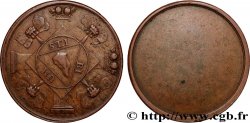
Obverse description : Oeil dans un triangle posé sur une étoile rayonnante.
Reverse
Reverse legend : 17E J.:. 2E M.:. 5869 INST.:. DU SÉR.:. GR.:. M.:. NATIONAL PIERRE VAN HUMBEECK.
Reverse translation : 17e jour du 2e mois de l’An de la vraie lumière 5869 Installation du Sérénissime Grand Maitre PIERRE VAN HUMBEECK.
Commentary
L’article de Wikipédia sur notre personnage mentionne son anti-cléricalisme notoire, indique que son passage au Ministère de l’Éducation déclencha une guerre scolaire mais ne mentionne pas ce que nous apprend ce jeton : comme en France, la lutte contre la religion et l’éducation religieuse fut l’œuvre des obédiences comme le Grand Orient.
La franc-maçonnerie s’implante en France aux alentours du premier quart du XVIIIe s. sous l’influence d’aristocrates anglais. Initiatique, elle est fondée sur le rite hiramique, du nom d’Hiram de Tyr, personnage biblique, architecte du roi Salomon sur le chantier du Temple et qui a résisté à la torture sans livrer ses secrets. Hiram a aussi donné un point de départ du calendrier maçonnique commençant 4000 ans avant le calendrier chrétien. Les symboles servent de signes de reconnaissance entre les initiés, notamment des outils de constructeur de cathédrales (équerre, compas, niveau, maillet, etc.), des formes (triangle, étoile), des nombres (trois, cinq, sept) et des lettres.
The Wikipedia article on our character mentions his notorious anti-clericalism, indicates that his time at the Ministry of Education triggered a school war but does not mention what this token teaches us: as in France, the fight against religion and religious education was the work of obediences like the Grand Orient. Freemasonry was established in France around the first quarter of the 18th century under the influence of English aristocrats. Initiatory, it is based on the Hiramic rite, named after Hiram of Tyre, a biblical character, architect of King Solomon on the construction site of the Temple and who resisted torture without revealing his secrets. Hiram also gave a starting point for the Masonic calendar beginning 4000 years before the Christian calendar. Symbols serve as signs of recognition between initiates, including cathedral builder's tools (square, compass, level, mallet, etc.), shapes (triangle, star), numbers (three, five, seven) and letters
La franc-maçonnerie s’implante en France aux alentours du premier quart du XVIIIe s. sous l’influence d’aristocrates anglais. Initiatique, elle est fondée sur le rite hiramique, du nom d’Hiram de Tyr, personnage biblique, architecte du roi Salomon sur le chantier du Temple et qui a résisté à la torture sans livrer ses secrets. Hiram a aussi donné un point de départ du calendrier maçonnique commençant 4000 ans avant le calendrier chrétien. Les symboles servent de signes de reconnaissance entre les initiés, notamment des outils de constructeur de cathédrales (équerre, compas, niveau, maillet, etc.), des formes (triangle, étoile), des nombres (trois, cinq, sept) et des lettres.
The Wikipedia article on our character mentions his notorious anti-clericalism, indicates that his time at the Ministry of Education triggered a school war but does not mention what this token teaches us: as in France, the fight against religion and religious education was the work of obediences like the Grand Orient. Freemasonry was established in France around the first quarter of the 18th century under the influence of English aristocrats. Initiatory, it is based on the Hiramic rite, named after Hiram of Tyre, a biblical character, architect of King Solomon on the construction site of the Temple and who resisted torture without revealing his secrets. Hiram also gave a starting point for the Masonic calendar beginning 4000 years before the Christian calendar. Symbols serve as signs of recognition between initiates, including cathedral builder's tools (square, compass, level, mallet, etc.), shapes (triangle, star), numbers (three, five, seven) and letters
Historical background
FREEMASONRY
The compass and the square are very often associated in an ambivalent symbol of balance: fixity and mobility, passive and active, matter and spirit.. The compass is the tool of the Creator and of the great Architect of the Universe. The spacing of the branches of the compass obeys precise rules and varies according to the three degrees: apprentice, companion, master. The Napoleonic era, in the activity of lodges as in that of many groups, saw a flowering after the terrible years of the revolutionary period. Masonic activity, rid of its republican theories and firmly controlled by a Grand-Master appointed by the Emperor, experienced a vigor in unity never found since.. It is considered that each regiment, each garrison, each city had its Lodge. The testimonies that the sumptuous tokens of the period leave us show that these lodges were rich and influential.. The symbolism is sought after, without comparison with the later eras, which were much more conventional, even bland or destitute at the beginning of the 20th century.. Freemasonry had more than a thousand lodges spread over one hundred and thirty departments and more than sixty thousand Brothers.
 Report a mistake
 Print the page
 Share my selection
 Ask a question
 Consign / sell
Related articles

 Full data

Your Recently Viewed Items

CARACALLA Tétradrachme syro-phénicien XF/VF
300.00 €

FREEMASONRY PIERRE VAN HUMBEECK - BELGIQUE AU
100.00 €
20 centimes Marianne 1983 Pessac F.156/23 MS
7.00 €

III REPUBLIC Médaille de concours agricole XF/AU
42.00 €
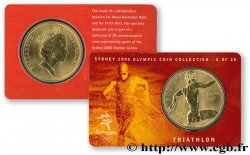
AUSTRALIA 5 Dollars J.O. de Sydney : Triathlon 2000 MS
4.00 €

MONACO 20 Francs Rainier III 1950 Paris AU
7.00 €
cgbfr.com numismatists


