


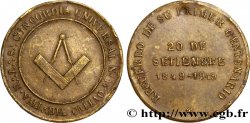
fjt_533646 - FREEMASONRY LOGE CONCORDIA UNIVERSAL N°14 CALLAO, Centenaire 1848-1949 n.d.

70.00 €(Approx. 83.30$ | 60.90£)
Quantity
Add to your cart

Type : LOGE CONCORDIA UNIVERSAL N°14 CALLAO, Centenaire 1848-1949
Date: n.d.
Metal : copper
Diameter : 30 mm
Orientation dies : 12 h.
Weight : 10 g.
Edge : Lisse
Catalogue references :
Predigree :
Exemplaire provenant de la Collection JCT
Obverse
Obverse legend : R :. L :. S :. CONCORDIA UNIVERSAL N°14 / VALL :. DEL CALLAO /.
Obverse description : Équerre et compas entrecroisés.
Reverse
Reverse legend : RECUERDO DE SU PRIMER CENTENARIO.
Reverse description : sur trois lignes ; 20 DE / SETIEMBRE / 1849 - 1949.
Commentary
La franc-maçonnerie est apparue au Pérou avec les guerres de l’indépendance. La première loge, Paz y Perfecta Union, eut en 1821 José de San martin parmi ses fondateurs, quand il entra à Lima en libérateur. La naissance d’autres loges suivit ses victoires et celles du frère Antonio José de Sucre. En 1830, fut constitué un Suprême Conseil et l’année suivante la première Grande Loge du Pérou. En 1833, le pouvoir passa aux mains des militaires hostiles à la franc-maçonnerie et les loges furent fermées jusqu’en 1845. En 1852, un nouveau Grand orient national fut fondé, mais en 1858 une scission eut pour conséquence la constitution de la Grande Loge Nationale du Pérou. En 1860, un nouveau schisme éclata. Grande Loge et Grand Orient disparurent. En 1882 enfin a été constituée la grande Loge des francsmaçons Anciens, Libres et Acceptés du Pérou, qui existe encore actuellement. Elle compte une centaine de loges. A coté d’elle, continue à exister le Suprême Conseil du Rite Ecossais..
Freemasonry appeared in Peru with the wars of independence. The first lodge, Peace and Perfection Union, had José de San Martin among its founders in 1821, when he entered Lima as a liberator. The birth of other lodges followed his victories and those of Brother Antonio José de Sucre. In 1830, a Supreme Council was formed, and the following year, the first Grand Lodge of Peru. In 1833, power passed into the hands of military personnel hostile to Freemasonry, and the lodges were closed until 1845. In 1852, a new National Grand Orient was founded, but in 1858 a split resulted in the formation of the National Grand Lodge of Peru. In 1860, a new schism broke out. Both the Grand Lodge and the Grand Orient disappeared. In 1882, the Grand Lodge of Ancient, Free and Accepted Freemasons of Peru was finally established, and it still exists today. It has about a hundred lodges. Alongside it, the Supreme Council of the Scottish Rite continues to exist.
Freemasonry appeared in Peru with the wars of independence. The first lodge, Peace and Perfection Union, had José de San Martin among its founders in 1821, when he entered Lima as a liberator. The birth of other lodges followed his victories and those of Brother Antonio José de Sucre. In 1830, a Supreme Council was formed, and the following year, the first Grand Lodge of Peru. In 1833, power passed into the hands of military personnel hostile to Freemasonry, and the lodges were closed until 1845. In 1852, a new National Grand Orient was founded, but in 1858 a split resulted in the formation of the National Grand Lodge of Peru. In 1860, a new schism broke out. Both the Grand Lodge and the Grand Orient disappeared. In 1882, the Grand Lodge of Ancient, Free and Accepted Freemasons of Peru was finally established, and it still exists today. It has about a hundred lodges. Alongside it, the Supreme Council of the Scottish Rite continues to exist.
Historical background
FREEMASONRY
The compass and the square are very often associated in an ambivalent symbol of balance: fixity and mobility, passive and active, matter and spirit.. The compass is the tool of the Creator and of the great Architect of the Universe. The spacing of the branches of the compass obeys precise rules and varies according to the three degrees: apprentice, companion, master. The Napoleonic era, in the activity of lodges as in that of many groups, saw a flowering after the terrible years of the revolutionary period. Masonic activity, rid of its republican theories and firmly controlled by a Grand-Master appointed by the Emperor, experienced a vigor in unity never found since.. It is considered that each regiment, each garrison, each city had its Lodge. The testimonies that the sumptuous tokens of the period leave us show that these lodges were rich and influential.. The symbolism is sought after, without comparison with the later eras, which were much more conventional, even bland or destitute at the beginning of the 20th century.. Freemasonry had more than a thousand lodges spread over one hundred and thirty departments and more than sixty thousand Brothers.
 Report a mistake
 Print the page
 Share my selection
 Ask a question
 Consign / sell
Related articles

 Full data


Your Recently Viewed Items
FREEMASONRY LOGE CONCORDIA UNIVERSAL N°14 CALLAO, Centenaire 1848-1949 AU
70.00 €
cgbfr.com numismatists


