


E-auction 622-610450 - fme_1008023 - ARTISTS : ENGRAVORS, PAINTERS, SCULPTORS Médaille, Léonard de Vinci

You must signin and be an approved bidder to bid, LOGIN TO BID. Accounts are subject to approval and the approval process takes place within 48 hours. Do not wait until the day a sale closes to register. Clicking on « bid » constitutes acceptance of the terms of use of cgb.fr private e-auctions.
Bids must be placed in whole Euro amounts only. The sale will start closing at the time stated on the item description; any bids received at the site after the closing time will not be executed. Transmission times may vary and bids could be rejected if you wait until the last second. For further information ckeck the E-auctions F.A.Q.
NO BUYER'S FEE.
NO BUYER'S FEE.
| Estimate : | 70 € |
| Price : | 22 € |
| Maximum bid : | 22 € |
| End of the sale : | 17 March 2025 20:33:40 |
| bidders : | 5 bidders |
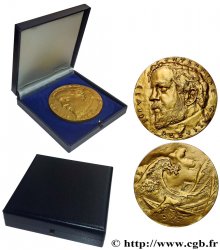
Type : Médaille, Léonard de Vinci
Date: 1970
Metal : bronze
Diameter : 80,5 mm
Orientation dies : 12 h.
Engraver JOLY Raymond (1911-2006)
Weight : 242,22 g.
Edge : lisse + 1970 + corne BRONZE
Puncheon : corne BRONZE
Coments on the condition:
Médaille nettoyée, notamment à l’avers. Traces de concrétions blanche, traces d’oxydation et de rayures
Catalogue references :
Obverse
Obverse legend : MCD-LII / LEO-NARD / DE-VIN-CI/ MCM-LII.
Obverse description : Buste de face, signé : R.Joly.
Reverse
Reverse legend : NE SAIS-TU PAS- QUE / NOTRE
AME - EST FAITE / D'HAR-MONIE. .
Reverse description : Le personnage qui servit à Léonard
de Vinci pour exprimer le nombre d'or plus communément “Homme de Vitruve” d’après un dessin du maître vers 1490. Soit une représentation d’un homme étendant ses membres dans un cercle
parfait. La figure géométrique centrale est
extraite de son « Codex Atlanticus », traité sur
la perfection des compositions créées par la
nature ; il suffit de les étudier, pour faire progresser l'humanité.
La légende présente une citation attribué à Leonard montrant une vision ambivalente du peintre créateur de formes et d’harmonie .
Commentary
Léonard de Vinci célèbre italien de la Renaissance est un artiste polymathe aussi bien peintre que savant, si il excelle dans la peinture avec des oeuvres comme La belle ferronnière en 1495 ou Saint jean Baptiste en 1513 tout deux conservé au Musée du Louvre (Paris) il réalise également de nombreuse études sur le corps humain notamment l’homme de vitruve.
A partir du canon parfait décrit par Vitruve dans De Architectura publié en 27 de notre ère, Léonard modifie certaine proportions pour présenter sa vision idéale du corps humain.
Si il ne sera jamais mathématicien à cause de sa formation Léonard ne cessera de s’intéresser à la symétrie et au calculs des proportions qui donneront à ses oeuvres un canon naturaliste..
Leonardo da Vinci, a famous Italian Renaissance artist, was a polymath, both a painter and a scholar. He excelled in painting, with works such as The Beautiful Ironworker in 1495 and Saint John the Baptist in 1513, both preserved at the Louvre Museum (Paris). He also produced numerous studies of the human body, notably the Vitruvian Man. From the perfect canon described by Vitruvius in De Architectura published in 27 AD, Leonardo modified certain proportions to present his ideal vision of the human body. Although he would never become a mathematician because of his training, Leonardo never ceased to be interested in symmetry and the calculation of proportions, which would give his works a naturalistic canon.
A partir du canon parfait décrit par Vitruve dans De Architectura publié en 27 de notre ère, Léonard modifie certaine proportions pour présenter sa vision idéale du corps humain.
Si il ne sera jamais mathématicien à cause de sa formation Léonard ne cessera de s’intéresser à la symétrie et au calculs des proportions qui donneront à ses oeuvres un canon naturaliste..
Leonardo da Vinci, a famous Italian Renaissance artist, was a polymath, both a painter and a scholar. He excelled in painting, with works such as The Beautiful Ironworker in 1495 and Saint John the Baptist in 1513, both preserved at the Louvre Museum (Paris). He also produced numerous studies of the human body, notably the Vitruvian Man. From the perfect canon described by Vitruvius in De Architectura published in 27 AD, Leonardo modified certain proportions to present his ideal vision of the human body. Although he would never become a mathematician because of his training, Leonardo never ceased to be interested in symmetry and the calculation of proportions, which would give his works a naturalistic canon.
Historical background
ARTISTS : ENGRAVORS, PAINTERS, SCULPTORS
n/a
 Report a mistake
 Print the page
 Share my selection
 Ask a question
 Consign / sell
 Full data


Your Recently Viewed Items

10 Francs BERLIOZ FRANCE 1972 F.63.01 XF
15.00 €

NAVARRE-BEARN - HENRY III Teston VF/XF
150.00 €

ARTISTS : ENGRAVORS, PAINTERS, SCULPTORS Médaille, Léonard de Vinci AU/AU
22.00 €
cgbfr.com numismatists


