


fjt_1098233 - AGRICULTURAL, HORTICULTURAL, FISHING AND HUNTING SOCIETIES Comice agricole d’Orléans n.d.

45.00 €(Approx. 53.55$ | 39.15£)
Quantity
Add to your cart

Type : Comice agricole d’Orléans
Date: (après 1880)
Date: n.d.
Metal : silver
Diameter : 31 mm
Orientation dies : 12 h.
Weight : 13,90 g.
Edge : lisse
Puncheon : main indicatrice (1845-1860) et ARGENT
Coments on the condition:
Patine grise hétérogène, légèrement irisée, avec un reste de brillant de frappe au revers. Petite usure et quelques rayures
Obverse
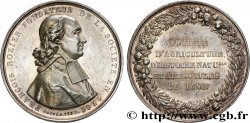
Obverse legend : OLIVIER - DE SERRES.
Obverse description : Buste habillé à gauche, au-dessous signature H. DE LONGUEIL.
Reverse
Reverse legend : COMICE AGRICOLE DE L’ARRONDT D’ORLÉANS.
Reverse description : Autour et dans une couronne de diverses cultures, vigne, olivier, blé, avec, sur le feuillage, une tête de bélier, de vache et de cheval ainsi qu'une charrue, au centre en deux lignes : CONSEIL/ D’ADMon..
Commentary
Poinçon corne. Olivier de Serres, le “père de l’agronomie française”, est né à Villeneuve-de-Berg dans le Vivarais. Issu d’une famille protestante aisée, il montre très tôt une curiosité intellectuelle proche des humanistes. Il est surtout connu pour avoir introduit en France la culture de la soie mais ses travaux sur l’assolement triennal apportent d’importants changements pour les techniques de culture.
Horn punch. Olivier de Serres, the “father of French agronomy,” was born in Villeneuve-de-Berg in the Vivarais region. Born into a wealthy Protestant family, he showed early on an intellectual curiosity similar to that of the humanists. He is best known for having introduced silk cultivation to France, but his work on three-year crop rotation brought about important changes in cultivation techniques.
Horn punch. Olivier de Serres, the “father of French agronomy,” was born in Villeneuve-de-Berg in the Vivarais region. Born into a wealthy Protestant family, he showed early on an intellectual curiosity similar to that of the humanists. He is best known for having introduced silk cultivation to France, but his work on three-year crop rotation brought about important changes in cultivation techniques.
Historical background
AGRICULTURAL, HORTICULTURAL, FISHING AND HUNTING SOCIETIES
The Agricultural Societies were free associations which set themselves the task of discussing agricultural theories, perfecting methods, etc., and on the establishment of which the law imposed no other condition than that of obtaining the approval of their statutes by the prefectural authority. Those which deal more especially with practical applications are called agricultural councils..
 Report a mistake
 Print the page
 Share my selection
 Ask a question
 Consign / sell
Related articles
 Full data

Your Recently Viewed Items

DOMBES - PRINCIPALITY OF DOMBES - GASTON OF ORLEANS Double tournois, type 6 VG/V
30.00 €

AGRICULTURAL, HORTICULTURAL, FISHING AND HUNTING SOCIETIES Comice agricole d’O
45.00 €

AGRICULTURAL, HORTICULTURAL, FISHING AND HUNTING SOCIETIES SOCIETE D'HORTICULTUR
30.00 €

ITALY - PAPAL STATES - PIUS VI (Giovanni Angelo Braschi) Médaille, Ouverture et
120.00 €

CILICIA - KINGDOM OF ARMENIA - HETHUM and ISABELLA Tram c. 1250 Atelier indéter
100.00 €
cgbfr.com numismatists


