


bpv_141605 - VESPASIAN Tétradrachme syro-phénicien
Not available.
Item sold on our e-shop (2016)
Price : 380.00 €
Item sold on our e-shop (2016)
Price : 380.00 €
Type : Tétradrachme syro-phénicien
Date: an 5
Mint name / Town : Antioche, Syrie, Séleucie et Piérie
Metal : silver
Diameter : 24 mm
Orientation dies : 12 h.
Weight : 14,77 g.
Rarity : R2
Coments on the condition:
Très légère usure de circulation limitée à la mèche sous les lauriers au droit et à quelques plumes du ventre de l’aigle au revers. Avant nettoyage, l’exemplaire avait une patine très sombre caractéristique des monnaies de la trouvaille de Banias avant nettoyage
Catalogue references :
Predigree :
Cet exemplaire est le 0117_009, il provient de la trouvaille dite de Banias, provenance que signe sa patine caractéristique
Obverse
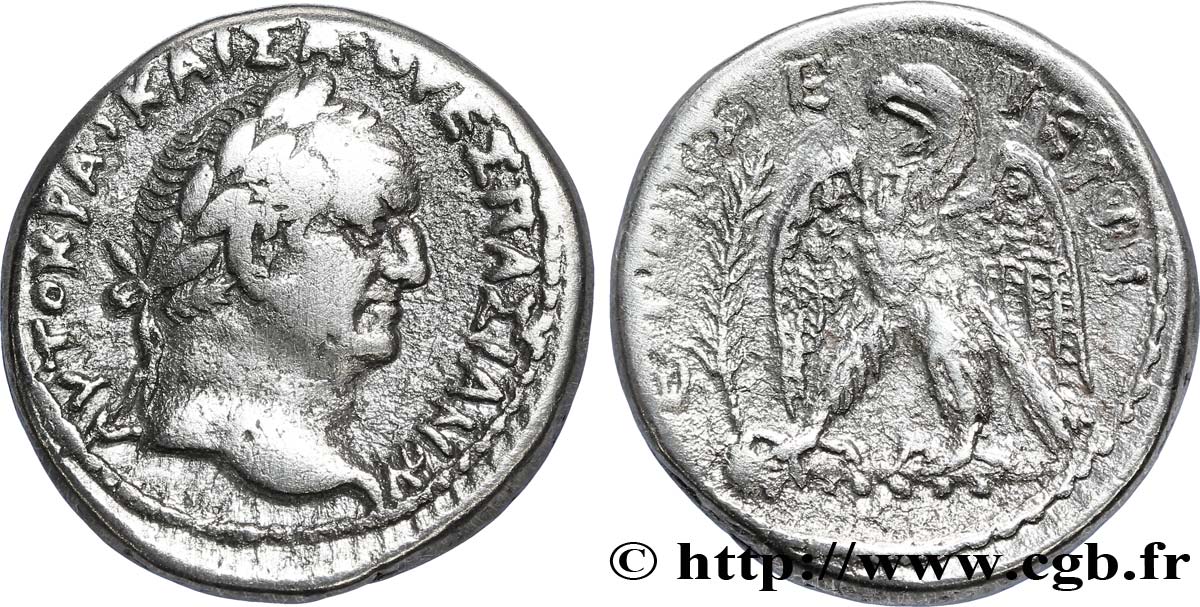
Obverse description : Tête laurée de Vespasien à droite (O*).
Obverse legend : AUTOKRAT KAISA OUESPASIANOU, (Autokratoros Kaisaros ouespasianou)
Obverse translation : (L'empereur césar Vespasien).
Reverse
Reverse description : Aigle debout à gauche sur une massue, les ailes déployées.
Reverse legend : ETOUS E IEROU (Etous e Ierou)
Reverse translation : (cinquième année sainte).
Commentary
Les monnaies du troisième groupe des frappes de Vespasien, caractérisées par un aigle à gauche sur une massue, sans couronne dans le bec, sont du style d’Alexandrie mais de la datation syrienne avec la lettre annuelle surmontée d’une barre. Les quantités frappées suivent les besoins : les frappes les plus massives sont celles de l’An 2, fin de la Guerre juive et elles se terminent en l’An 5 avec des quantités frappées décroissantes au fil des années.
Plusieurs graveurs participent à cette série où celui de notre exemplaire est très bien représenté. On doit remarquer que les pièces des groupes dits au style d’Alexandrie ont une caractéristique commune : l’aigle ne tient pas de couronne (groupes 1, 2 et 3) dans le bec. Ceci renforce l’idée que cette couronne était une distinction attribuée à la ville émettrice et que nous aurions affaire à un atelier militaire ou plus simplement à un atelier - quelque soit sa localisation - fourni en métal par le Trésor Militaire, sans lien organique avec une ville.
Les frappes de l’an 5, dernière année de frappe pour Vespasien, sont de loin les plus rares du troisième groupe ; elles sont d’ailleurs les seules de cette année avec celles, très rares elles aussi, avec le revers à l’autel, groupe dix des frappes de Vespasien.
Dans la base TSP maintenue par Michel Prieur, onze exemplaires seulement sont maintenant répertoriés ; les seuls musées à présenter un exemplaire sont Berlin et l’ANS de New-York.
The coins of the third group of Vespasian's strikes, characterized by an eagle facing left on a club, without a crown in the beak, are of the Alexandrian style but of Syrian dating with the annual letter surmounted by a bar. The quantities minted follow the needs: the most massive mintings are those of Year 2, end of the Jewish War and they end in Year 5 with decreasing quantities minted over the years.
Several engravers participate in this series where that of our example is very well represented. It should be noted that the coins of the so-called Alexandrian style groups have a common characteristic: the eagle does not hold a crown (groups 1, 2 and 3) in its beak.. This reinforces the idea that this crown was a distinction awarded to the issuing city and that we would be dealing with a military workshop or more simply a workshop - whatever its location - supplied with metal by the Military Treasury, without an organic link with a city..
The strikes of year 5, the last year of Vespasian's strikes, are by far the rarest of the third group; they are also the only ones of this year with those, also very rare, with the reverse with the altar, group ten of Vespasian's strikes.
In the TSP database maintained by Michel Prieur, only eleven examples are now listed; the only museums to present a example are Berlin and the ANS in New York.
Plusieurs graveurs participent à cette série où celui de notre exemplaire est très bien représenté. On doit remarquer que les pièces des groupes dits au style d’Alexandrie ont une caractéristique commune : l’aigle ne tient pas de couronne (groupes 1, 2 et 3) dans le bec. Ceci renforce l’idée que cette couronne était une distinction attribuée à la ville émettrice et que nous aurions affaire à un atelier militaire ou plus simplement à un atelier - quelque soit sa localisation - fourni en métal par le Trésor Militaire, sans lien organique avec une ville.
Les frappes de l’an 5, dernière année de frappe pour Vespasien, sont de loin les plus rares du troisième groupe ; elles sont d’ailleurs les seules de cette année avec celles, très rares elles aussi, avec le revers à l’autel, groupe dix des frappes de Vespasien.
Dans la base TSP maintenue par Michel Prieur, onze exemplaires seulement sont maintenant répertoriés ; les seuls musées à présenter un exemplaire sont Berlin et l’ANS de New-York.
The coins of the third group of Vespasian's strikes, characterized by an eagle facing left on a club, without a crown in the beak, are of the Alexandrian style but of Syrian dating with the annual letter surmounted by a bar. The quantities minted follow the needs: the most massive mintings are those of Year 2, end of the Jewish War and they end in Year 5 with decreasing quantities minted over the years.
Several engravers participate in this series where that of our example is very well represented. It should be noted that the coins of the so-called Alexandrian style groups have a common characteristic: the eagle does not hold a crown (groups 1, 2 and 3) in its beak.. This reinforces the idea that this crown was a distinction awarded to the issuing city and that we would be dealing with a military workshop or more simply a workshop - whatever its location - supplied with metal by the Military Treasury, without an organic link with a city..
The strikes of year 5, the last year of Vespasian's strikes, are by far the rarest of the third group; they are also the only ones of this year with those, also very rare, with the reverse with the altar, group ten of Vespasian's strikes.
In the TSP database maintained by Michel Prieur, only eleven examples are now listed; the only museums to present a example are Berlin and the ANS in New York.
Historical background
VESPASIAN
(1/07/69-24/06/79)
Vespasien was born on November 17, 9 in Flacrines, near Reate (in Sabine country). He belongs to the Italian municipal bourgeoisie. Aedile in 38, lender in 40, consul in 51, proconsul of Africa in 63, he commanded with Claude the expedition to Brittany. Nero entrusted him with three legions and a proconsular imperium to crush the revolt of Judea in 66. He was proclaimed august on July 1, 69 in Alexandria and his sons, Titus and Domitian, were promoted to Caesar. Vitellius was eliminated on December 20, 69. Titus was directly associated with the government by his father from 71. His reign was devoted to the political and economic restoration of Rome. In 73, he took on the censorship. He died in Reate on June 24, 79.
 Report a mistake
 Print the page
 Share my selection
 Ask a question
 Consign / sell
Related articles

 Full data


Your Recently Viewed Items
LIBERIA 20 Dollars Proof Année de la chèvre 2003 MS
22.00 €

SILVER INVESTMENT 1 Dollar type Liberty Silver Eagle 2019 MS
50.00 €
cgbfr.com numismatists


