


fme_1123536 - III REPUBLIC Plaquette, Fernand Chapsal
70.00 €(Approx. 81.90$ | 60.20£)
Quantity
Add to your cart

Type : Plaquette, Fernand Chapsal
Date: 1920
Mint name / Town : 17 - Saintes
Metal : bronze
Diameter : 70 mm
Orientation dies : 12 h.
Engraver YENCESSE Ovide (1869-1947)
Weight : 88,91 g.
Edge : lisse + BRONZE
Puncheon : BRONZE
Coments on the condition:
Médaille ayant été nettoyée, présentant des concrétions blanches au revers. Taches d’oxydation. Petite usure
Obverse
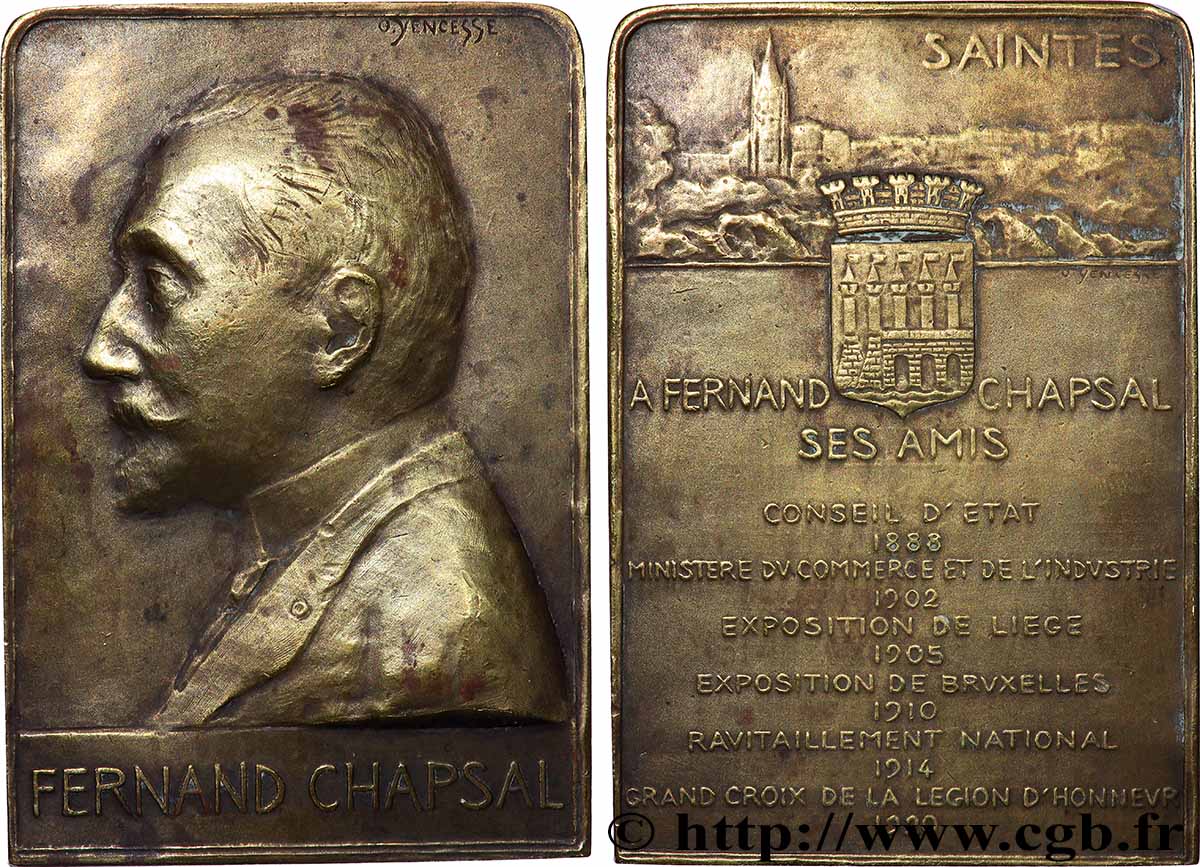
Obverse legend : FERNAND CHAPSAL.
Obverse description : Buste à gauche de Fernand Chapsal. Signé : O. YENCESSE.
Reverse
Reverse legend : SAINTES / A FERNAND CHAPSAL / SES AMIS / CONSEIL D’ÉTAT / 1888 / MINISTRE DU COMMERCE ET DE L’INDUSTRIE / 1902 / EXPOSITION DE LIÈGE / 1905 / EXPOSITION DE BRUXELLES / 1910 / RAVITAILLEMENT NATIONAL / 1914 / GRAND CROIX DE LA LÉGION D’HONNEUR / 1920.
Reverse description : Légende en 15 lignes avec un écu couronné de la ville de Saintes et une vue de ville au-dessus.
Commentary
Dimensions : 70*47,5 mm
Fernand Chapsal, né à Limoges le 10 mars 1862, décédé à Neuilly-sur-Seine le 10 février 1939, est un homme politique français. Il était membre du Parti républicain, radical et radical-socialiste (PRS).
Ovide Yencesse (1869 - 1947), est un graveur-médailleur et sculpteur français. Il fut directeur de l'école des beaux-arts de Dijon de 1919 à 1934.
Son talent est remarqué par la critique ; le très influent Roger Marx trouvant qu'il apporte un « frisson nouveau » dans la médaille, en y introduisant l'impressionnisme. « C'est un art d'intimité, de compassion sociale, résolument moderne, écrit-il dans un article de 1902. Les qualités dictinctives du talent de M. Yencesse sont la pénétration, la tendresse. Dans ses compositions, ses portraits, il arrive à nous toucher au plus profond de l'âme, par la sobriété de la mise en scène, par l'élimination des détails ; il généralise l'accidentel et élève de la sorte au symbole tout spectacle pris autour de lui. La facture, très particulière, elle aussi, contribue à accroître le trouble où nous jettent ces images ; les reliefs émergent à peine du champ de la médaille, la pénombre enveloppe toutes les parties de l'ensemble, comme dans les peintures d'Eugène Carrière. Jamais on n'a mieux fait sentir quels rapports étroits unissent la glyptique et la peinture. » Cette facture très particulière, que son fondeur A. Liard savait parfaitement traduire, lui vaudra, par allusion à la peinture d'Eugène Carrière, le surnom de « Carrière de la médaille ». À l'Exposition universelle de 1900 à Paris, il obtient la médaille d'or et la Légion d'honneur.
Dimensions: 70*47.5 mm Fernand Chapsal, born in Limoges on March 10, 1862, died in Neuilly-sur-Seine on February 10, 1939, was a French politician. He was a member of the Republican, Radical and Radical-Socialist Party (PRS)..
Ovide Yencesse (1869 - 1947) was a French engraver, medalist, and sculptor.. He was director of the Dijon School of Fine Arts from 1919 to 1934..
His talent was noticed by critics; the highly influential Roger Marx found that he brought a \\\"new thrill\\\" to the medal by introducing Impressionism.. \\\"It is an art of intimacy, of social compassion, resolutely modern,\\\" he wrote in a 1902 article.. The qualities that dictate M’s talent. Yencesse are penetration, tenderness. In his compositions and portraits, he manages to touch us in the depths of our souls through the simplicity of his staging and the elimination of details; he generalizes the accidental and thus elevates every scene around him to the level of symbol.. The highly distinctive style also contributes to the unsettling feeling these images evoke; the reliefs barely emerge from the medal's surface, and the penumbra envelops all parts of the composition, as in the paintings of Eugène Carrière.. Never before have the close ties between glyptics and painting been so clearly demonstrated.. \\\"This very unusual invoice, which its foundry A. Liard was a perfect translator, which earned him, by allusion to the painting of Eugène Carrière, the nickname \\\"Carrière of the medal\\\".. At the 1900 Universal Exhibition in Paris, he won the gold medal and the Legion of Honour.
Fernand Chapsal, né à Limoges le 10 mars 1862, décédé à Neuilly-sur-Seine le 10 février 1939, est un homme politique français. Il était membre du Parti républicain, radical et radical-socialiste (PRS).
Ovide Yencesse (1869 - 1947), est un graveur-médailleur et sculpteur français. Il fut directeur de l'école des beaux-arts de Dijon de 1919 à 1934.
Son talent est remarqué par la critique ; le très influent Roger Marx trouvant qu'il apporte un « frisson nouveau » dans la médaille, en y introduisant l'impressionnisme. « C'est un art d'intimité, de compassion sociale, résolument moderne, écrit-il dans un article de 1902. Les qualités dictinctives du talent de M. Yencesse sont la pénétration, la tendresse. Dans ses compositions, ses portraits, il arrive à nous toucher au plus profond de l'âme, par la sobriété de la mise en scène, par l'élimination des détails ; il généralise l'accidentel et élève de la sorte au symbole tout spectacle pris autour de lui. La facture, très particulière, elle aussi, contribue à accroître le trouble où nous jettent ces images ; les reliefs émergent à peine du champ de la médaille, la pénombre enveloppe toutes les parties de l'ensemble, comme dans les peintures d'Eugène Carrière. Jamais on n'a mieux fait sentir quels rapports étroits unissent la glyptique et la peinture. » Cette facture très particulière, que son fondeur A. Liard savait parfaitement traduire, lui vaudra, par allusion à la peinture d'Eugène Carrière, le surnom de « Carrière de la médaille ». À l'Exposition universelle de 1900 à Paris, il obtient la médaille d'or et la Légion d'honneur.
Dimensions: 70*47.5 mm Fernand Chapsal, born in Limoges on March 10, 1862, died in Neuilly-sur-Seine on February 10, 1939, was a French politician. He was a member of the Republican, Radical and Radical-Socialist Party (PRS)..
Ovide Yencesse (1869 - 1947) was a French engraver, medalist, and sculptor.. He was director of the Dijon School of Fine Arts from 1919 to 1934..
His talent was noticed by critics; the highly influential Roger Marx found that he brought a \\\"new thrill\\\" to the medal by introducing Impressionism.. \\\"It is an art of intimacy, of social compassion, resolutely modern,\\\" he wrote in a 1902 article.. The qualities that dictate M’s talent. Yencesse are penetration, tenderness. In his compositions and portraits, he manages to touch us in the depths of our souls through the simplicity of his staging and the elimination of details; he generalizes the accidental and thus elevates every scene around him to the level of symbol.. The highly distinctive style also contributes to the unsettling feeling these images evoke; the reliefs barely emerge from the medal's surface, and the penumbra envelops all parts of the composition, as in the paintings of Eugène Carrière.. Never before have the close ties between glyptics and painting been so clearly demonstrated.. \\\"This very unusual invoice, which its foundry A. Liard was a perfect translator, which earned him, by allusion to the painting of Eugène Carrière, the nickname \\\"Carrière of the medal\\\".. At the 1900 Universal Exhibition in Paris, he won the gold medal and the Legion of Honour.
Historical background
III REPUBLIC
(4/09/1870-10/07/1940)
The news of the capitulation of Sedan provokes the revolution of September 4, 1870 in Paris. Proclaimed at the Hôtel de Ville, the Republic is endowed with a provisional government called the Government of National Defense. Threatened on the left by the insurrection of the Commune and on the right by the monarchists, the new regime had a difficult start.. Initially head of the executive power (February 1871), Thiers was responsible for reorganizing the country before choosing its form of government.. He became President of the Republic in August 1871 and, despite his action to liberate the territory, had to leave his post in March 1873 in the face of royalist opposition.. He is then replaced by Mac-Mahon favorable to the restoration of the monarchy but this one is not restored following the question of the flag. The law of the septennat was then put in place in November 1873 and then, in 1875, the fundamental laws were passed which served as the Constitution of the Third Republic.. Parliamentary system, it is characterized in particular by the clear preponderance of the legislative power on the executive power. Anticlerical, the Third Republic makes school free, secular and compulsory but continues the colonial policy for its economic, strategic and moral ambitions. Separation of Church and State was passed in 1905.. The idea of revenge on Germany and significant nationalism are at the heart of the Boulangist crisis, the Panama scandal or the Dreyfus affair of the years 1886-1899, while foreign policy is very active, particularly in Morocco and that the arms race develops. The First World War was expensive for France, which only recovered from 1920 or even 1928 for the coin with the "Poincaré" franc.. The crisis of 1929 is felt only from 1932 but lasts until 1939, a period during which ministerial instability is very important. Wavering in 1934, the Third Republic found a new unitary cement with anti-fascism which enabled the Popular Front to come to power in 1936.. But, paralyzed against Germany, France was then bogged down in a "phony war" and then suffered one of the greatest defeats in its history in June 1940.. Gathered in the National Assembly in Vichy on July 10, 1940, the Chambers, although elected in 1936, voted full powers to Pétain in a sort of collective suicide by 569 votes for, 80 votes against and 18 abstentions..
 Report a mistake
 Print the page
 Share my selection
 Ask a question
 Consign / sell
Related articles

 Full data


cgbfr.com numismatists


