


E-auction 443-354567 - fme_412172 - III REPUBLIC Médaille pour l’élection de Jean Casimir-Perier
You must signin and be an approved bidder to bid, LOGIN TO BID. Accounts are subject to approval and the approval process takes place within 48 hours. Do not wait until the day a sale closes to register. Clicking on « bid » constitutes acceptance of the terms of use of cgb.fr private e-auctions.
Bids must be placed in whole Euro amounts only. The sale will start closing at the time stated on the item description; any bids received at the site after the closing time will not be executed. Transmission times may vary and bids could be rejected if you wait until the last second. For further information ckeck the E-auctions F.A.Q.
NO BUYER'S FEE.
NO BUYER'S FEE.
| Estimate : | 150 € |
| Price : | 74 € |
| Maximum bid : | 76 € |
| End of the sale : | 11 October 2021 18:41:30 |
| bidders : | 6 bidders |
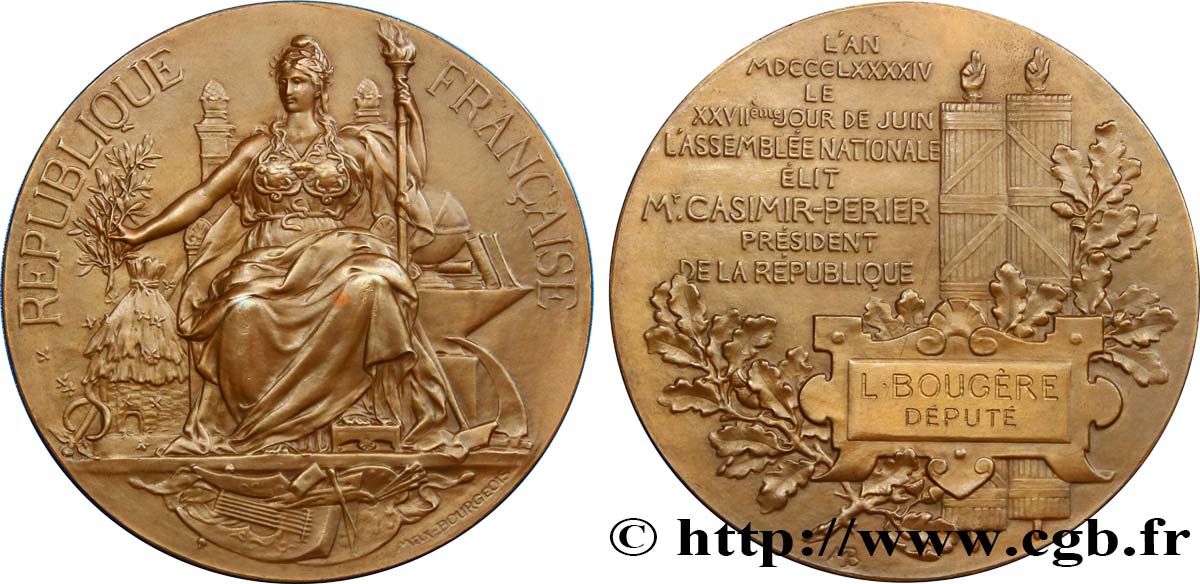
Type : Médaille pour l’élection de Jean Casimir-Perier
Date: 1894
Mint name / Town : 49 - Angers
Metal : bronze
Diameter : 72 mm
Orientation dies : 12 h.
Engraver BOURGEOIS Léon Max (1839-1901)
Weight : 177 g.
Edge : lisse + corne BRONZE
Coments on the condition:
Superbe médaille avec de très beaux reliefs et une patine sombre et brillante, particulièrement agréable
Obverse
Obverse legend : RÉPUBLIQUE FRANÇAISE.
Obverse description : La République trônant avec une torche dans la main gauche et une branche de lauriers dans la droite ; dans un environnement avec une ruche, une lyre, une enclume, un globe, une faux, des livres et une palette de peinture.
Reverse
Reverse legend : L’AN / MDCCCCLXXXXIV / LE XXVIIIÈME JOUR DE JUIN / L’ASSEMBLÉE NATIONALE ÉLIT / MR CASIMIR-PERIER / PRÉSIDENT / DE LA RÉPUBLIQUE.
Reverse description : Légende en 9 lignes avec un cartouche posé sur une branche de chêne avec deux faisceaux.
Commentary
Médaille signée par le graveur Léon Max Bourgeois, avec le monogramme MB au revers. Les productions de Max Bourgeois sont souvent associées à l’Assemblée nationale, au Sénat, sans que sa biographie n’ait laissé de grandes traces...
Médaille attribuée au député L. BOUGÈRE. Laurent Bougère est un homme politique français né le 14 décembre 1864 à Angers (Maine-et-Loire) et décédé le 18 août 1918 à Savennières (Maine-et-Loire). Frère de Ferdinand Bougère, il est employé dans la banque familiale, qu'il dirige à partir de 1885, ainsi qu'une entreprise de matériaux de chemin de fer. Il est conseiller d'arrondissement, conseiller municipal d'Angers et conseiller général du canton de Candé. Il est député de Maine-et-Loire de 1893 à 1918, siégeant à droite.
Jean Casimir-Perier, né le 8 novembre 1847 à Paris et mort le 11 mars 1907 dans le 16e arrondissement, est un homme d'État français. Il est président de la République française du 27 juin 1894 au 16 janvier 1895, date de sa démission. Élu à l’âge de 46 ans, il est le deuxième plus jeune jamais élu à cette fonction, toutes républiques confondues, après Louis-Napoléon Bonaparte. Il détient aussi le record du mandat de président de la République française le plus court, toutes républiques confondues, soit 6 mois et 16 jours..
Medal signed by the engraver Léon Max Bourgeois, with the monogram MB on the reverse. Max Bourgeois's works are often associated with the National Assembly and the Senate, without his biography having left much of a mark.. . .
Medal awarded to MP L. BOUGERE. Laurent Bougère is a French politician born on December 14, 1864 in Angers (Maine-et-Loire) and died on August 18, 1918 in Savennières (Maine-et-Loire). Brother of Ferdinand Bougère, he was employed in the family bank, which he ran from 1885, as well as a railway materials company.. He is a district councilor, municipal councilor of Angers and general councilor of the canton of Candé. He was a deputy for Maine-et-Loire from 1893 to 1918, sitting on the right..
Jean Casimir-Perier, born November 8, 1847 in Paris and died March 11, 1907 in the 16th arrondissement, was a French statesman. He was President of the French Republic from June 27, 1894 to January 16, 1895, the date of his resignation.. Elected at the age of 46, he is the second youngest person ever elected to this office, in all republics, after Louis-Napoléon Bonaparte.. He also holds the record for the shortest term as President of the French Republic, of all republics combined, at 6 months and 16 days..
Médaille attribuée au député L. BOUGÈRE. Laurent Bougère est un homme politique français né le 14 décembre 1864 à Angers (Maine-et-Loire) et décédé le 18 août 1918 à Savennières (Maine-et-Loire). Frère de Ferdinand Bougère, il est employé dans la banque familiale, qu'il dirige à partir de 1885, ainsi qu'une entreprise de matériaux de chemin de fer. Il est conseiller d'arrondissement, conseiller municipal d'Angers et conseiller général du canton de Candé. Il est député de Maine-et-Loire de 1893 à 1918, siégeant à droite.
Jean Casimir-Perier, né le 8 novembre 1847 à Paris et mort le 11 mars 1907 dans le 16e arrondissement, est un homme d'État français. Il est président de la République française du 27 juin 1894 au 16 janvier 1895, date de sa démission. Élu à l’âge de 46 ans, il est le deuxième plus jeune jamais élu à cette fonction, toutes républiques confondues, après Louis-Napoléon Bonaparte. Il détient aussi le record du mandat de président de la République française le plus court, toutes républiques confondues, soit 6 mois et 16 jours..
Medal signed by the engraver Léon Max Bourgeois, with the monogram MB on the reverse. Max Bourgeois's works are often associated with the National Assembly and the Senate, without his biography having left much of a mark.. . .
Medal awarded to MP L. BOUGERE. Laurent Bougère is a French politician born on December 14, 1864 in Angers (Maine-et-Loire) and died on August 18, 1918 in Savennières (Maine-et-Loire). Brother of Ferdinand Bougère, he was employed in the family bank, which he ran from 1885, as well as a railway materials company.. He is a district councilor, municipal councilor of Angers and general councilor of the canton of Candé. He was a deputy for Maine-et-Loire from 1893 to 1918, sitting on the right..
Jean Casimir-Perier, born November 8, 1847 in Paris and died March 11, 1907 in the 16th arrondissement, was a French statesman. He was President of the French Republic from June 27, 1894 to January 16, 1895, the date of his resignation.. Elected at the age of 46, he is the second youngest person ever elected to this office, in all republics, after Louis-Napoléon Bonaparte.. He also holds the record for the shortest term as President of the French Republic, of all republics combined, at 6 months and 16 days..
Historical background
III REPUBLIC
(4/09/1870-10/07/1940)
The news of the capitulation of Sedan provokes the revolution of September 4, 1870 in Paris. Proclaimed at the Hôtel de Ville, the Republic is endowed with a provisional government called the Government of National Defense. Threatened on the left by the insurrection of the Commune and on the right by the monarchists, the new regime had a difficult start.. Initially head of the executive power (February 1871), Thiers was responsible for reorganizing the country before choosing its form of government.. He became President of the Republic in August 1871 and, despite his action to liberate the territory, had to leave his post in March 1873 in the face of royalist opposition.. He is then replaced by Mac-Mahon favorable to the restoration of the monarchy but this one is not restored following the question of the flag. The law of the septennat was then put in place in November 1873 and then, in 1875, the fundamental laws were passed which served as the Constitution of the Third Republic.. Parliamentary system, it is characterized in particular by the clear preponderance of the legislative power on the executive power. Anticlerical, the Third Republic makes school free, secular and compulsory but continues the colonial policy for its economic, strategic and moral ambitions. Separation of Church and State was passed in 1905.. The idea of revenge on Germany and significant nationalism are at the heart of the Boulangist crisis, the Panama scandal or the Dreyfus affair of the years 1886-1899, while foreign policy is very active, particularly in Morocco and that the arms race develops. The First World War was expensive for France, which only recovered from 1920 or even 1928 for the coin with the "Poincaré" franc.. The crisis of 1929 is felt only from 1932 but lasts until 1939, a period during which ministerial instability is very important. Wavering in 1934, the Third Republic found a new unitary cement with anti-fascism which enabled the Popular Front to come to power in 1936.. But, paralyzed against Germany, France was then bogged down in a "phony war" and then suffered one of the greatest defeats in its history in June 1940.. Gathered in the National Assembly in Vichy on July 10, 1940, the Chambers, although elected in 1936, voted full powers to Pétain in a sort of collective suicide by 569 votes for, 80 votes against and 18 abstentions..
 Report a mistake
 Print the page
 Share my selection
 Ask a question
 Consign / sell
Related articles

 Full data


Your Recently Viewed Items
50 Francs CÉRÈS FRANCE 1937 F.17.38 VF
50.00 €
cgbfr.com numismatists


