


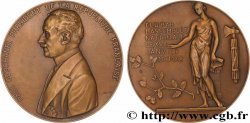
fme_1122824 - III REPUBLIC Médaille, Jean-Alfred Fournier

Not available.
Item sold on our e-shop (2026)
Price : 60.00 €
Item sold on our e-shop (2026)
Price : 60.00 €
Type : Médaille, Jean-Alfred Fournier
Date: 1902
Metal : bronze
Diameter : 68 mm
Orientation dies : 12 h.
Engraver CHAPLAIN Jules-Clément (1839-1909)
Weight : 140,76 g.
Edge : lisse + corne BRONZE
Puncheon : corne BRONZE
Coments on the condition:
Patine hétérogène avec des traces d’usure, rayures et taches d’oxydation. Quelques coups sur les bordures. Traces d’un ancien nettoyage
Obverse
Obverse legend : ALFRED. FOURNIER. DE. L’AC.MIE DE. MEDECINE..
Obverse description : Buste de profil à gauche. Signé : J. C. CHAPLAIN / 1902.
Reverse
Reverse legend : ANÉPIGRAPHE.
Reverse description : Le professeur de médecine, assis, porte son habit de chirurgien composé d’un grand tablier et d’un calot, une loupe à la main. Un amour ailé lui fait face avec un carquois et son arc. Sur la table sont posés divers instruments d’auscultation, une béquille posée au sol. Signé : . C. CHAPLAIN / 1902 .
Commentary
Alfred Fournier (1832-1914) est médecin et membre de l’Académie de médecine. Spécialiste des maladies vénériennes, de la syphilis en particulier, il est le fondateur de la lutte anti-vénérienne. En 1901, il crée la Société de prophylaxie sanitaire et morale qui se donne pour objectif de lutter contre la syphilis, vue comme un véritable fléau social, et s’organise sur le modèle de la lutte contre l’alcoolisme ou la tuberculose.
Alfred Fournier (1832-1914) was a physician and member of the French Academy of Medicine. A specialist in venereal diseases, particularly syphilis, he was the founder of the anti-venereal disease movement. In 1901, he created the Society for Sanitary and Moral Prophylaxis, whose objective was to combat syphilis, seen as a true social scourge, and which was organized on the model of the fight against alcoholism or tuberculosis.
Alfred Fournier (1832-1914) was a physician and member of the French Academy of Medicine. A specialist in venereal diseases, particularly syphilis, he was the founder of the anti-venereal disease movement. In 1901, he created the Society for Sanitary and Moral Prophylaxis, whose objective was to combat syphilis, seen as a true social scourge, and which was organized on the model of the fight against alcoholism or tuberculosis.
Historical background
III REPUBLIC
(4/09/1870-10/07/1940)
The news of the capitulation of Sedan provokes the revolution of September 4, 1870 in Paris. Proclaimed at the Hôtel de Ville, the Republic is endowed with a provisional government called the Government of National Defense. Threatened on the left by the insurrection of the Commune and on the right by the monarchists, the new regime had a difficult start.. Initially head of the executive power (February 1871), Thiers was responsible for reorganizing the country before choosing its form of government.. He became President of the Republic in August 1871 and, despite his action to liberate the territory, had to leave his post in March 1873 in the face of royalist opposition.. He is then replaced by Mac-Mahon favorable to the restoration of the monarchy but this one is not restored following the question of the flag. The law of the septennat was then put in place in November 1873 and then, in 1875, the fundamental laws were passed which served as the Constitution of the Third Republic.. Parliamentary system, it is characterized in particular by the clear preponderance of the legislative power on the executive power. Anticlerical, the Third Republic makes school free, secular and compulsory but continues the colonial policy for its economic, strategic and moral ambitions. Separation of Church and State was passed in 1905.. The idea of revenge on Germany and significant nationalism are at the heart of the Boulangist crisis, the Panama scandal or the Dreyfus affair of the years 1886-1899, while foreign policy is very active, particularly in Morocco and that the arms race develops. The First World War was expensive for France, which only recovered from 1920 or even 1928 for the coin with the "Poincaré" franc.. The crisis of 1929 is felt only from 1932 but lasts until 1939, a period during which ministerial instability is very important. Wavering in 1934, the Third Republic found a new unitary cement with anti-fascism which enabled the Popular Front to come to power in 1936.. But, paralyzed against Germany, France was then bogged down in a "phony war" and then suffered one of the greatest defeats in its history in June 1940.. Gathered in the National Assembly in Vichy on July 10, 1940, the Chambers, although elected in 1936, voted full powers to Pétain in a sort of collective suicide by 569 votes for, 80 votes against and 18 abstentions..
 Report a mistake
 Print the page
 Share my selection
 Ask a question
 Consign / sell
Related articles
 Full data



Your Recently Viewed Items

5 francs IIe type Domard 1838 Lille F.324/74 VF35
25.00 €

5 francs IIe type Domard 1842 Lille F.324/99 F15
18.00 €

10 francs Turin, petite tête 1949 Beaumont-Le-Roger F.362/7 AU52
4.00 €

1 centime Épi, BU (Brillant Universel) 1998 Pessac F.106/58 MS63
16.00 €

5 francs Napoléon III, tête laurée 1870 Paris F.331/16 XF40
20.00 €

10 francs Génie de la Bastille 1990 Pessac F.375/5 MS60
3.00 €
cgbfr.com numismatists


