


E-auction 289-209950 - fme_369623 - III REPUBLIC Médaille des fêtes communales de Cambrai
You must signin and be an approved bidder to bid, LOGIN TO BID. Accounts are subject to approval and the approval process takes place within 48 hours. Do not wait until the day a sale closes to register. Clicking on « bid » constitutes acceptance of the terms of use of cgb.fr private e-auctions.
Bids must be placed in whole Euro amounts only. The sale will start closing at the time stated on the item description; any bids received at the site after the closing time will not be executed. Transmission times may vary and bids could be rejected if you wait until the last second. For further information ckeck the E-auctions F.A.Q.
NO BUYER'S FEE.
NO BUYER'S FEE.
| Estimate : | 80 € |
| Price : | 13 € |
| Maximum bid : | 13 € |
| End of the sale : | 29 October 2018 18:48:30 |
| bidders : | 9 bidders |
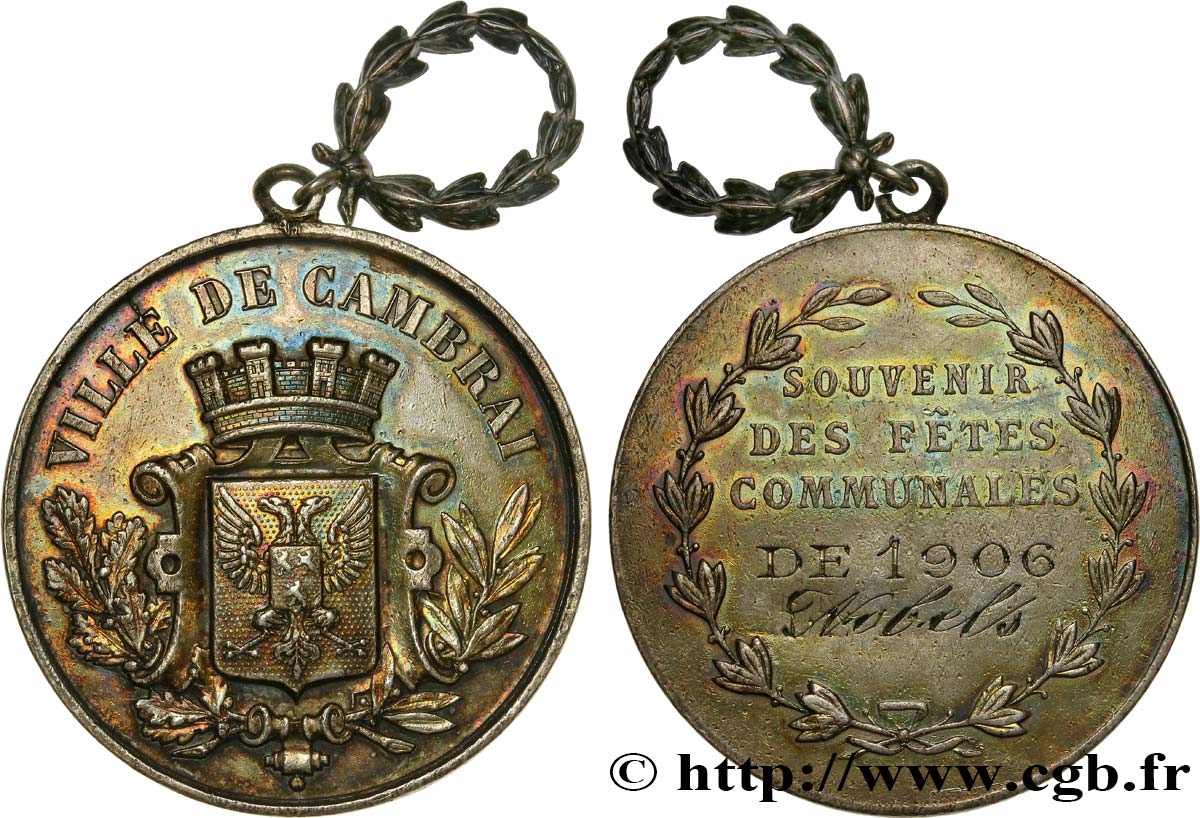
Type : Médaille des fêtes communales de Cambrai
Date: 1906
Mint name / Town : 59 - Cambrai
Metal : silver plated bronze
Diameter : 43 mm
Orientation dies : 12 h.
Weight : 32 g.
Edge : lisse
Coments on the condition:
Jolie médaille avec des traces de circulation et une agréable patine irisée
Obverse
Obverse legend : VILLE DE CAMBRAI.
Obverse description : Écu couronné de la ville de Cambrai dans une couronne de chêne et de lauriers.
Reverse
Reverse legend : SOUVENIR / DES FÊTES / COMMUNALES / DE 1906 / NOBELS.
Reverse description : Légende en 5 lignes dans une couronne de lauriers.
Commentary
Médaille datée de 1906 et attribuée à Nobles, en bronze argenté ou argent, mais non signée.
Cambrai est une commune française située dans le département du Nord, en région Nord-Pas-de-Calais-Picardie.
Vers la fin de l'Empire romain, Cambrai remplace Bavay comme « capitale » de la cité des Nerviens. Au début de l'époque mérovingienne, Cambrai devient le siège d'un vaste évêché s'étendant sur toute la rive droite de l'Escaut et le centre d'une petite principauté ecclésiastique qui dépendra du Saint-Empire romain germanique jusqu'à l'annexion à la France en 1678. Fénelon, surnommé « le Cygne de Cambrai », en fut le plus illustre des archevêques.
Les terres fertiles qui l'entourent et l'industrie textile font sa prospérité au Moyen Âge mais à l'époque moderne, restée à l'écart des grandes voies de chemin de fer, elle s'industrialise moins que ses voisines du Nord-Pas-de-Calais-Picardie. Occupée et partiellement détruite par l'armée allemande pendant la Première Guerre mondiale, Cambrai voit se dérouler à ses portes en 1917 la bataille où les chars sont pour la première fois utilisés massivement. La Seconde Guerre mondiale est suivie de reconstructions et d'un rapide développement économique et démographique, brutalement inversé par le premier choc pétrolier de 1973..
Medal dated 1906 and attributed to Nobles, in silver-plated bronze or silver, but unsigned.
Cambrai is a French commune located in the Nord department, in the Nord-Pas-de-Calais-Picardie region..
Towards the end of the Roman Empire, Cambrai replaced Bavay as the \\\"capital\\\" of the city of the Nervii. At the beginning of the Merovingian period, Cambrai became the seat of a vast bishopric extending over the entire right bank of the Scheldt and the center of a small ecclesiastical principality which would depend on the Holy Roman Empire until its annexation to France in 1678.. Fénelon, nicknamed \\\"the Swan of Cambrai\\\", was the most illustrious of its archbishops.
The fertile lands surrounding it and the textile industry made it prosperous in the Middle Ages, but in modern times, having remained away from the main railway lines, it became less industrialized than its neighbors in Nord-Pas-de-Calais-Picardy.. Occupied and partially destroyed by the German army during the First World War, Cambrai saw the battle take place on its doorstep in 1917 where tanks were used on a massive scale for the first time.. The Second World War was followed by reconstruction and rapid economic and demographic development, brutally reversed by the first oil shock of 1973..
Cambrai est une commune française située dans le département du Nord, en région Nord-Pas-de-Calais-Picardie.
Vers la fin de l'Empire romain, Cambrai remplace Bavay comme « capitale » de la cité des Nerviens. Au début de l'époque mérovingienne, Cambrai devient le siège d'un vaste évêché s'étendant sur toute la rive droite de l'Escaut et le centre d'une petite principauté ecclésiastique qui dépendra du Saint-Empire romain germanique jusqu'à l'annexion à la France en 1678. Fénelon, surnommé « le Cygne de Cambrai », en fut le plus illustre des archevêques.
Les terres fertiles qui l'entourent et l'industrie textile font sa prospérité au Moyen Âge mais à l'époque moderne, restée à l'écart des grandes voies de chemin de fer, elle s'industrialise moins que ses voisines du Nord-Pas-de-Calais-Picardie. Occupée et partiellement détruite par l'armée allemande pendant la Première Guerre mondiale, Cambrai voit se dérouler à ses portes en 1917 la bataille où les chars sont pour la première fois utilisés massivement. La Seconde Guerre mondiale est suivie de reconstructions et d'un rapide développement économique et démographique, brutalement inversé par le premier choc pétrolier de 1973..
Medal dated 1906 and attributed to Nobles, in silver-plated bronze or silver, but unsigned.
Cambrai is a French commune located in the Nord department, in the Nord-Pas-de-Calais-Picardie region..
Towards the end of the Roman Empire, Cambrai replaced Bavay as the \\\"capital\\\" of the city of the Nervii. At the beginning of the Merovingian period, Cambrai became the seat of a vast bishopric extending over the entire right bank of the Scheldt and the center of a small ecclesiastical principality which would depend on the Holy Roman Empire until its annexation to France in 1678.. Fénelon, nicknamed \\\"the Swan of Cambrai\\\", was the most illustrious of its archbishops.
The fertile lands surrounding it and the textile industry made it prosperous in the Middle Ages, but in modern times, having remained away from the main railway lines, it became less industrialized than its neighbors in Nord-Pas-de-Calais-Picardy.. Occupied and partially destroyed by the German army during the First World War, Cambrai saw the battle take place on its doorstep in 1917 where tanks were used on a massive scale for the first time.. The Second World War was followed by reconstruction and rapid economic and demographic development, brutally reversed by the first oil shock of 1973..
Historical background
III REPUBLIC
(4/09/1870-10/07/1940)
The news of the capitulation of Sedan provokes the revolution of September 4, 1870 in Paris. Proclaimed at the Hôtel de Ville, the Republic is endowed with a provisional government called the Government of National Defense. Threatened on the left by the insurrection of the Commune and on the right by the monarchists, the new regime had a difficult start.. Initially head of the executive power (February 1871), Thiers was responsible for reorganizing the country before choosing its form of government.. He became President of the Republic in August 1871 and, despite his action to liberate the territory, had to leave his post in March 1873 in the face of royalist opposition.. He is then replaced by Mac-Mahon favorable to the restoration of the monarchy but this one is not restored following the question of the flag. The law of the septennat was then put in place in November 1873 and then, in 1875, the fundamental laws were passed which served as the Constitution of the Third Republic.. Parliamentary system, it is characterized in particular by the clear preponderance of the legislative power on the executive power. Anticlerical, the Third Republic makes school free, secular and compulsory but continues the colonial policy for its economic, strategic and moral ambitions. Separation of Church and State was passed in 1905.. The idea of revenge on Germany and significant nationalism are at the heart of the Boulangist crisis, the Panama scandal or the Dreyfus affair of the years 1886-1899, while foreign policy is very active, particularly in Morocco and that the arms race develops. The First World War was expensive for France, which only recovered from 1920 or even 1928 for the coin with the "Poincaré" franc.. The crisis of 1929 is felt only from 1932 but lasts until 1939, a period during which ministerial instability is very important. Wavering in 1934, the Third Republic found a new unitary cement with anti-fascism which enabled the Popular Front to come to power in 1936.. But, paralyzed against Germany, France was then bogged down in a "phony war" and then suffered one of the greatest defeats in its history in June 1940.. Gathered in the National Assembly in Vichy on July 10, 1940, the Chambers, although elected in 1936, voted full powers to Pétain in a sort of collective suicide by 569 votes for, 80 votes against and 18 abstentions..
 Report a mistake
 Print the page
 Share my selection
 Ask a question
 Consign / sell
Related articles
 Full data



Your Recently Viewed Items

10 Francs BERLIOZ FRANCE 1974 F.63.04 F+
3.00 €

10 Francs MINERVE FRANCE 1932 F.06.16 F
2.00 €
GALLIA BELGICA - LINGONES (Area of Langres) Denier KALETEDOY à la rouelle VF
10.00 €
HENRY IV Quart d'écu de Navarre 1594 Saint-Palais VF
140.00 €
SLOVENIA 0,02 Lipe (monnaie non adoptée) 1992 MS
3.00 €

PHILIPPINES Lot de deux monnaies 5 et 10 Piso 2005-2010 MS
3.00 €
cgbfr.com numismatists


