


Not available.
Item sold on our e-shop (2012)
Price : 45.00 €
Item sold on our e-shop (2012)
Price : 45.00 €
Type : Denier
Date: 109
Mint name / Town : Roma
Metal : silver
Millesimal fineness : 900 ‰
Diameter : 18 mm
Orientation dies : 6 h.
Weight : 3,30 g.
Rarity : R1
Officine: 1re
Coments on the condition:
Exemplaire sur un petit flan à l’usure importante, lisible et identifiable. Patine grise
Catalogue references :
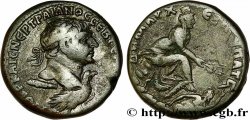
Obverse
Obverse legend : IMP TRAIANO AVG GER DAC P M TR P.
Obverse description : Tête laurée de Trajan à droite (O*).
Obverse translation : “Imperatori Traiano Augusto Germanico Dacico Pontifici Maximo Tribuniciæ Potestate”, (À l’empereur Trajan auguste germanique dacique grand pontife revêtu de la puissance tribunitienne).
Reverse
Reverse legend : COS V P P S P Q R OPTIMO PRINC.
Reverse description : Arabia (l’Arabie) drapée debout de face, tenant une branche de la main droite et de la canne de la main gauche ; un dromadaire à ses pieds à gauche.
Reverse translation : "Consul quintum Pater Patriae Senatus Populus que Romanus Optimo Principi", (Consul pour la cinquième fois, père de la patrie, le Sénat du peuple Romain, au meilleur des Princes).
Commentary
La représentation des camélidés est relativement rare dans le monnayage impérial. Un dromadaire ornait déjà le monnayage de Marcus Aemilius Scaurus et Publius Plautius en 58 avant J.-C. avec le roi nabatéen Aretas III qui se soumit à l’autorité romaine (RCV. 378). Sur notre exemplaire, c’est la personnification de la Province qui est représentée.
The representation of camelids is relatively rare in imperial coinage. A dromedary already adorned the coinage of Marcus Aemilius Scaurus and Publius Plautius in 58 BC with the Nabataean king Aretas III who submitted to Roman authority (RCV. 378). On our example, it is the personification of the Province that is represented
The representation of camelids is relatively rare in imperial coinage. A dromedary already adorned the coinage of Marcus Aemilius Scaurus and Publius Plautius in 58 BC with the Nabataean king Aretas III who submitted to Roman authority (RCV. 378). On our example, it is the personification of the Province that is represented
Historical background
TRAJANUS
(27/10/97-8/08/117)
Augustus
Trajan was born on September 18, 53 in Italica, near Seville in Spain, like his pupil Hadrian. He belongs to a family of settlers settled in Spain. After a brilliant military career under the Flavians, he was consul in 91 and legate of Germania Superior when he was adopted by Nerva in 97 to succeed him. After the death of the latter, he becomes august. His reign will be devoted to numerous military campaigns against the Germans on the Rhine limes, which earned him the title of Germanicus. Then, he led two Dacian wars against Decebalus which ended with the annexation of Dacia. Trajan prepares a campaign against the Parthians, the turbulent and powerful neighbors to the east. He left Rome for the East and established his headquarters in Antioch before invading the Parthian kingdom. He will go as far as Ctesiphon (Seleucia on the Tigris). When he died on August 8, 117, the Empire was at its peak and experienced its greatest territorial expansion..
 Report a mistake
 Print the page
 Share my selection
 Ask a question
 Consign / sell
Related articles
 Full data

Your Recently Viewed Items

PROBUS Aurelianus MS
95.00 €

FAUSTINA MINOR Sesterce XF
225.00 €
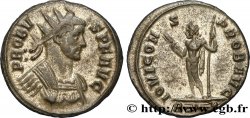
PROBUS Aurelianus AU
32.00 €

AURELIAN Aurelianus XF
225.00 €

GETA Denier XF
100.00 €

GETA Denier XF
150.00 €
cgbfr.com numismatists


