


bpv_153662 - TITUS Tétradrachme syro-phénicien
Not available.
Item sold on our e-shop (2015)
Price : 240.00 €
Item sold on our e-shop (2015)
Price : 240.00 €
Type : Tétradrachme syro-phénicien
Date: 71-72
Mint name / Town : Antioche, Syrie, Séleucie et Piérie
Metal : silver
Diameter : 24,00 mm
Orientation dies : 11 h.
Weight : 14,48 g.
Rarity : R1
Coments on the condition:
Nette usure, comme tous les exemplaires connus ou presque. Flan très légèrement taché et trop court. Il s’agit d’un exemplaire de relativement bonne qualité pour l’émission
Catalogue references :
Predigree :
Cet exemplaire est le 0140_026 de la base TSP, il provient de la collection Peter Gilmore et a été publié dans le Numismatic Circular 1980, 403
Obverse
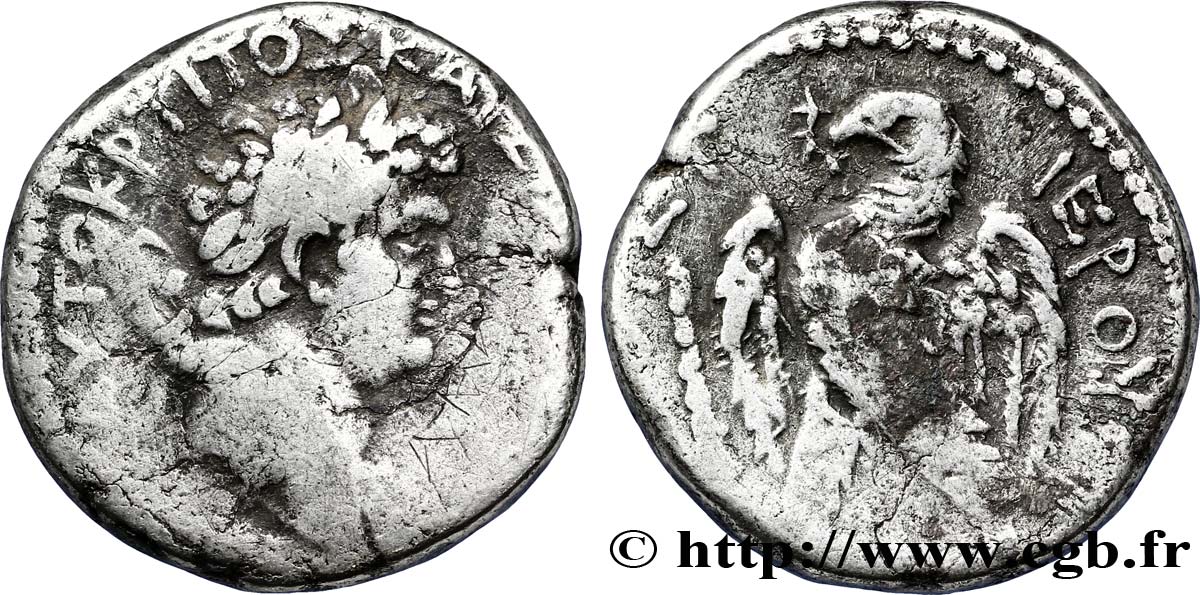
Obverse description : Tête laurée de Titus à droite avec l’égide (O*4).
Obverse legend : AUTOKR TITOS KAIS OUESP (Autokrator Titos Kaisaros Ouespasianos)
Obverse translation : (l’empereur Titus césar Vespasien).
Reverse
Reverse description : Aigle debout à gauche sur une palme, les ailes déployées ; dans le champ à gauche, une massue posée verticalement.
Reverse legend : [ETOUS] G - IEROU (Etous gamma Ierou)
Reverse translation : (année sacrée troisième du règne).
Commentary
Il existe deux séries de gravure pour le type, l’une avec des grosses têtes qui occupent presque tout le champ et d’autres avec des têtes plus petites, comme ici. Ce sont probablement deux émission différentes car les graveurs sont différents tant pour l’avers que le revers mais un travail de liaison de coin serait nécessaire pour le confirmer.
Cette pièce est une frappe pour Titus, ce qu’indique sans confusion la légende de droit, et la date est tout aussi certainement celle du règne de Vespasien : les émissions parallèles existent pour Vespasien et cet usage de dater les frappes du fils par les années régnales du père est bien attesté.
On pense bien entendu pour ce groupe à un atelier proche du front, Tyr, du fait de la massue, une ville de Judea Capta pour le lieu des combats, peut-être Jérusalem qui était déjà tombée, alors que les affrontements se poursuivaient. Il faut remarquer que le symbole du caducée entre les pattes de l’aigle renvoie au groupe 10 de Vespasien où l’aigle sur l’autel en tient un dans le bec. Malheureusement, nous n’avons pas d’explication.
La base TSP répertorie actuellement soixante deux exemplaires dont en musées Israel State Museum (2), Glasgow, ANS (2), Jérusalem, Yale, Jerusalem Hebrew University .
There are two series of engravings for the type, one with large heads that occupy almost the entire field and others with smaller heads, as here. These are probably two different issues as the engravers are different for both the obverse and reverse but a die bonding work would be necessary to confirm this.
This coin is a strike for Titus, which is clearly indicated by the legend on the right, and the date is just as certainly that of the reign of Vespasian: parallel issues exist for Vespasian and this practice of dating the strikes of the son by the regnal years of the father is well attested..
We naturally think of this group as a workshop close to the front, Tyre, because of the club, a city of Judea Capta for the place of the fighting, perhaps Jerusalem which had already fallen, while the clashes continued.. It should be noted that the symbol of the caduceus between the eagle's legs refers to group 10 of Vespasian where the eagle on the altar holds one in its beak. Unfortunately, we have no explanation..
The TSP database currently lists sixty-two examples, including those in museums: Israel State Museum (2), Glasgow, ANS (2), Jerusalem, Yale, Jerusalem Hebrew University
Cette pièce est une frappe pour Titus, ce qu’indique sans confusion la légende de droit, et la date est tout aussi certainement celle du règne de Vespasien : les émissions parallèles existent pour Vespasien et cet usage de dater les frappes du fils par les années régnales du père est bien attesté.
On pense bien entendu pour ce groupe à un atelier proche du front, Tyr, du fait de la massue, une ville de Judea Capta pour le lieu des combats, peut-être Jérusalem qui était déjà tombée, alors que les affrontements se poursuivaient. Il faut remarquer que le symbole du caducée entre les pattes de l’aigle renvoie au groupe 10 de Vespasien où l’aigle sur l’autel en tient un dans le bec. Malheureusement, nous n’avons pas d’explication.
La base TSP répertorie actuellement soixante deux exemplaires dont en musées Israel State Museum (2), Glasgow, ANS (2), Jérusalem, Yale, Jerusalem Hebrew University .
There are two series of engravings for the type, one with large heads that occupy almost the entire field and others with smaller heads, as here. These are probably two different issues as the engravers are different for both the obverse and reverse but a die bonding work would be necessary to confirm this.
This coin is a strike for Titus, which is clearly indicated by the legend on the right, and the date is just as certainly that of the reign of Vespasian: parallel issues exist for Vespasian and this practice of dating the strikes of the son by the regnal years of the father is well attested..
We naturally think of this group as a workshop close to the front, Tyre, because of the club, a city of Judea Capta for the place of the fighting, perhaps Jerusalem which had already fallen, while the clashes continued.. It should be noted that the symbol of the caduceus between the eagle's legs refers to group 10 of Vespasian where the eagle on the altar holds one in its beak. Unfortunately, we have no explanation..
The TSP database currently lists sixty-two examples, including those in museums: Israel State Museum (2), Glasgow, ANS (2), Jerusalem, Yale, Jerusalem Hebrew University
Historical background
TITUS
(1/07/69-13/09/81)
Augustus with Vespasianus
Titus, born December 30, 39, is the eldest son of Vespasian. He follows his father to Judea, where he is legate of the XV Apollinaris legion. After the proclamation of Alexandria, Vespasian leaves it to him to complete the pacification of Judea, during which he falls in love with Bérénice (cf. Racine's play). After the capture of Jerusalem in the summer of 70, he celebrated the triumph with his father in January 71. Associated with power by his father, he succeeded him on June 24, 79, having broken with the beautiful Jewish princess in 75. His reign n is only a series of disasters: the eruption of Vesuvius on August 24, 79 which destroyed Pompeii and Herculaneum, then the fire of Rome in 80. He died in 81, perhaps assassinated at the instigation of his brother, Domitian (Suetonius).
 Report a mistake
 Print the page
 Share my selection
 Ask a question
 Consign / sell
 Full data



cgbfr.com numismatists


