


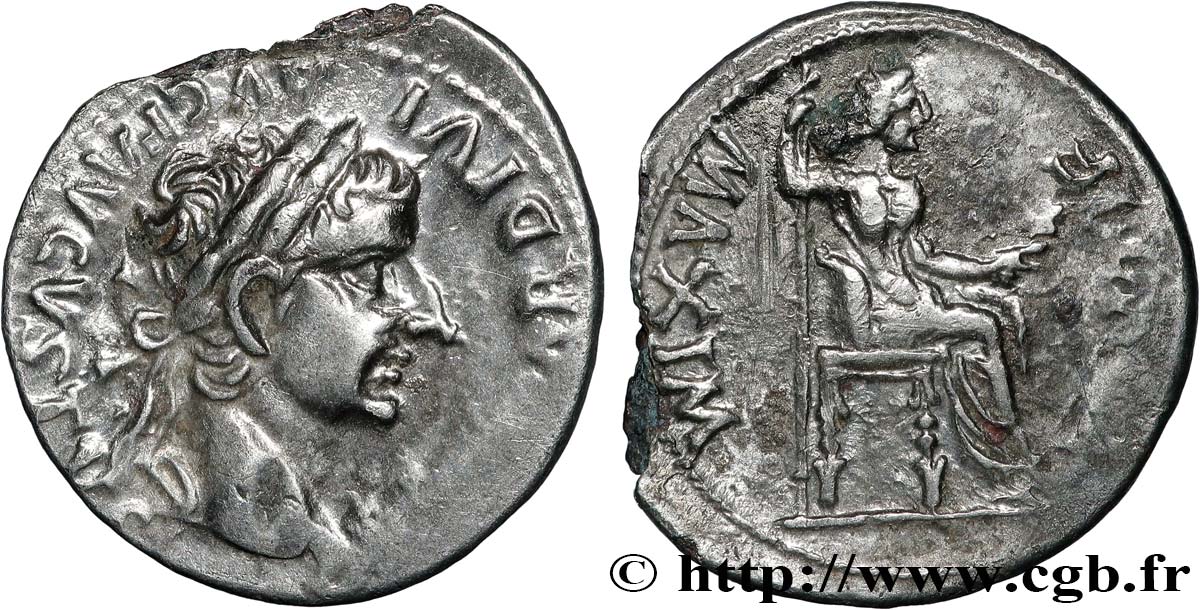
brm_853581 - TIBERIUS Denier
Not available.
Item sold on our e-shop (2025)
Price : 200.00 €
Item sold on our e-shop (2025)
Price : 200.00 €
Type : Denier
Date: c. 15-37
Mint name / Town : Lyon
Metal : silver
Millesimal fineness : 900 ‰
Diameter : 18,5 mm
Orientation dies : 3 h.
Weight : 2,59 g.
Rarity : R1
Coments on the condition:
Monnaie centrée. Manque de métal. Joli portrait de Tibère. Usure régulière. Patine grise
Catalogue references :
C.16 (2 fr.) - RIC.3 - BMC/RE.34 - RSC.16 - RCV.1763 (280$) - MRK.5 /4 (700€) - BN/R.16 - Giard/L1.144
Obverse
Obverse legend : TI CAESAR DIVI - AVG F AVGVSTVS.
Obverse description : Tête laurée de Tibère à droite (O*).
Obverse translation : “Tiberius Cæsar Divi Augusti Filius Augustus”, (Tibère César fils du divin Auguste, auguste).
Reverse
Reverse legend : PONTIF - MAXIM.
Reverse description : Pax (la Paix) ou Livie assise à droite sur un siège décoré, tenant une branche d'olivier de la main gauche et de la droite un long sceptre.
Reverse translation : “Pontifex Maximus”, (Grand pontife).
Commentary
Monnaie fourrée. Rubans de type 3. Siège avec les pieds droits. Comme pour le denier d'Auguste, cette pièce appartient à l'atelier impérial de Lyon et ce type de denier a circulé pendant pratiquement un siècle. Il se rencontre très souvent avec des monnaies gauloises de la phase terminale dans les fouilles archéologiques. C’est la monnaie romaine la plus courante en Gaule. La première émission se caractérise par un socle représenté par deux lignes et les pieds du siège sont droits au revers.
Cored coin. Type 3 ribbons. Seat with straight legs. As with the Augustus denarius, this piece belongs to the imperial workshop of Lyon and this type of denarius circulated for almost a century. It is very often encountered with Gallic coins from the terminal phase in archaeological excavations. It is the most common Roman coin in Gaul. The first issue is characterized by a base represented by two lines and the legs of the seat are straight on the back
Cored coin. Type 3 ribbons. Seat with straight legs. As with the Augustus denarius, this piece belongs to the imperial workshop of Lyon and this type of denarius circulated for almost a century. It is very often encountered with Gallic coins from the terminal phase in archaeological excavations. It is the most common Roman coin in Gaul. The first issue is characterized by a base represented by two lines and the legs of the seat are straight on the back
Historical background
TIBERIUS
(19/08/14-16/03/37)
Augustus
Tiberius, the son of Tiberius Claudius Nero and Livia, was born on November 16, 42 BC.. -VS. His father, Caesar's lieutenant during the War of Alexandria (48-47 BC. -VS. ), then rallied to Antoine. Octave kidnapped Livia, Tiberius' mother, and married her in 38 BC. -VS. while she is pregnant by Nero Drusus. To further complicate the family tree of the Julio-Claudians, Tiberius had to divorce Vipsania to marry Julie, the daughter of Augustus, widow of Agrippa (12 BC).. -VS. ). After having chosen him as heir, Augustus prefers his grandsons to him and Tiberius then goes into exile in Rhodes.. After a plot attempt by Julie, Tibère divorces her and will never see her again.. In 4, Augustus adopts Tiberius who succeeds him in 14. His reign will last 23 years. Germanicus, whom he did not love, died in 19. He lost his son Drusus in 23, murdered by his wife, Livilla, with the help of the prefect of the Praetorium, Séjan, her lover, who retained his power until 31. Denounced for his crimes by his sister-in-law, Antonia, Séjan is executed. Tiberius retired to Capri since the year 27, died, possibly assassinated, in 37 and his great-nephew Caligula, great-grandson of Augustus, succeeded him.
 Report a mistake
 Print the page
 Share my selection
 Ask a question
 Consign / sell
 Full data



Your Recently Viewed Items
MAXIMIANUS HERCULIUS Aurelianus XF
19.00 €

POSTUMUS Antoninien VF/XF
17.00 €

POSTUMUS Antoninien VF/VG
5.00 €

VICTORINUS Antoninien VF
6.00 €
cgbfr.com numismatists


