


bgr_329598 - THESSALY - LARISSA Drachme
Not available.
Item sold on our e-shop (2014)
Price : 650.00 €
Item sold on our e-shop (2014)
Price : 650.00 €
Type : Drachme
Date: c. 350-340 AC.
Mint name / Town : Larissa, Thessalie
Metal : silver
Diameter : 20,5 mm
Orientation dies : 12 h.
Weight : 5,96 g.
Rarity : R2
Coments on the condition:
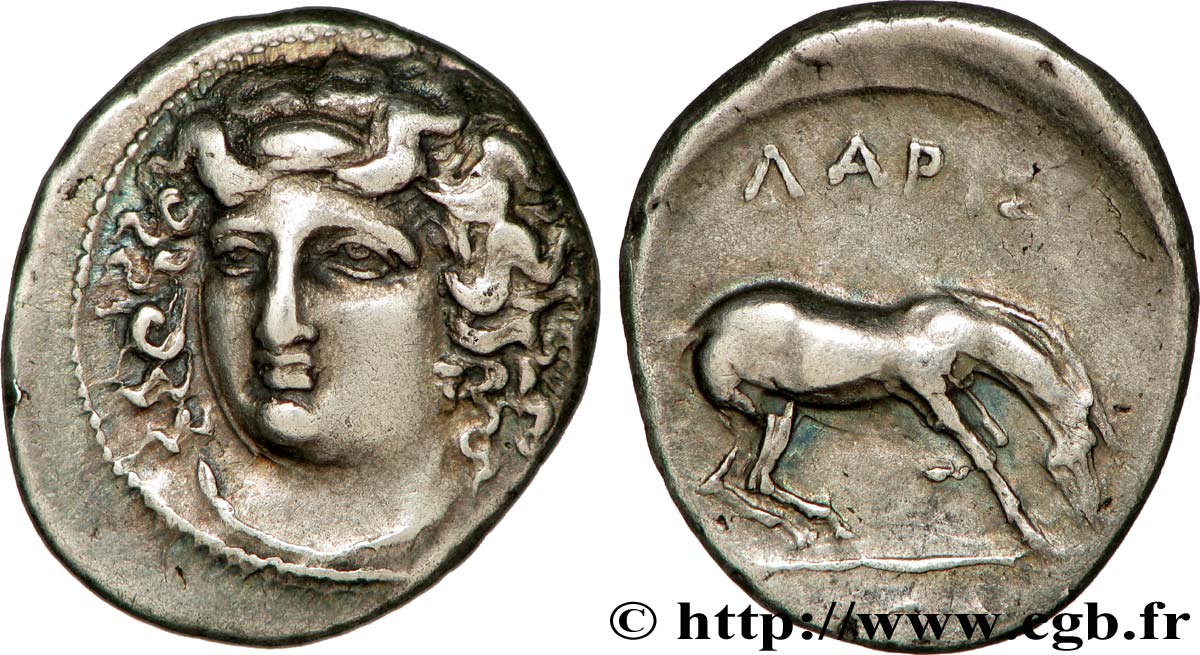
Exemplaire sur un grand flan ovale, bien centré, mettant en valeur et le portrait de la nymphe et l’attitude du cheval au revers. Très beau portrait expressif à l’usure superficielle. Joli revers bien venu à la frappe. Belle patine de collection ancienne avec des reflets mordoréset bleutés
Catalogue references :
Predigree :
Cet exemplaire provient du stock de Monnaie d’Antan
Obverse
Obverse legend : ANÉPIGRAPHE.
Obverse description : Tête de la nymphe Larissa de face tournée de trois-quarts de face à gauche, les cheveux retenus par un bandeau (l'ampyx).
Reverse
Reverse description : Cheval paissant à droite, l'antérieur repose sur la ligne de sol.
Reverse legend : LARIS// [AIWN]
Reverse translation : (de Larissa).
Commentary
Cet exemplaire, sur un flan relativement étroit tout en étant relativement complet, nous montre la maîtrise artistique du graveur qui a su habilement adapter son sujet à la forme circulaire du flan, tant au niveau du droit, où la chevelure vient harmonieusement occuper l’ensemble du flan et au revers, où le cheval semble se courber. Cette position où le cheval pose l’antérieur sur le sol semble beaucoup plus rare que ceux où il est carrément courbé avec le même antérieur plié. Au revers, nous, la première partie de la légende de Larissa (LARIS) semble absente et non pas manquante. Au-dessus de la ligne d’exergue, nous semblons apercevoir la longe du cheval.
This example, on a relatively narrow flan while being relatively complete, shows us the artistic mastery of the engraver who skillfully adapted his subject to the circular shape of the flan, both on the obverse, where the hair harmoniously occupies the entire flan and on the reverse, where the horse seems to bend. This position where the horse places the foreleg on the ground seems much rarer than those where it is completely bent with the same foreleg bent. On the reverse, we, the first part of the legend of Larissa (LARIS) seems absent and not missing. Above the exergue line, we seem to see the horse's rein
This example, on a relatively narrow flan while being relatively complete, shows us the artistic mastery of the engraver who skillfully adapted his subject to the circular shape of the flan, both on the obverse, where the hair harmoniously occupies the entire flan and on the reverse, where the horse seems to bend. This position where the horse places the foreleg on the ground seems much rarer than those where it is completely bent with the same foreleg bent. On the reverse, we, the first part of the legend of Larissa (LARIS) seems absent and not missing. Above the exergue line, we seem to see the horse's rein
Historical background
THESSALY - LARISSA
(400-344 BC)
Larissa, the most important city of Thessaly, takes its name from one of the daughters of the mythical king Pelasgos. Built on the right bank of the Peneios, the city was famous for its horse breeding and Thessalos, the eponymous hero of the region, trained wild bulls there.. When Philip II of Macedon invaded Thessaly in 353 BC. -VS. , he installed democratic governments there under the protection of Macedonian garrisons responsible for maintaining order. He created four great districts at the head of which he placed tetrarchs, Simos being that of the district of Larissa. This organization was to last only eight years because, in 344 BC. -VS. , Philip II invades Thessaly again, drives out Simos and incorporates the whole province into the kingdom of Macedonia, ending the coinage. For the coinage of Larissa, there are three studies: the article by F. Hermann, Die Silbermünzen von Larissa in Thessalien, ZfN. 35 (1925), the article by T. R. Martin, The Chronology of the fourth century B. VS. , Facing Head Silver Coinage of Larissa, MN. 28, 1983 and the article by C. Lorber, The Early Facing Head Drachms of Thessalian Larissa, in Florilegium Numismaticum, Studia in Honorem U. Westermark, Stockholm 1992.
 Report a mistake
 Print the page
 Share my selection
 Ask a question
 Consign / sell
Related articles
 Full data



Your Recently Viewed Items
5 Francs NEW HEBRIDES 1941 P.04a XF-
380.00 €

AQUITAINE - DUCHY OF AQUITAINE - RICHARD II Hardi VF/XF
36.00 €

CONSTANTINE I THE GREAT Follis ou nummus AU
125.00 €

LOUIS XV THE BELOVED Dixième d'écu aux branches d’olivier, tête ceinte d’
52.00 €

THE CONVENTION 2 sols dit "à la table de loi" 1793 Strasbourg VG
28.00 €
INSURANCES Médaille, L’Abeille AU
75.00 €
cgbfr.com numismatists


