


E-auction 102-53629 - bpv_295222 - SYRIA - ROMAN PROVINCE - CAIUS CASSIUS LONGINUS Tétradrachme syro-phénicien
You must signin and be an approved bidder to bid, LOGIN TO BID. Accounts are subject to approval and the approval process takes place within 48 hours. Do not wait until the day a sale closes to register. Clicking on « bid » constitutes acceptance of the terms of use of cgb.fr private e-auctions.
Bids must be placed in whole Euro amounts only. The sale will start closing at the time stated on the item description; any bids received at the site after the closing time will not be executed. Transmission times may vary and bids could be rejected if you wait until the last second. For further information ckeck the E-auctions F.A.Q.
NO BUYER'S FEE.
NO BUYER'S FEE.
| Estimate : | 140 € |
| Price : | 43 € |
| Maximum bid : | 51 € |
| End of the sale : | 30 March 2015 16:01:30 |
| bidders : | 8 bidders |
Type : Tétradrachme syro-phénicien
Date: 43-42 AC.
Mint name / Town : Antioche, Syrie, Séleucie et Piérie
Metal : silver
Diameter : 26 mm
Orientation dies : 12 h.
Weight : 13,80 g.
Rarity : R1
Coments on the condition:
Flan court, date certaine mais lue par déduction et élimination
Catalogue references :
Predigree :
Cet exemplaire est le 0007_011 de la base TSP et provient de la vente Hans M. F. Schulman (26-29 April 1972), lot 287
Obverse
Obverse legend : ANÉPIGRAPHE.
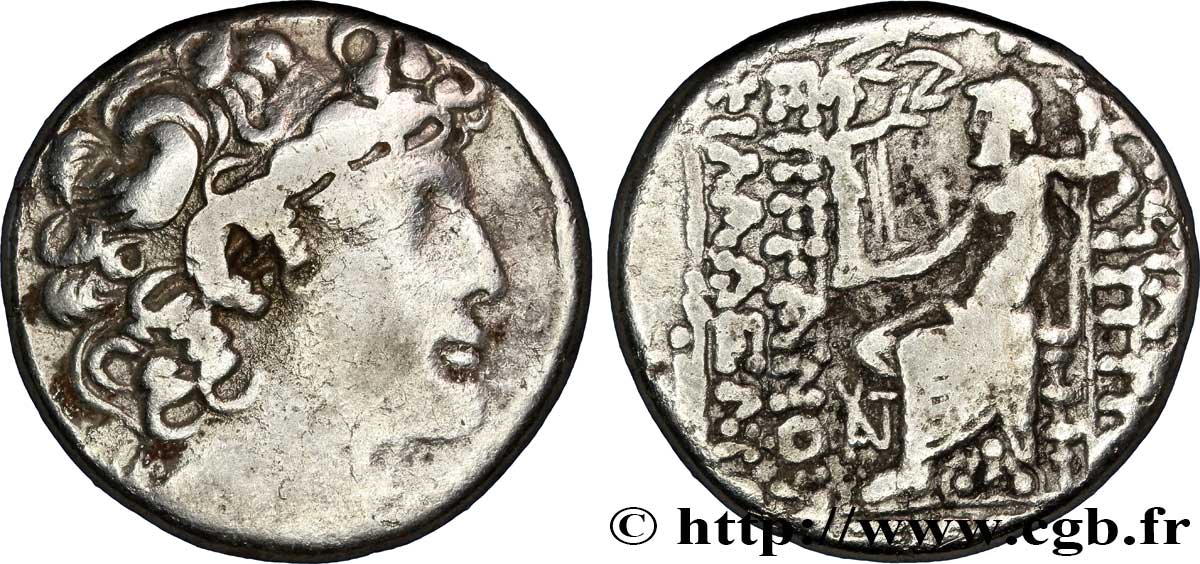
Obverse description : Tête diadémée de Philippe Philadelphe à droite, entouré de la stemma (O’).
Reverse
Reverse description : Zeus assis à gauche sur un trône avec dossier, tenant de la main droite une Niké qui le couronne et un sceptre long de la main gauche ; au-dessus de Zeus, le foudre ; monogramme dans le champ à gauche ; date à l’exergue.
Reverse legend : BASILEWS/ FILIPPOU/ EPIFANOUS/ FILADELFOU, s(Basilews Filippou Epifanous Filadelfou)
Reverse translation : (Roi Philippe Epiphane Philadelphe/ monogramme d’Antioche et millésime 6 à l’exergue).
Commentary
An 6 de l’ère césarienne, exemplaire classique de la série intermédiaire entre les frappes séleucides et les frappes impériales syriennes. La colonisation romaine est encore discrète et la prise de contrôle est aimable avec des constructions d’amphithéâtres, des travaux publics et des cérémonies. La monnaie, bien que contrôlée par Rome, reste au type séleucide et seul le petit monogramme indique la prise de pouvoir, ainsi que le millésime, ici l’an 6 de l’ère césarienne.
Notons que l’ère césarienne est conservée pour dater la monnaie, bien que le pouvoir politique à Antioche soit aux mains des Pompéiens.
Style classique pour l’émission avec les mèches traitées en “serpents”.
Les émissions au type immobilisé de Philippe Philadelphe sont très importantes car elles illustrent parfaitement la logique impériale de la colonisation romaine. Autant une conquête de revendication territoriale d'expansion de l'espace vital autour d'un pouvoir central de type national va chercher à éliminer toutes les symboliques locales dans les pays conquis pour imposer celles du conquérant (selon le principe de un peuple, un roi, une foi, une loi), autant un empire va laisser cohabiter des symboliques différentes. C'est ce qui se passe en Syrie, Palestine et Phénicie dans les premiers temps de l'expansion. Loin d'imposer le denier ou la typologie romaine, les Latins vont respecter la métrologie et même le type. Il faudra attendre les rares émissions d'Auguste au revers du Zeus, presque cinquante ans, pour voir apparaître le portrait du Prince sur les monnaies locales en argent.
Dans la base TSP maintenue par Michel Prieur, dix-huit exemplaires sont maintenant répertoriés, dont un à l’ANS.
Year 6 of the Caesarian era, a classic example of the intermediate series between the Seleucid strikes and the Syrian imperial strikes. Roman colonization is still discreet and the takeover is friendly with the construction of amphitheaters, public works and ceremonies. The coin, although controlled by Rome, remains of the Seleucid type and only the small monogram indicates the seizure of power, as well as the year, here the year 6 of the Caesarian era..
Note that the Caesarean era is retained to date the coin, although political power in Antioch was in the hands of the Pompeians.
Classic style for the show with the strands treated in “snakes”.
The immobilized type emissions of Philippe Philadelphe are very important because they perfectly illustrate the imperial logic of Roman colonization.. Just as a conquest of territorial claim of expansion of the living space around a central power of national type will seek to eliminate all local symbols in the conquered countries to impose those of the conqueror (according to the principle of one people, one king, one faith, one law), so an empire will allow different symbols to coexist. This is what happened in Syria, Palestine and Phoenicia in the early days of expansion.. Far from imposing the denarius or Roman typology, the Latins will respect metrology and even the type. It was not until the rare issues of Augustus on the reverse of the Zeus, almost fifty years later, that the portrait of the Prince appeared on local silver coins..
In the TSP database maintained by Michel Prieur, eighteen examples are now listed, including one at the ANS
Notons que l’ère césarienne est conservée pour dater la monnaie, bien que le pouvoir politique à Antioche soit aux mains des Pompéiens.
Style classique pour l’émission avec les mèches traitées en “serpents”.
Les émissions au type immobilisé de Philippe Philadelphe sont très importantes car elles illustrent parfaitement la logique impériale de la colonisation romaine. Autant une conquête de revendication territoriale d'expansion de l'espace vital autour d'un pouvoir central de type national va chercher à éliminer toutes les symboliques locales dans les pays conquis pour imposer celles du conquérant (selon le principe de un peuple, un roi, une foi, une loi), autant un empire va laisser cohabiter des symboliques différentes. C'est ce qui se passe en Syrie, Palestine et Phénicie dans les premiers temps de l'expansion. Loin d'imposer le denier ou la typologie romaine, les Latins vont respecter la métrologie et même le type. Il faudra attendre les rares émissions d'Auguste au revers du Zeus, presque cinquante ans, pour voir apparaître le portrait du Prince sur les monnaies locales en argent.
Dans la base TSP maintenue par Michel Prieur, dix-huit exemplaires sont maintenant répertoriés, dont un à l’ANS.
Year 6 of the Caesarian era, a classic example of the intermediate series between the Seleucid strikes and the Syrian imperial strikes. Roman colonization is still discreet and the takeover is friendly with the construction of amphitheaters, public works and ceremonies. The coin, although controlled by Rome, remains of the Seleucid type and only the small monogram indicates the seizure of power, as well as the year, here the year 6 of the Caesarian era..
Note that the Caesarean era is retained to date the coin, although political power in Antioch was in the hands of the Pompeians.
Classic style for the show with the strands treated in “snakes”.
The immobilized type emissions of Philippe Philadelphe are very important because they perfectly illustrate the imperial logic of Roman colonization.. Just as a conquest of territorial claim of expansion of the living space around a central power of national type will seek to eliminate all local symbols in the conquered countries to impose those of the conqueror (according to the principle of one people, one king, one faith, one law), so an empire will allow different symbols to coexist. This is what happened in Syria, Palestine and Phoenicia in the early days of expansion.. Far from imposing the denarius or Roman typology, the Latins will respect metrology and even the type. It was not until the rare issues of Augustus on the reverse of the Zeus, almost fifty years later, that the portrait of the Prince appeared on local silver coins..
In the TSP database maintained by Michel Prieur, eighteen examples are now listed, including one at the ANS
Historical background
SYRIA - ROMAN PROVINCE - CAIUS CASSIUS LONGINUS
43-42 AC.
Caius Cassius Longinus had been part of the army of Crassus which was crushed at Carrhae (May 53 BC. -VS. ). He succeeded in escaping a disastrous fate, gathered together the remnants of the army and organized the defense of Syria where he ensured the charge of prosecutor. Supporter of Pompey, he was pardoned by Caesar after Pharsalus in 48 BC. -VS. which did not prevent him from being involved in the plot where the Dictator lost his life on the Ides of March (March 15, 44 BC).. -VS. ). After the death of Caesar and the attitude of Marc Antoine, he left Italy and took refuge in Syria. In 43 BC. -VS. , he received with Brutus, another assassin of Caesar an "Imperium" over the whole of the East. This power being only nominal Caius Cassius ensured it by despoiling the rich Jews of Antioch to pay his troops and make himself popular. The legitimate governor, Dollabella, tried to dislodge him from Antioch but Caius Cassius, in retaliation, attacked Laodicea and pushed Dollabella to suicide then occupied Tarsus and Rhodes. On Octavian's injunction, Cassius and Brutus were declared public enemies by the "lex Pedia" in the fall of the same year. Cassius and Brutus joined forces in Greece in September 42 BC. -VS. The final meeting took place at Philippi in Macedonia in October 42. During the first fight, Cassius seeing himself lost, preferred to commit suicide.
 Report a mistake
 Print the page
 Share my selection
 Ask a question
 Consign / sell
Your Recently Viewed Items
SYRIA - ROMAN PROVINCE - MARCUS ANTONIUS Tétradrachme syro-phénicien XF
250.00 €
PICARDY - GENTRY AND TOWNS Louis Hesselin, Maître de la Chambre aux Deniers XF
12.00 €

ITALY - PAPAL STATES - CLEMENT XIV (Giovanni Ganganelli) Grosso an IV 1772 Rome
40.00 €
cgbfr.com numismatists


