


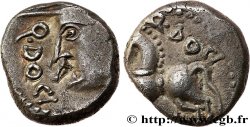
bga_293650 - GALLIA BELGICA - SEQUANI (Area of Besançon) Obole à la croix, MASO tête à droite, type du coin d’Arbois

Not available.
Item sold on our e-shop (2023)
Price : 145.00 €
Item sold on our e-shop (2023)
Price : 145.00 €
Type : Obole à la croix, MASO tête à droite, type du coin d’Arbois
Date: c. 80-50 AC.
Metal : silver
Diameter : 9,5 mm
Orientation dies : 3 h.
Weight : 0,55 g.
Rarity : R2
Coments on the condition:
Monnaie stylisée, sur un flan court, avec une frappe centrée mais un peu défectueuse. Patine sombre et cristallisée
Catalogue references :
Obverse
Obverse legend : ANÉPIGRAPHE.
Obverse description : Tête stylisée à droite, la chevelure formée par des esses ; grènetis.
Reverse
Reverse legend : M/A/S/.O. (LE A EN FORME DE DELTA).
Reverse description : Croix cantonnée avec une lettre dans chaque canton ; listel.
Commentary
Avers stylisé, comme le bga_264677 de CELTIC V, mais avec la tête à droite. Avec le bga_293654, ce sont les deux premiers exemplaires que nous avons avec le Delta dans le premier canton (soit MASO).
Il existe de nombreuses variantes pour ces très rares oboles ! Le droit peut avoir une tête à droite ou à gauche, avec ou sans la croisette dans la chevelure. Le revers peut aussi présenter plusieurs combinaisons de lettres ; MASO ou MAOS.
Selon l’étude qui a été réalisée à l’occasion de la publication du coin d’Arbois, cet exemplaire avec la tête à droite et la légende MASO appartiendrait à la classe I, variante plus rare au profil à droite, mais avec la légende MASO et non pas MAOS comme c’est le cas sur le coin.
L’attribution à l’Est de la France, autour du Jura est probable au vu de récentes découvertes. Il semble qu’il y ait eu des confusions entre les monnaies de ce type, et les imitations de Marseille épigraphes MSAO, émises dans la vallée du Rhône ou plus précisément par les Allobroges (cf. DT. 3173).
En recherchant des références pour cette obole, on se rend compte qu’il s’agit d’un monnayage très rare et curieusement absent de la plupart des publications et des collections publiées.
Ce type semble indirectement copié sur les oboles de Marseille. Il présente aussi certaines similitudes avec les oboles à la croix des Volques Tectosages
.
Stylized obverse, like bga_264677 of CELTIC V, but with the head on the right. With the bga_293654, these are the first two examples that we have with the Delta in the first canton (i.e. MASO).
There are many variations of these very rare obols! The obol can have a head on the right or left, with or without the cross in the hair.. The reverse can also present several combinations of letters; MASO or MAOS.
According to the study carried out on the occasion of the publication of the Arbois die, this specimen with the head on the right and the legend MASO would belong to class I, a rarer variant with the profile on the right, but with the legend MASO and not MAOS as is the case on the die..
The attribution to the East of France, around the Jura, is probable in view of recent discoveries.. It seems that there was confusion between coins of this type and the imitations of Marseille epigraphs MSAO, issued in the Rhone valley or more precisely by the Allobroges (cf.. DT. 3173).
When researching references for this obol, one realizes that it is a very rare coinage and curiously absent from most published publications and collections..
This type seems to be indirectly copied from the Marseille obolus. It also has some similarities with the cross obols of the Volques Tectosages
Il existe de nombreuses variantes pour ces très rares oboles ! Le droit peut avoir une tête à droite ou à gauche, avec ou sans la croisette dans la chevelure. Le revers peut aussi présenter plusieurs combinaisons de lettres ; MASO ou MAOS.
Selon l’étude qui a été réalisée à l’occasion de la publication du coin d’Arbois, cet exemplaire avec la tête à droite et la légende MASO appartiendrait à la classe I, variante plus rare au profil à droite, mais avec la légende MASO et non pas MAOS comme c’est le cas sur le coin.
L’attribution à l’Est de la France, autour du Jura est probable au vu de récentes découvertes. Il semble qu’il y ait eu des confusions entre les monnaies de ce type, et les imitations de Marseille épigraphes MSAO, émises dans la vallée du Rhône ou plus précisément par les Allobroges (cf. DT. 3173).
En recherchant des références pour cette obole, on se rend compte qu’il s’agit d’un monnayage très rare et curieusement absent de la plupart des publications et des collections publiées.
Ce type semble indirectement copié sur les oboles de Marseille. Il présente aussi certaines similitudes avec les oboles à la croix des Volques Tectosages
.
Stylized obverse, like bga_264677 of CELTIC V, but with the head on the right. With the bga_293654, these are the first two examples that we have with the Delta in the first canton (i.e. MASO).
There are many variations of these very rare obols! The obol can have a head on the right or left, with or without the cross in the hair.. The reverse can also present several combinations of letters; MASO or MAOS.
According to the study carried out on the occasion of the publication of the Arbois die, this specimen with the head on the right and the legend MASO would belong to class I, a rarer variant with the profile on the right, but with the legend MASO and not MAOS as is the case on the die..
The attribution to the East of France, around the Jura, is probable in view of recent discoveries.. It seems that there was confusion between coins of this type and the imitations of Marseille epigraphs MSAO, issued in the Rhone valley or more precisely by the Allobroges (cf.. DT. 3173).
When researching references for this obol, one realizes that it is a very rare coinage and curiously absent from most published publications and collections..
This type seems to be indirectly copied from the Marseille obolus. It also has some similarities with the cross obols of the Volques Tectosages
Historical background
GALLIA BELGICA - SEQUANI (Area of Besançon)
(2nd - 1st century BC)
The Séquanes were one of the most important peoples of eastern Gaul. They were the enemies of the Aedui, their neighbors. Their territory was very vast and extended between the Saône, the Rhône, the Jura and the Vosges. The Jura lakes separated them from the Helvetians. They had been very powerful in the 3rd and 2nd centuries BC, but had lost their luster after the Germans had occupied part of their territory around 70 BC. Their neighbors were the Leuques, the Lingones, Aedui and Helvetians. Their principal oppidum was Vesontio (Besançon). Mentioned several times by Caesar, during the campaign of 52 BC, they provided a contingent of 12,000 men for the relief army. Caesar (BG. I, 1-3, 6, 8-10, 12, 19, 31-33, 35, 38, 40, 44, 48, 54; IV, 10; VI, 12; VII, 66, 67, 75, 90). Kruta: 16, 71, 111, 364.
 Report a mistake
 Print the page
 Share my selection
 Ask a question
 Consign / sell
Related articles
 Full data


Your Recently Viewed Items
GUINEA-BISSAU 50 Centavos monnayage colonial Portugais 1952 Llantrisant AU
6.00 €
cgbfr.com numismatists


