


E-auction 411-323534 - fme_371446 - SECOND EMPIRE Médaille, Musée national de Picardie
You must signin and be an approved bidder to bid, LOGIN TO BID. Accounts are subject to approval and the approval process takes place within 48 hours. Do not wait until the day a sale closes to register. Clicking on « bid » constitutes acceptance of the terms of use of cgb.fr private e-auctions.
Bids must be placed in whole Euro amounts only. The sale will start closing at the time stated on the item description; any bids received at the site after the closing time will not be executed. Transmission times may vary and bids could be rejected if you wait until the last second. For further information ckeck the E-auctions F.A.Q.
NO BUYER'S FEE.
NO BUYER'S FEE.
| Estimate : | 160 € |
| Price : | 72 € |
| Maximum bid : | 138 € |
| End of the sale : | 01 March 2021 18:35:30 |
| bidders : | 9 bidders |
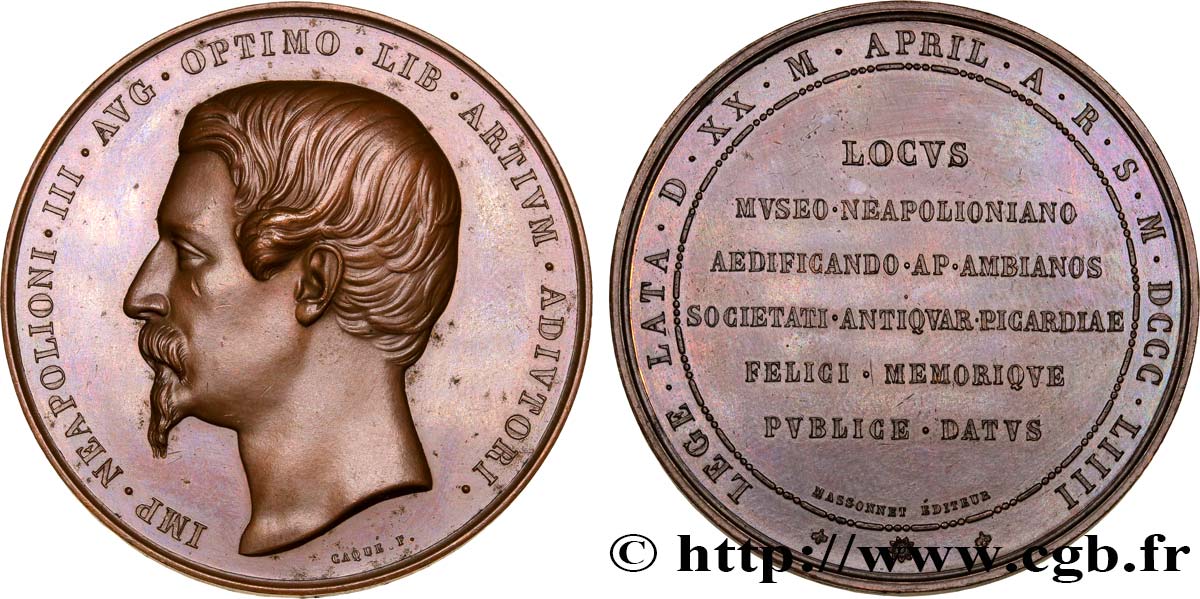
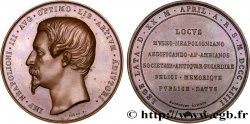
Type : Médaille, Musée national de Picardie
Date: 1870
Mint name / Town : 80 - Amiens
Metal : copper
Diameter : 52 mm
Orientation dies : 12 h.
Engraver CAQUÉ Armand Auguste (1795-1881)
Weight : 70 g.
Edge : lisse + main CUIVRE
Puncheon : main indicatrice (1845-1860) et CUIVRE
Coments on the condition:
Superbe médaille avec un très beau portrait au droit. Fine patine brune, bien homogène. Traces de manipulation
Obverse
Obverse legend : IMP. NAPOLIONI. III. AVG. OPTIMO. LIB. ARTIBVM. ADIVTORI..
Obverse description : Tête nue à gauche ; signé au-dessous CAQUE F..
Reverse
Reverse legend : LEGE. LATA D. XX. M. APRIL. A. R. S. M. DCCC. LIIII // LOCVS / MVSEO. NEAPOLIONIANO / AEDIFICANDO. AP. AMBIANOS / SOCIETATI. ANTIQVAR. PICARDIAE / FELICI. MEMOIQVE / PVBLICE. DATVS.
Reverse description : Légende en six lignes, signé : MASSONET EDITEUR.
Commentary
Le musée de Picardie est un musée d'art et d'archéologie situé à Amiens, en France. Il regroupe de riches collections qui vont de la Préhistoire au XXe siècle, notamment en archéologie et en peinture. Il a reçu le label « musée de France ».
Le musée fut créé en 1802 sous le nom « musée Napoléon », en référence à l'empereur Napoléon Ier, considéré comme le « fondateur » du musée, après qu'il eut envoyé une série de tableaux à l'occasion de la signature de la paix d'Amiens.
Le bâtiment actuel du musée fut construit entre 1855 et 1867 sur les plans des architectes Henri Parent et Arthur Diet qui prirent modèle sur l'agrandissement du Palais du Louvre de Napoléon III. Véritable palais, le bâtiment a été spécifiquement conçu - ce qui, à l'époque, était une véritable innovation - pour être un musée accueillant les collections régionales d'antiquités et des œuvres d'art. C'est aussi un bâtiment à la gloire de la Picardie et à ses hommes illustres. Sur les médaillons de la façade sont sculptés les portraits d'Antoine Parmentier, Jean de La Fontaine, Robert de Luzarches… Sur le plafond peint du grand salon on peut voir Jeanne Hachette, Pierre l'Ermite, Jean Racine…
Il est l'un des premiers établissements modernes de ce type bâti en France et servit de modèle pour d'autres villes. L'édifice a été créé grâce à l'action militante de la Société des antiquaires de Picardie, soucieuse de doter la cité d'un équipement propre à accueillir les objets récoltés depuis des décennies..
The Museum of Picardy is an art and archaeology museum located in Amiens, France.. It brings together rich collections ranging from prehistory to the 20th century, particularly in archaeology and painting.. It has received the “Musée de France” label..
The museum was founded in 1802 under the name \\\"Musée Napoléon\\\", in reference to Emperor Napoleon I, considered the \\\"founder\\\" of the museum, after he sent a series of paintings on the occasion of the signing of the Peace of Amiens..
The current museum building was built between 1855 and 1867 to the plans of architects Henri Parent and Arthur Diet, who modeled it on the expansion of the Louvre Palace by Napoleon III.. A true palace, the building was specifically designed - which, at the time, was a real innovation - to be a museum housing regional collections of antiquities and works of art.. It is also a building to the glory of Picardy and its illustrious men.. On the medallions of the facade are sculpted portraits of Antoine Parmentier, Jean de La Fontaine, Robert de Luzarches… On the painted ceiling of the great hall one can see Jeanne Hachette, Pierre l'Ermite, Jean Racine… It is one of the first modern establishments of this type built in France and served as a model for other towns. The building was created thanks to the militant action of the Société des antiquaires de Picardie, keen to provide the city with facilities capable of housing the objects collected over the decades..
Le musée fut créé en 1802 sous le nom « musée Napoléon », en référence à l'empereur Napoléon Ier, considéré comme le « fondateur » du musée, après qu'il eut envoyé une série de tableaux à l'occasion de la signature de la paix d'Amiens.
Le bâtiment actuel du musée fut construit entre 1855 et 1867 sur les plans des architectes Henri Parent et Arthur Diet qui prirent modèle sur l'agrandissement du Palais du Louvre de Napoléon III. Véritable palais, le bâtiment a été spécifiquement conçu - ce qui, à l'époque, était une véritable innovation - pour être un musée accueillant les collections régionales d'antiquités et des œuvres d'art. C'est aussi un bâtiment à la gloire de la Picardie et à ses hommes illustres. Sur les médaillons de la façade sont sculptés les portraits d'Antoine Parmentier, Jean de La Fontaine, Robert de Luzarches… Sur le plafond peint du grand salon on peut voir Jeanne Hachette, Pierre l'Ermite, Jean Racine…
Il est l'un des premiers établissements modernes de ce type bâti en France et servit de modèle pour d'autres villes. L'édifice a été créé grâce à l'action militante de la Société des antiquaires de Picardie, soucieuse de doter la cité d'un équipement propre à accueillir les objets récoltés depuis des décennies..
The Museum of Picardy is an art and archaeology museum located in Amiens, France.. It brings together rich collections ranging from prehistory to the 20th century, particularly in archaeology and painting.. It has received the “Musée de France” label..
The museum was founded in 1802 under the name \\\"Musée Napoléon\\\", in reference to Emperor Napoleon I, considered the \\\"founder\\\" of the museum, after he sent a series of paintings on the occasion of the signing of the Peace of Amiens..
The current museum building was built between 1855 and 1867 to the plans of architects Henri Parent and Arthur Diet, who modeled it on the expansion of the Louvre Palace by Napoleon III.. A true palace, the building was specifically designed - which, at the time, was a real innovation - to be a museum housing regional collections of antiquities and works of art.. It is also a building to the glory of Picardy and its illustrious men.. On the medallions of the facade are sculpted portraits of Antoine Parmentier, Jean de La Fontaine, Robert de Luzarches… On the painted ceiling of the great hall one can see Jeanne Hachette, Pierre l'Ermite, Jean Racine… It is one of the first modern establishments of this type built in France and served as a model for other towns. The building was created thanks to the militant action of the Société des antiquaires de Picardie, keen to provide the city with facilities capable of housing the objects collected over the decades..
Historical background
SECOND EMPIRE
(02/12/1852-04/09/1870)
Proclaimed Emperor under the name of Napoleon III, Louis Napoleon made his solemn entry into Paris on December 2, 1852.. He married Eugénie Marie de Montijo, a Spanish aristocrat, in January 1853. His reign can be divided into three periods: the authoritarian Empire until 1860; the Liberal Empire from 1860 to 1870 then the Parliamentary Empire in 1870. During the authoritarian Empire, Napoleon III exercised his power without sharing, controlled the press while the newspapers practiced self-censorship to avoid their suppression.. The prefects exercise unlimited power in the departments, the mayors, the civil servants are appointed by the government. As under the First Empire, Education and the University are monitored. Maintaining the main principles of the revolution, the sovereignty of the people is continued thanks to the consultation by plebiscite. On the economic level, the boom is important, industrialization develops as well as credit organizations and department stores. Military prestige is increased by the Crimean War which allows France to play an international role. The attack of Orsini (January 1858) does not prevent France from intervening in Italy to make triumph the principle of nationalities and allows the attachment of Nice and Savoy by the treaty of Turin (March 1860). From 1860, the Empire moved towards more freedoms: free trade treaty with England, appearance of a weak opposition in the Legislative Body, granting of the right to strike (1864), liberalization of the press (1868). On the international level, France acquires New Caledonia, Cochinchina and encourages the digging of the Suez Canal by Ferdinand de Lesseps. In Mexico, however, support for Maximilian and Austria was a failure. The 1869 elections were very bad for the regime and the opposition obtained 45% of the votes. The regime then evolved towards a parliamentary Empire by calling Émile Ollivier, leader of the Orléanist and liberal party, to power. After Sadowa in 1866 when Prussia crushed Austria, the affair of the throne of Spain and the dispatch from Ems led to the war which was declared on July 19, 1870. Accumulating setbacks, the French army was surrounded in Metz then Napoleon III, ill, capitulated at Sedan on September 2. As soon as the news was known, the decline of the Empire was announced by Gambetta, then the Republic was proclaimed on September 4.. Napoleon III was then taken captive to Hesse and then left for Kent where he died in 1873..
 Report a mistake
 Print the page
 Share my selection
 Ask a question
 Consign / sell
Related articles
 Full data



Your Recently Viewed Items
1000 Francs MALI 1960 P.09 UNC-
750.00 €

GALLIA - RHONE VALLEY Denier au cavalier DVRNACOS / AVSCRO AU
180.00 €

FINLAND 5 Euro ÉTÉ 2013 MS
9.00 €

25 centimes Lindauer 1933 F.171/17 AU
1.00 €
SECOND EMPIRE Médaille, Musée national de Picardie AU
72.00 €

SECOND EMPIRE Médaille, Napoléon III, exposition universelle AU
100.00 €
cgbfr.com numismatists


