


E-auction 574-521099 - fme_593265 - SECOND EMPIRE Médaille de visite - Chambre de commerce
You must signin and be an approved bidder to bid, LOGIN TO BID. Accounts are subject to approval and the approval process takes place within 48 hours. Do not wait until the day a sale closes to register. Clicking on « bid » constitutes acceptance of the terms of use of cgb.fr private e-auctions.
Bids must be placed in whole Euro amounts only. The sale will start closing at the time stated on the item description; any bids received at the site after the closing time will not be executed. Transmission times may vary and bids could be rejected if you wait until the last second. For further information ckeck the E-auctions F.A.Q.
NO BUYER'S FEE.
NO BUYER'S FEE.
| Estimate : | 60 € |
| Price : | 22 € |
| Maximum bid : | 31 € |
| End of the sale : | 15 April 2024 20:34:20 |
| bidders : | 3 bidders |
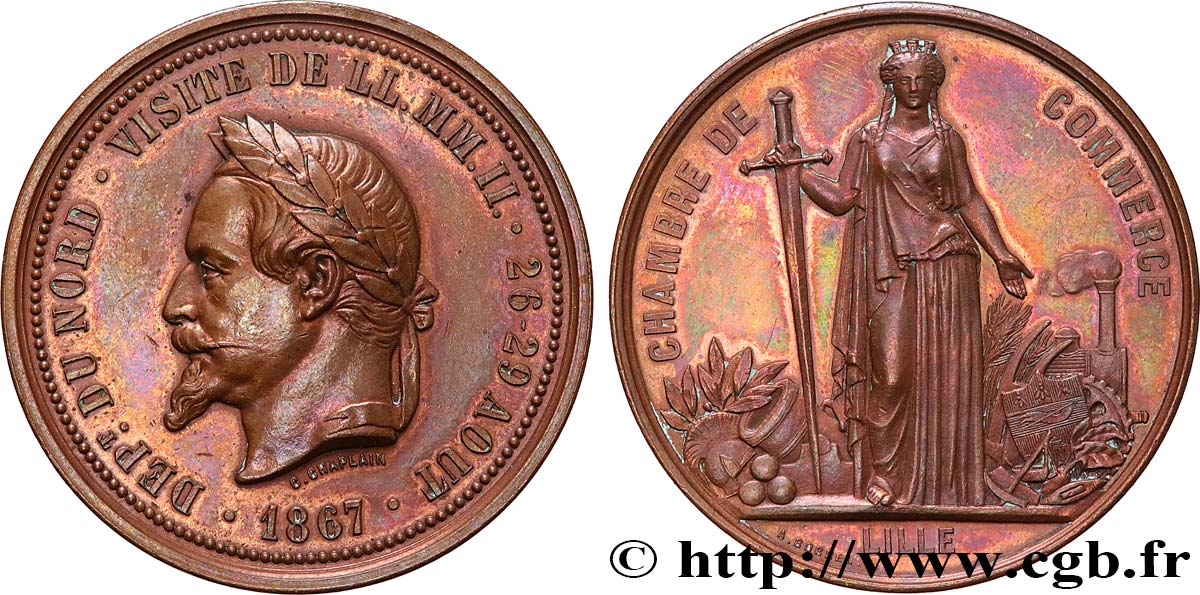
Type : Médaille de visite - Chambre de commerce
Date: 1867
Mint name / Town : 59 - Lille
Metal : copper
Diameter : 36,5 mm
Orientation dies : 12 h.
Engraver BORREL Alfred (1836-1927)
Weight : 20,4 g.
Edge : lisse + abeille CUIVRE
Puncheon : Abeille CUIVRE
Coments on the condition:
Patine hétérogène, irisée au revers, et avec du rouge de frappe autour des reliefs. La médaille présente des marques d’usure et quelques coups
Catalogue references :
Obverse
Obverse legend : DEPT. DU NORD. VISITE DE LL. MM. II. 26-29 AOÛT. / 1867.
Obverse description : Tête laurée de Napoléon III à gauche; signé : C. CHAPLAIN.
Reverse
Reverse legend : CHAMBRE DE - COMMERCE // LILLE.
Reverse description : Allégorie féminine de la ville de Lille tenant une épée devant un décor de casque grec, mortier et boulets, armoiries, blé et charrue, locomotive et matériel de mineur; signé : A. BORREL.
Commentary
Cet exemplaire est conservé dans une boîte cartonnée rouge à feutrine bleue.
Jules Clément Chaplain est un médailliste parisien né à Mortagne en 1839, mort en 1909. Il a étudié auprès du graveur Eugène Oudiné et est allé à l’école des Beaux Arts en 1857. Il obtient en 1860 le second prix de Rome, puis le premier prix en 1863. Il continua ses études en Italie jusqu’en 1868. Il reçoit la légion d’honneur en 1878 et officier en 1888. Il signe les 5, 10 et 20 Francs coq Marianne.
Il est intéressant de noter que le graveur Jules Clément Chaplain signe C. CHAPLAIN au droit alors qu’il signera par la suite J. CHAPLAIN, J. C. CHAPLAIN et J. C. C.
Alfred Borrel, médailliste, fils de Valentin Maurice Borrel, est né en 1836 à Paris et mort en 1927. Il est élève des Beaux Arts en 1856 et gagne le second Grand Prix de Rome en 1860.
Sources : Forrer L., Biographical dictionary of medaillist.
This example is preserved in a red cardboard box with blue felt. Jules Clément Chaplain was a Parisian medalist born in Mortagne in 1839 and died in 1909. He studied with the engraver Eugène Oudiné and attended the École des Beaux-Arts in 1857. He was awarded the second Prix de Rome in 1860, then the first prize in 1863. He continued his studies in Italy until 1868. He received the Legion of Honour in 1878 and an officer in 1888. He signed the 5, 10 and 20 Francs rooster Marianne. It is interesting to note that the engraver Jules Clément Chaplain signs C. CHAPLAIN on the obverse while he will subsequently sign J. CHAPLAIN, JC CHAPLAIN and JCC Alfred Borrel, medallist, son of Valentin Maurice Borrel, was born in 1836 in Paris and died in 1927. He was a student of the Beaux Arts in 1856 and won the second Grand Prix de Rome in 1860. Sources: Forrer L., Biographical dictionary of medallist
Jules Clément Chaplain est un médailliste parisien né à Mortagne en 1839, mort en 1909. Il a étudié auprès du graveur Eugène Oudiné et est allé à l’école des Beaux Arts en 1857. Il obtient en 1860 le second prix de Rome, puis le premier prix en 1863. Il continua ses études en Italie jusqu’en 1868. Il reçoit la légion d’honneur en 1878 et officier en 1888. Il signe les 5, 10 et 20 Francs coq Marianne.
Il est intéressant de noter que le graveur Jules Clément Chaplain signe C. CHAPLAIN au droit alors qu’il signera par la suite J. CHAPLAIN, J. C. CHAPLAIN et J. C. C.
Alfred Borrel, médailliste, fils de Valentin Maurice Borrel, est né en 1836 à Paris et mort en 1927. Il est élève des Beaux Arts en 1856 et gagne le second Grand Prix de Rome en 1860.
Sources : Forrer L., Biographical dictionary of medaillist.
This example is preserved in a red cardboard box with blue felt. Jules Clément Chaplain was a Parisian medalist born in Mortagne in 1839 and died in 1909. He studied with the engraver Eugène Oudiné and attended the École des Beaux-Arts in 1857. He was awarded the second Prix de Rome in 1860, then the first prize in 1863. He continued his studies in Italy until 1868. He received the Legion of Honour in 1878 and an officer in 1888. He signed the 5, 10 and 20 Francs rooster Marianne. It is interesting to note that the engraver Jules Clément Chaplain signs C. CHAPLAIN on the obverse while he will subsequently sign J. CHAPLAIN, JC CHAPLAIN and JCC Alfred Borrel, medallist, son of Valentin Maurice Borrel, was born in 1836 in Paris and died in 1927. He was a student of the Beaux Arts in 1856 and won the second Grand Prix de Rome in 1860. Sources: Forrer L., Biographical dictionary of medallist
Historical background
SECOND EMPIRE
(02/12/1852-04/09/1870)
Proclaimed Emperor under the name of Napoleon III, Louis Napoleon made his solemn entry into Paris on December 2, 1852.. He married Eugénie Marie de Montijo, a Spanish aristocrat, in January 1853. His reign can be divided into three periods: the authoritarian Empire until 1860; the Liberal Empire from 1860 to 1870 then the Parliamentary Empire in 1870. During the authoritarian Empire, Napoleon III exercised his power without sharing, controlled the press while the newspapers practiced self-censorship to avoid their suppression.. The prefects exercise unlimited power in the departments, the mayors, the civil servants are appointed by the government. As under the First Empire, Education and the University are monitored. Maintaining the main principles of the revolution, the sovereignty of the people is continued thanks to the consultation by plebiscite. On the economic level, the boom is important, industrialization develops as well as credit organizations and department stores. Military prestige is increased by the Crimean War which allows France to play an international role. The attack of Orsini (January 1858) does not prevent France from intervening in Italy to make triumph the principle of nationalities and allows the attachment of Nice and Savoy by the treaty of Turin (March 1860). From 1860, the Empire moved towards more freedoms: free trade treaty with England, appearance of a weak opposition in the Legislative Body, granting of the right to strike (1864), liberalization of the press (1868). On the international level, France acquires New Caledonia, Cochinchina and encourages the digging of the Suez Canal by Ferdinand de Lesseps. In Mexico, however, support for Maximilian and Austria was a failure. The 1869 elections were very bad for the regime and the opposition obtained 45% of the votes. The regime then evolved towards a parliamentary Empire by calling Émile Ollivier, leader of the Orléanist and liberal party, to power. After Sadowa in 1866 when Prussia crushed Austria, the affair of the throne of Spain and the dispatch from Ems led to the war which was declared on July 19, 1870. Accumulating setbacks, the French army was surrounded in Metz then Napoleon III, ill, capitulated at Sedan on September 2. As soon as the news was known, the decline of the Empire was announced by Gambetta, then the Republic was proclaimed on September 4.. Napoleon III was then taken captive to Hesse and then left for Kent where he died in 1873..
 Report a mistake
 Print the page
 Share my selection
 Ask a question
 Consign / sell
Related articles

 Full data

Your Recently Viewed Items
200 Rials IRAN 1979 P.113c UNC
35.00 €
LICINIUS I Follis ou nummus VF
75.00 €
Essai de 25 centimes Patey 1910 GEM.66 1 MS
650.00 €

SPAIN 5 Pesetas 1878 Madrid VF
28.00 €
GREECE 20 Lepta Phoenix type sans cercle 1831 VF
90.00 €

LUCILLA Dupondius, (MB, Æ 25) AU/VF
250.00 €
cgbfr.com numismatists


