


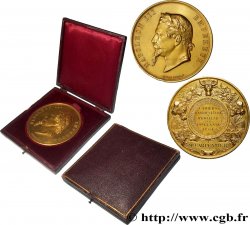
fme_593125 - SECOND EMPIRE Médaille de la victoire de Solférino

Not available.
Item sold on our e-shop (2021)
Price : 12.00 €
Item sold on our e-shop (2021)
Price : 12.00 €
Type : Médaille de la victoire de Solférino
Date: 1859
Mint name / Town : Italie, Solferino
Metal : brass
Diameter : 27,5 mm
Orientation dies : 12 h.
Weight : 4,6 g.
Edge : lisse
Coments on the condition:
Patine hétérogène. La médaille a gardé du brillant de frappe. Coup au centre au revers. Présence de quelques taches noires
Obverse
Obverse legend : NAPOLEON III - EMPEREUR / V. EMMANUEL II ROI DE SARDAIGNE.
Obverse description : Deux buste face à face dans des médaillons, encadrés de l’aigle impérial et du lion italien.
Reverse
Reverse legend : ALLIANCE FRANCO-SARDE POUR L’INDEPENDANCE DE L’ITALIE / VICTOIRE / DE SOLFERINO / GAGNÉE / LE 24 JUIN / 1859.
Reverse description : Légende en 6 lignes dans une couronne de chêne et de lauriers ; légende circulaire autour.
Commentary
Diamètre sans bélière : 23 mm
La bataille de Solférino a eu lieu le 24 juin 1859 durant la campagne d'Italie. Elle s'est déroulée en Lombardie, dans la province de Mantoue. Il s'agit d'une victoire de l'armée française de Napoléon III alliée à l'armée sarde sur l'armée autrichienne de l'empereur François-Joseph..
Diameter without bail: 23 mm The Battle of Solferino took place on June 24, 1859, during the Italian Campaign. It took place in Lombardy, in the province of Mantua. It was a victory for the French army of Napoleon III, allied with the Sardinian army, over the Austrian army of Emperor Franz Joseph.
La bataille de Solférino a eu lieu le 24 juin 1859 durant la campagne d'Italie. Elle s'est déroulée en Lombardie, dans la province de Mantoue. Il s'agit d'une victoire de l'armée française de Napoléon III alliée à l'armée sarde sur l'armée autrichienne de l'empereur François-Joseph..
Diameter without bail: 23 mm The Battle of Solferino took place on June 24, 1859, during the Italian Campaign. It took place in Lombardy, in the province of Mantua. It was a victory for the French army of Napoleon III, allied with the Sardinian army, over the Austrian army of Emperor Franz Joseph.
Historical background
SECOND EMPIRE
(02/12/1852-04/09/1870)
Proclaimed Emperor under the name of Napoleon III, Louis Napoleon made his solemn entry into Paris on December 2, 1852.. He married Eugénie Marie de Montijo, a Spanish aristocrat, in January 1853. His reign can be divided into three periods: the authoritarian Empire until 1860; the Liberal Empire from 1860 to 1870 then the Parliamentary Empire in 1870. During the authoritarian Empire, Napoleon III exercised his power without sharing, controlled the press while the newspapers practiced self-censorship to avoid their suppression.. The prefects exercise unlimited power in the departments, the mayors, the civil servants are appointed by the government. As under the First Empire, Education and the University are monitored. Maintaining the main principles of the revolution, the sovereignty of the people is continued thanks to the consultation by plebiscite. On the economic level, the boom is important, industrialization develops as well as credit organizations and department stores. Military prestige is increased by the Crimean War which allows France to play an international role. The attack of Orsini (January 1858) does not prevent France from intervening in Italy to make triumph the principle of nationalities and allows the attachment of Nice and Savoy by the treaty of Turin (March 1860). From 1860, the Empire moved towards more freedoms: free trade treaty with England, appearance of a weak opposition in the Legislative Body, granting of the right to strike (1864), liberalization of the press (1868). On the international level, France acquires New Caledonia, Cochinchina and encourages the digging of the Suez Canal by Ferdinand de Lesseps. In Mexico, however, support for Maximilian and Austria was a failure. The 1869 elections were very bad for the regime and the opposition obtained 45% of the votes. The regime then evolved towards a parliamentary Empire by calling Émile Ollivier, leader of the Orléanist and liberal party, to power. After Sadowa in 1866 when Prussia crushed Austria, the affair of the throne of Spain and the dispatch from Ems led to the war which was declared on July 19, 1870. Accumulating setbacks, the French army was surrounded in Metz then Napoleon III, ill, capitulated at Sedan on September 2. As soon as the news was known, the decline of the Empire was announced by Gambetta, then the Republic was proclaimed on September 4.. Napoleon III was then taken captive to Hesse and then left for Kent where he died in 1873..
 Report a mistake
 Print the page
 Share my selection
 Ask a question
 Consign / sell
Related articles

 Full data


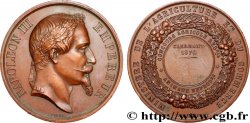
Your Recently Viewed Items
5000 Dinara Non émis YUGOSLAVIA 1950 P.067Y XF+
700.00 €
100 Rand SOUTH AFRICA 1994 P.126a UNC
60.00 €
100 Francs TAHITI 1969 P.23 UNC
165.00 €

50 Kroner NORWAY 1983 P.37d UNC
30.00 €
FRANCIS I Dizain franciscus, 1er type n.d. Bordeaux VF
40.00 €

SECOND EMPIRE Médaille de récompense, Société pour l’instruction élément
5.00 €
cgbfr.com numismatists


