


fme_933876 - PREMIER EMPIRE / FIRST FRENCH EMPIRE Médaille, Bataille de Somosierra, refrappe

Not available.
Item sold on our e-shop (2025)
Price : 30.00 €
Item sold on our e-shop (2025)
Price : 30.00 €
Type : Médaille, Bataille de Somosierra, refrappe
Date: (1808)
Metal : bronze
Diameter : 41 mm
Orientation dies : 12 h.
Engraver DEPAULIS Alexis-Joseph (1790-1867) / BRENET Nicolas-Guy-Antoine (1773-1846)
Weight : 36,85 g.
Edge : lisse + corne BRONZE
Puncheon : corne BRONZE
Coments on the condition:
Patine hétérogène avec des traces d’usure, coups, notamment sur la tranche et rayures
Obverse
Obverse legend : NAPOLÉON EMP. ET ROI.
Obverse description : Tête laurée de profil à droite.
Reverse
Reverse legend : À L’EXERGUE : BATAILLE DE SOMMO SIERRA / LINQUISITION DETRUITE / MDCCCVIII.
Reverse description : Cosaque et cavalier fuyant devant l’armée française, en arrière-plan champ de bataille. Signé : BRENET.
Commentary
Refrappe moderne (poinçon corne assez mal venu).
La bataille de Lützen, aussi appelée par les historiens allemands bataille de Großgörschen, a lieu le 2 mai 1813, lors du retour de l’armée napoléonienne après le désastre de la campagne de Russie. Wittgenstein attaque une colonne avancée de Napoléon près de Lützen, afin de reprendre la ville de Leipzig. Après une journée de combats intenses, les forces prussiennes et russes battent en retraite. L’absence de cavalerie empêche les Français de les poursuivre.
Modern re-striking (horn mark rather inappropriate). The Battle of Lützen, also called by German historians the Battle of Großgörschen, took place on May 2, 1813, during the return of the Napoleonic army after the disastrous Russian campaign. Wittgenstein attacked an advanced column of Napoleon near Lützen, in order to retake the city of Leipzig. After a day of intense fighting, the Prussian and Russian forces retreated. The lack of cavalry prevented the French from pursuing them.
La bataille de Lützen, aussi appelée par les historiens allemands bataille de Großgörschen, a lieu le 2 mai 1813, lors du retour de l’armée napoléonienne après le désastre de la campagne de Russie. Wittgenstein attaque une colonne avancée de Napoléon près de Lützen, afin de reprendre la ville de Leipzig. Après une journée de combats intenses, les forces prussiennes et russes battent en retraite. L’absence de cavalerie empêche les Français de les poursuivre.
Modern re-striking (horn mark rather inappropriate). The Battle of Lützen, also called by German historians the Battle of Großgörschen, took place on May 2, 1813, during the return of the Napoleonic army after the disastrous Russian campaign. Wittgenstein attacked an advanced column of Napoleon near Lützen, in order to retake the city of Leipzig. After a day of intense fighting, the Prussian and Russian forces retreated. The lack of cavalry prevented the French from pursuing them.
Historical background
PREMIER EMPIRE / FIRST FRENCH EMPIRE
(18/05/1804-6/04/1814)
Reinforced by the Cadoudal conspiracy of March 1804, the idea of hereditary power found its culmination on May 18, 1804 when Napoleon Bonaparte became Emperor of the French under the name of Napoleon I.. Ratified by plebiscite, the Empire was consecrated on December 2, 1804 during the coronation of Notre-Dame. With the Constitution of Year XII still in effect, the First Empire seems to function as a continuation of the French Republic led by an emperor. It is actually a personal dictatorship where the emperor appoints and dismisses ministers, initiates laws and controls the Legislative Body.. In the departments, the prefects inform the Ministry of the Interior. The posts, the press, the printing press are controlled by censorship. The great bodies of the State are reorganized as well as Justice with the Penal Code which completes the Civil Code completed under the Consulate. Universities and schools are supervised. In 1805, Napoleon became King of Italy while coalitions formed against the Empire. Despite the naval defeat of Trafalgar, the imperial armies won many land victories such as Austerlitz, Jena or Eylau which ensured control of continental Europe. Dismembered, it is attributed to the Bonaparte family which seems to triumph everywhere. Fortified by the continental blockade, industry is prosperous but trade suffers. In 1808, the continental blockade was reinforced by a second decree issued in Milan on December 17, 1807.. The war in Spain begins after Junot conquers Portugal, which refuses to apply the blockade. Quickly, the people of Madrid rise up against the French occupation of Murat. On May 1 and 2, the French fiercely repress guerrilla movements. Mass executions take place. They are immortalized by Goya in his famous Primer y Dos de Mayo. Joseph, King of Naples, is reluctantly appointed King of Spain. Murat replaces him on the throne of Naples with his wife Caroline. Despite the forced abdications of Charles IV and Ferdinand VII in Bayonne, in the presence of Napoleon, the French witness a general uprising in Spain and are beaten in Bailen on July 22: they lose Madrid. Wellington and an English expeditionary force land in Portugal on August 1. Junot must capitulate at Cintra on August 30. The French retake Madrid on December 4, 1808.. In April 1809, Pius VII excommunicated Napoleon who had him sequestered in retaliation. The allies form the fifth coalition, but the Austrians are defeated at Eckmühl on April 12, Essling on May 21 and Wagram on July 6, 1809. At the Treaty of Vienna, Austria cedes Carniola, Carinthia and Croatia which will form the Illyrian provinces which are incorporated into the Empire. The Vendôme column was inaugurated in 1810. That year, Napoleon was at the height of his power and France had 130 departments from the Tiber to the Elbe.. After divorcing Josephine in December 1809, he married Marie-Louise of Austria on April 2, 1810. Louis abdicated from the throne of Holland on July 9, 1810, refusing to apply the Continental Blockade and the Kingdom was annexed to France. In 1811, the Emperor, who had his marriage with Joséphine dissolved, married Archduchess Marie-Louise, who gave him a son, the King of Rome, who was born in the Tuileries on March 20, 1811.. Franco-Russian relations deteriorated after Austrian marriage. Finally, Napoleon crossed the Niemen on June 24, 1812. This is the beginning of the Russian campaign. At the head of the Grande Armée, he took Vilna (June 28), won the victory of Smolensk (August 18), then the difficult battle of the Moscova (September 5-7). He takes Moscow between September 15 and 18. The city is set on fire by the Russians and the French must evacuate it. The Grande Armée is forced to retreat with the Russian winter starting very early and an enemy practicing a scorched earth policy. It is the battle of Berezina on November 27-29, 1812. Over 600. 000 men, less than 30. 000 crossed the Russian border. General Malet attempts a coup in Paris on October 23. He was shot on the 29th. The Russians occupy Warsaw, Hamburg and Dresden. The Prussians win the victories of Lutzen and Bautzen on May 2 and 21, 1813. All of Europe leagued against Napoleon during the sixth coalition and he was defeated in the Battle of Nations on October 16-19, 1813. The French campaign begins in January 1814. Despite the victories of Montmirail and Montereau on February 10 and 18, Napoleon could not prevent the capitulation of Paris on March 31. He was forced to abdicate on April 6, 1814 and left for the island of Elba..
 Report a mistake
 Print the page
 Share my selection
 Ask a question
 Consign / sell
Related articles

 Full data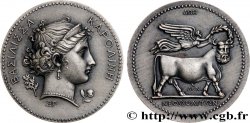


Your Recently Viewed Items
ARCADIA - ACHAEAN LEAGUE - ANTIGONEIA (MANTINEIA) Hemidrachme XF
120.00 €

ACHAIA - ACHAEAN LEAGUE - PATRAS (PATRA) Hemidrachme AU
200.00 €
VATICAN SÉRIE Euro BRILLANT UNIVERSEL 2010 Brilliant Uncirculated
90.00 €
2 décimes Dupré 1796 Paris F.145/1 AU53 PCGS
450.00 €
SCIENCE & SCIENTIFIC Médaille, Albert Schweitzer, lot de 2 ex. XF
40.00 €

INSURANCES Médaille de récompense, Société des agriculteurs AU
53.00 €
cgbfr.com numismatists


