


Live auction - brm_1144287 - POMPONIA Denier

You must signin and be an approved bidder to bid, LOGIN TO BID. Accounts are subject to approval and the approval process takes place within 48 hours. Do not wait until the day a sale closes to register. Clicking on "BID" constitutes acceptance of the terms of use of cgb.fr private live auctions.
Bids must be placed in whole Euro amounts only. The sale will start closing at the time stated on the item description; any bids received at the site after the closing time will not be executed. Transmission times may vary and bids could be rejected if you wait until the last second. For further information check the Live auction FAQ
All winning bids are subject to a 18% buyer’s fee.
All winning bids are subject to a 18% buyer’s fee.
| Estimate : | 950 € |
| Price : | 958 € |
| Maximum bid : | 958 € |
| End of the sale : | 22 September 2026 14:33:25 |
| bidders : | 5 bidders |
Type : Denier
Date: 66 AC.
Mint name / Town : Roma
Metal : silver
Millesimal fineness : 950 ‰
Diameter : 19 mm
Orientation dies : 5 h.
Weight : 4,25 g.
Rarity : R3
Coments on the condition:
Monnaie légèrement décentrée au revers. Joli portrait d’Apollon, finement détaillé et bien venu à la frappe. Patine grise avec de légers reflets dorés
Catalogue references :
Obverse
Obverse legend : ANÉPIGRAPHE.
Obverse description : Tête laurée d’Apollon à droite ; derrière, une sandale (calceus).
Reverse
Reverse legend : Q. POMPONI/ MVSA.
Reverse description : Thalia (Thalie), muse de la Comédie debout à gauche, tenant un masque comique de la main droite et le bras gauche appuyé sur une colonne.
Reverse translation : “Quintus Pomponius/ Musa”, (Quintus Pomponius Musa).
Commentary
Pour ce type, M. Crawford a relevé une estimation inférieure à dix coins de droit et de onze coins de revers pour trois variétés. Ce denier est en fait infiniment plus rare que ne le laissent imaginer les ouvrages généraux. Le symbole du droit se rapporte à Thalia (muse de la Comédie) avec une sandale placée derrière la tête d’Apollon. Le calceus, chaussure typique des Romains se portait avec la toge, c’était une sorte de brodequin de cuir.
For this type, Mr. Crawford noted a lower estimate of ten obverse dies and eleven reverse dies for three varieties. This denarius is in fact infinitely rarer than general works suggest. The obverse symbol refers to Thalia (muse of Comedy) with a sandal placed behind the head of Apollo. The calceus, a typical Roman shoe worn with the toga, was a kind of leather boot.
For this type, Mr. Crawford noted a lower estimate of ten obverse dies and eleven reverse dies for three varieties. This denarius is in fact infinitely rarer than general works suggest. The obverse symbol refers to Thalia (muse of Comedy) with a sandal placed behind the head of Apollo. The calceus, a typical Roman shoe worn with the toga, was a kind of leather boot.
Historical background
POMPONIA
(66 BC)
The gens Pomponia is a plebeian family of Rome with several consuls.
 Report a mistake
 Print the page
 Share my selection
 Ask a question
 Consign / sell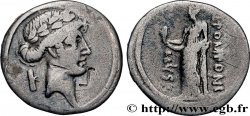
 Full data
Your Recently Viewed Items

VALENS Silique AU
160.00 €

CURTIA Denier AU
84.00 €

TRAJANUS Denier AU
211.00 €
POSTUMUS Antoninien AU
16.00 €
VESPASIAN Denier XF
75.00 €

VESPASIAN Denier XF
110.00 €
cgbfr.com numismatists


