


Live auction - fmd_1099876 - Piéfort au quadruple (ou double piéfort) du 1 franc 1832 T.T.4814 c.7
You must signin and be an approved bidder to bid, LOGIN TO BID. Accounts are subject to approval and the approval process takes place within 48 hours. Do not wait until the day a sale closes to register. Clicking on "BID" constitutes acceptance of the terms of use of cgb.fr private live auctions.
Bids must be placed in whole Euro amounts only. The sale will start closing at the time stated on the item description; any bids received at the site after the closing time will not be executed. Transmission times may vary and bids could be rejected if you wait until the last second. For further information check the Live auction FAQ
All winning bids are subject to a 18% buyer’s fee.
All winning bids are subject to a 18% buyer’s fee.
| Estimate : | 1 000 € |
| Price : | 575 € |
| Maximum bid : | 575 € |
| End of the sale : | 09 June 2026 17:46:18 |
| bidders : | 4 bidders |
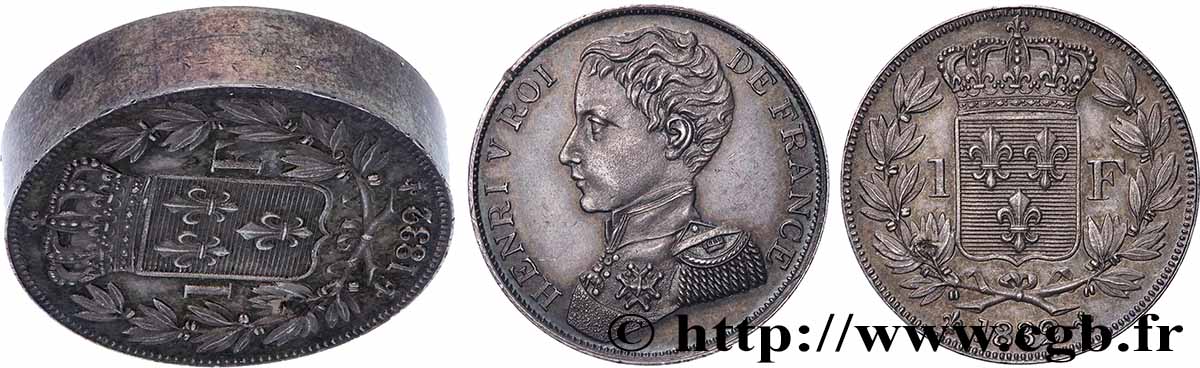
Type : Piéfort au quadruple (ou double piéfort) du 1 franc
Date: 1832
Quantity minted : ---
Metal : silver
Diameter : 23 mm
Orientation dies : 6 h.
Weight : 21,56 g.
Edge : lisse
Rarity : R3
Coments on the condition:
Présence d’un petit coup sur la tranche au-dessus du “O” de ROI au droit
Catalogue references :
Obverse
Obverse legend : HENRI V ROI - DE FRANCE.
Obverse description : Buste enfantin nu de Henri V à gauche en habit militaire.
Reverse
Reverse legend : 1 - F // (LIS) 1832 (LIS).
Reverse description : Écu de France couronné entre deux branches d'olivier.
Commentary
Il est intéressant de constater que la gamme des monnaies frappées par le prétendant royaliste légitimiste ne fait pas l’impasse sur les piéforts au double et au quadruple, vieille tradition royale. En 1832, la frappe de ces piéforts avait un sens dans ce que l’on pourrait appeler une stratégie de communication politique. On ignore bien entendu pourquoi le double est en frappe médaille et le quadruple en frappe monnaie.
It is interesting to note that the range of coins struck by the legitimist royalist pretender does not overlook the double and quadruple pieforts, an old royal tradition. In 1832, the striking of these pieforts made sense in what one could call a political communication strategy. Of course, we do not know why the double is in medal striking and the quadruple in coin striking
It is interesting to note that the range of coins struck by the legitimist royalist pretender does not overlook the double and quadruple pieforts, an old royal tradition. In 1832, the striking of these pieforts made sense in what one could call a political communication strategy. Of course, we do not know why the double is in medal striking and the quadruple in coin striking
Historical background
HENRY V COUNT OF CHAMBORD
(1820-1883)
Grandson of Charles X, Henri was born on September 29, 1820. He is the son of the Duke of Berry who was assassinated on February 13, 1820 by Louvel. On August 2, 1830, Charles X abdicated in his favour, but Henri followed his grandfather into exile in England and then in Prague. His mother, Marie-Caroline de Bourbon, tried to raise western France in 1832. Her attempt failed. In 1833, Henri V was 13 years old, he was considered to be of age. After the fall of the Empire in 1870, the Legitimists tried to impose the Restoration of the Bourbons on the throne of France. This restoration fails because Henri categorically refuses the tricolor flag, preferring the white fleur-de-lis flag..
 Report a mistake
 Print the page
 Share my selection
 Ask a question
 Consign / sell
Related articles

 Full data


Your Recently Viewed Items
50 Francs RACINE Épreuve FRANCE 1962 F.64.00E AU
494.00 €

LOUIS XV THE BELOVED Double louis d'or aux écus ovales, buste lauré 1774 Bayon
3000.00 €
LOUIS XIV THE GREAT or THE SUN KING Jeton de Jardinier ? VF
10.00 €
ORLÉANAIS - Gentry and towns Canal de Briare, méreau pour la viande XF
74.00 €

Concours de 5 francs, essai en cuivre argenté par Magniadas 1848 Paris VG.3082
250.00 €

GOLD, PALLADIUM & PLATINUM INVESTMENT 1 Souverain Georges V 1912 Londres AU
376.00 €
cgbfr.com numismatists


