


Not available.
Item sold on our e-shop
Price : 180.00 €
Item sold on our e-shop
Price : 180.00 €
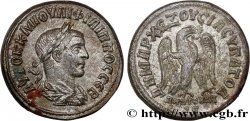
Type : Tétradrachme syro-phénicien
Date: 249
Mint name / Town : Antioche, Syrie, Séleucie et Piérie
Metal : billon
Diameter : 28,00 mm
Orientation dies : 12 h.
Weight : 11,30 g.
Coments on the condition:
Aucune usure, bonne frappe quoique légèrement décentrée au revers, coin de droit un peu mou, patine de collection
Catalogue references :
Obverse
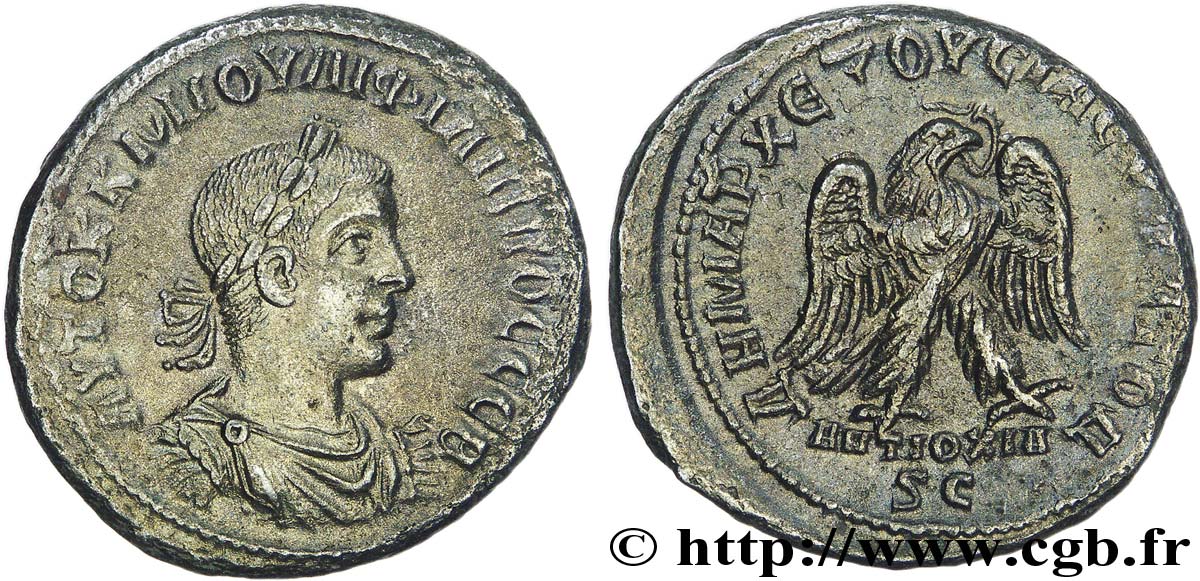
Obverse description : Buste lauré, drapé et cuirassé de Philippe II Auguste à droite, les ptéryges de l’épaule gauche visibles, vu de trois quarts en avant (A*).
Obverse legend : AUTOK K M IOUL FILIPPOS SEB, (Autokratoros Kaisaros Markos Ioulios Filippos Sebastos)
Obverse translation : (L’empereur césar Marc Jules Philippe auguste).
Reverse
Reverse legend : ANTIOXIA / S|C À L’EXERGUE.
Reverse description : Aigle debout à droite, les ailes largement déployées, tête à droite et queue à gauche, tenant une couronne feuillée dans son bec.
Reverse legend : DHMARC - EX OUSIAS UPATOD
Reverse translation : (Revêtu de la puissance tribunitienne / Consul pour la quatrième fois / avec l’accord du Sénat d’Antioche).
Commentary
Le type 467 a été dissocié en trois, 467 pour les portraits où l’on ne voit les ptéryges que sur une épaule, 467A pour ceux où les deux ptéryges sont visibles et 467B pour ceux où les deux ptéryges sont visibles et où celui de gauche est en position de “bras levé”.
Il semble y avoir corrélation entre les ptéryges indiquant le bras levé et la présence d’une forme de trabea sur l’épaule opposée. Un pointage systématique serait utile.
Notre exemplaire a des ptéryges gauches particulièrement mises en valeur.
S’il n’y a pas de frappes du 4e consulat pour Otacilie, pour une raison que nous ignorons, il en existe de nombreuses pour Philippe II, qui sont aux titulatures et titres de son père.
Il existe à Antioche de très nombreuses frappes datées d’un quatrième consulat de Philippe l’Arabe dont nous ne trouvons pas trace à Rome. Il est extrêmement regrettable que les quelques informations dont nous disposons sur le Sénat d’Antioche soient largement plus tardives (4e et 5e siècle) car les émissions de tétradrachmes laissent à penser que non seulement le Sénat d’Antioche manifestait son indépendance envers Rome en frappant de l’argent avec la titulature “SC / ANTIOXIA” mais encore qu’il avait son propre comput impérial sous Philippe.
La richesse des variantes de bustes pour des émissions de circulation à Antioche est telle que certains, Jean-Marc Doyen par exemple, ont pu considérer que l’Orient avait été, sur le plan des bustes monétaires, le laboratoire dont l’Occident va s’inspirer.
En effet, de Caracalla à Philippe, les variantes de bustes à attributs sont nombreuses et, contrairement à la pratique de Rome qui les réserve à des émissions de donativa ou de prestige, manifestement destinées à la circulation.
Ce n’est que bien plus tard, avec un décalage de trente ans, que Rome enrichira son répertoire de bustes. Persistance d’une supériorité artistique de l’Orient hellénistique sur l’Occident romain, quatre siècles après la conquête de la Grèce ? Souci de propagande exacerbé à la frontière de l’Empire, moins prégnant dans la capitale ? Influence d’empereurs sémites préoccupés de leur image de marque locale auprès de populations dont ils sont issus ? Souci oriental de la forme plus que du fond ? Graveurs libres et en concurrence à Antioche, esclaves et peu motivés à Rome ? Nous ne savons mais il n’en reste pas moins que la constatation est indiscutable.
Dès que Philippe II est proclamé auguste, il utilise toujours les titres de son père au revers mais encore adopte sa titulature de droit. Les collectionneurs débutants ont d’ailleurs des difficultés à distinguer le père du fils ; la règle est simple : le père a toujours une ride qui barre le front, le fils toujours un front lisse.
On note que les sigma sont gravés en C.
Dans la base TSP maintenue par Michel Prieur, vingt-sept exemplaires sont maintenant répertoriés pour ce type. Notre exemplaire, qui provient de la trouvaille de Syrie 1930, est le 0467A_002.
Type 467 has been split into three, 467 for portraits where the pteryges are only visible on one shoulder, 467A for those where both pteryges are visible and 467B for those where both pteryges are visible and the left one is in a “raised arm” position..
There appears to be a correlation between the pteryges indicating the raised arm and the presence of a form of trabea on the opposite shoulder. A systematic score would be useful.
Our specimen has particularly highlighted left pteryges.
If there are no strikes of the 4th consulate for Otacilia, for a reason unknown to us, there are many for Philip II, which are in the titles and titles of his father..
There are numerous coins in Antioch dated to a fourth consulate of Philip the Arab, of which we find no trace in Rome.. It is extremely regrettable that the little information we have on the Senate of Antioch is much later (4th and 5th century) because the issues of tetradrachms suggest that not only did the Senate of Antioch demonstrate its independence from Rome by minting money with the title “SC / ANTIOXIA” but also that it had its own imperial computus under Philip.
The wealth of variants of busts for circulation issues in Antioch is such that some, Jean-Marc Doyen for example, were able to consider that the East had been, in terms of monetary busts, the laboratory from which the West would draw inspiration..
Indeed, from Caracalla to Philip, the variants of busts with attributes are numerous and, contrary to the practice of Rome which reserves them for donativa or prestige issues, clearly intended for circulation.
It was only much later, with a gap of thirty years, that Rome would enrich its repertoire of busts.. Persistence of an artistic superiority of the Hellenistic East over the Roman West, four centuries after the conquest of Greece? Concern for propaganda exacerbated on the borders of the Empire, less pervasive in the capital? Influence of Semitic emperors concerned with their local brand image among the populations from which they came? Oriental concern for form more than content? Free and competing engravers in Antioch, slaves and little motivated in Rome? We do not know, but the fact remains that the observation is indisputable..
As soon as Philip II was proclaimed Augustus, he still used his father's titles on the reverse but also adopted his title by right.. Beginner collectors have difficulty distinguishing the father from the son; the rule is simple: the father always has a wrinkle across his forehead, the son always has a smooth forehead..
Note that the sigmas are engraved in C.
In the TSP database maintained by Michel Prieur, twenty-seven examples are now listed for this type. Our example, which comes from the 1930 Syrian find, is 0467A_002
Il semble y avoir corrélation entre les ptéryges indiquant le bras levé et la présence d’une forme de trabea sur l’épaule opposée. Un pointage systématique serait utile.
Notre exemplaire a des ptéryges gauches particulièrement mises en valeur.
S’il n’y a pas de frappes du 4e consulat pour Otacilie, pour une raison que nous ignorons, il en existe de nombreuses pour Philippe II, qui sont aux titulatures et titres de son père.
Il existe à Antioche de très nombreuses frappes datées d’un quatrième consulat de Philippe l’Arabe dont nous ne trouvons pas trace à Rome. Il est extrêmement regrettable que les quelques informations dont nous disposons sur le Sénat d’Antioche soient largement plus tardives (4e et 5e siècle) car les émissions de tétradrachmes laissent à penser que non seulement le Sénat d’Antioche manifestait son indépendance envers Rome en frappant de l’argent avec la titulature “SC / ANTIOXIA” mais encore qu’il avait son propre comput impérial sous Philippe.
La richesse des variantes de bustes pour des émissions de circulation à Antioche est telle que certains, Jean-Marc Doyen par exemple, ont pu considérer que l’Orient avait été, sur le plan des bustes monétaires, le laboratoire dont l’Occident va s’inspirer.
En effet, de Caracalla à Philippe, les variantes de bustes à attributs sont nombreuses et, contrairement à la pratique de Rome qui les réserve à des émissions de donativa ou de prestige, manifestement destinées à la circulation.
Ce n’est que bien plus tard, avec un décalage de trente ans, que Rome enrichira son répertoire de bustes. Persistance d’une supériorité artistique de l’Orient hellénistique sur l’Occident romain, quatre siècles après la conquête de la Grèce ? Souci de propagande exacerbé à la frontière de l’Empire, moins prégnant dans la capitale ? Influence d’empereurs sémites préoccupés de leur image de marque locale auprès de populations dont ils sont issus ? Souci oriental de la forme plus que du fond ? Graveurs libres et en concurrence à Antioche, esclaves et peu motivés à Rome ? Nous ne savons mais il n’en reste pas moins que la constatation est indiscutable.
Dès que Philippe II est proclamé auguste, il utilise toujours les titres de son père au revers mais encore adopte sa titulature de droit. Les collectionneurs débutants ont d’ailleurs des difficultés à distinguer le père du fils ; la règle est simple : le père a toujours une ride qui barre le front, le fils toujours un front lisse.
On note que les sigma sont gravés en C.
Dans la base TSP maintenue par Michel Prieur, vingt-sept exemplaires sont maintenant répertoriés pour ce type. Notre exemplaire, qui provient de la trouvaille de Syrie 1930, est le 0467A_002.
Type 467 has been split into three, 467 for portraits where the pteryges are only visible on one shoulder, 467A for those where both pteryges are visible and 467B for those where both pteryges are visible and the left one is in a “raised arm” position..
There appears to be a correlation between the pteryges indicating the raised arm and the presence of a form of trabea on the opposite shoulder. A systematic score would be useful.
Our specimen has particularly highlighted left pteryges.
If there are no strikes of the 4th consulate for Otacilia, for a reason unknown to us, there are many for Philip II, which are in the titles and titles of his father..
There are numerous coins in Antioch dated to a fourth consulate of Philip the Arab, of which we find no trace in Rome.. It is extremely regrettable that the little information we have on the Senate of Antioch is much later (4th and 5th century) because the issues of tetradrachms suggest that not only did the Senate of Antioch demonstrate its independence from Rome by minting money with the title “SC / ANTIOXIA” but also that it had its own imperial computus under Philip.
The wealth of variants of busts for circulation issues in Antioch is such that some, Jean-Marc Doyen for example, were able to consider that the East had been, in terms of monetary busts, the laboratory from which the West would draw inspiration..
Indeed, from Caracalla to Philip, the variants of busts with attributes are numerous and, contrary to the practice of Rome which reserves them for donativa or prestige issues, clearly intended for circulation.
It was only much later, with a gap of thirty years, that Rome would enrich its repertoire of busts.. Persistence of an artistic superiority of the Hellenistic East over the Roman West, four centuries after the conquest of Greece? Concern for propaganda exacerbated on the borders of the Empire, less pervasive in the capital? Influence of Semitic emperors concerned with their local brand image among the populations from which they came? Oriental concern for form more than content? Free and competing engravers in Antioch, slaves and little motivated in Rome? We do not know, but the fact remains that the observation is indisputable..
As soon as Philip II was proclaimed Augustus, he still used his father's titles on the reverse but also adopted his title by right.. Beginner collectors have difficulty distinguishing the father from the son; the rule is simple: the father always has a wrinkle across his forehead, the son always has a smooth forehead..
Note that the sigmas are engraved in C.
In the TSP database maintained by Michel Prieur, twenty-seven examples are now listed for this type. Our example, which comes from the 1930 Syrian find, is 0467A_002
Historical background
PHILIPPUS II
(05/244-09/249)
Augustus
Philip II, son of Philip the Arab and Otacilia Severa, was named Augustus in 247. He participated in the commemoration of the millennium of Rome which began on April 21, 247. Philip, his father, was killed at the battle of Verona . Philip II was assassinated shortly thereafter. We do not know what happened to Otacilia Sévéra. Philip II was made Caesar shortly after the accession of his father who awarded him the title of prince of youth.
 Report a mistake
 Print the page
 Share my selection
 Ask a question
 Consign / sell
Related articles

 Full data
Your Recently Viewed Items
50 Francs DJIBOUTI 1952 P.25 UNC-
72.00 €
50 Leva Zlatni BULGARIA 1917 P.024a VF
60.00 €

LORRAINE - DUCHY OF LORRAINE - FRANCIS I Demi-gros VF
29.00 €

1 franc Semeuse, nickel 1967 Paris F.226/12 MS65
110.00 €

GERMANY Médaille de mariage par Philipp Heinrich Müller AU
450.00 €
ALGERIA 100 Dinars 40e anniversaire de l’indépendance 2002 MS
17.00 €
cgbfr.com numismatists


