


E-auction 163-99791 - bpv_192780 - PHILIPPUS Tétradrachme syro-phénicien
You must signin and be an approved bidder to bid, LOGIN TO BID. Accounts are subject to approval and the approval process takes place within 48 hours. Do not wait until the day a sale closes to register. Clicking on « bid » constitutes acceptance of the terms of use of cgb.fr private e-auctions.
Bids must be placed in whole Euro amounts only. The sale will start closing at the time stated on the item description; any bids received at the site after the closing time will not be executed. Transmission times may vary and bids could be rejected if you wait until the last second. For further information ckeck the E-auctions F.A.Q.
NO BUYER'S FEE.
NO BUYER'S FEE.
| Estimate : | 90 € |
| Price : | 42 € |
| Maximum bid : | 42 € |
| End of the sale : | 30 May 2016 15:13:00 |
| bidders : | 9 bidders |
Type : Tétradrachme syro-phénicien
Date: 248
Mint name / Town : Antioche, Syrie, Séleucie et Piérie
Metal : billon
Diameter : 25,00 mm
Orientation dies : 12 h.
Weight : 12,44 g.
Coments on the condition:
Frappe bien centrée sur un flan régulier, très faible usure de circulation, patine grise
Catalogue references :
Predigree :
Cet exemplaire, qui provient de la trouvaille dite de Syrie 1930, est le 0368_038 de la base TSP
Obverse
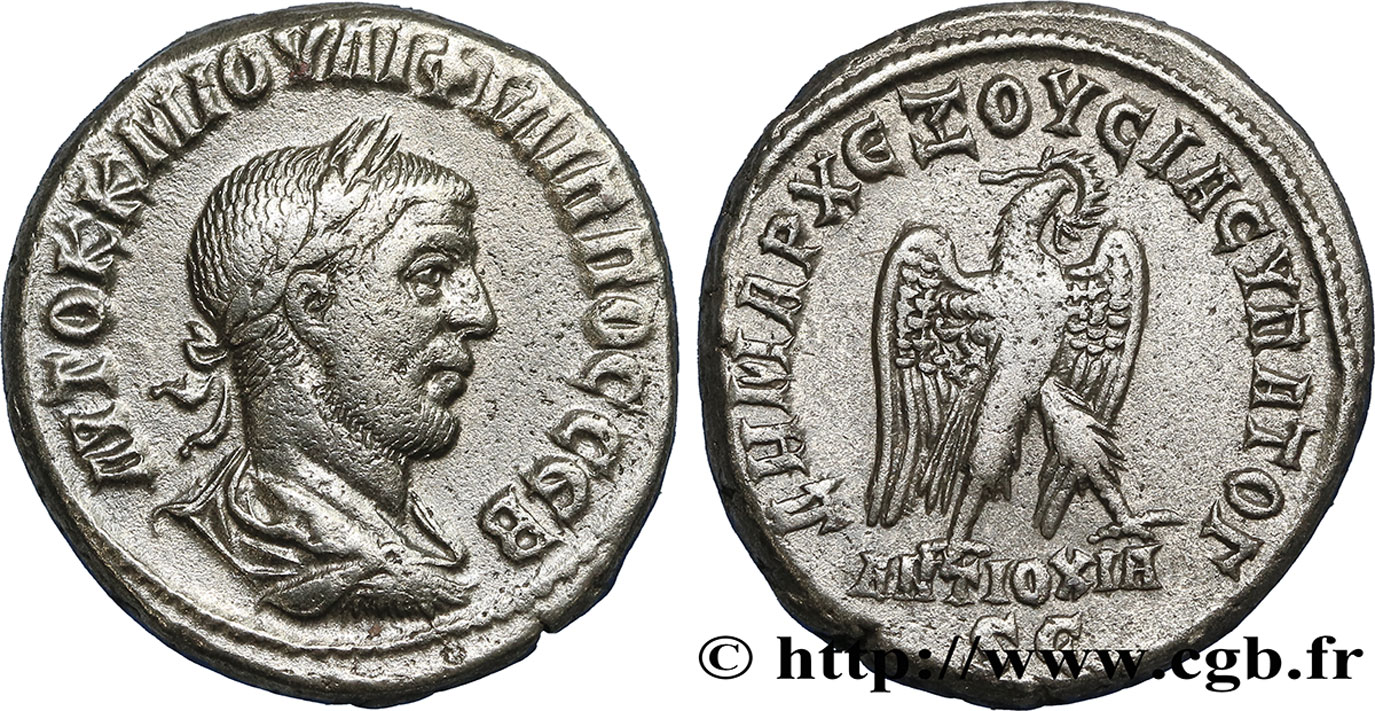
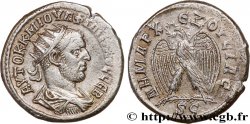
Obverse description : Buste lauré, drapé et cuirassé de Philippe Ier à droite, vu de trois quarts en arrière (A*2).
Obverse legend : AUTOK K M IOUL FILIPPOS SEB, (Autokratoros Kaisaros Markos Ioulios Filippos Sebastos)
Obverse translation : (L’empereur césar Marc Jules Philippe auguste).
Reverse
Reverse legend : ANTIOXIA / S|C À L’EXERGUE.
Reverse description : Aigle debout à droite, les ailes écartées, la gauche passant derrière la patte gauche, tête à droite et queue à gauche, tenant une couronne feuillée dans son bec.
Reverse legend : DHMARC - EX OUSIAS UPATOG
Reverse translation : (Revêtu de la puissance tribunitienne / Consul pour la troisième fois / avec l’accord du Sénat d’Antioche).
Commentary
Ce type de buste, en proportion, est de loin le plus courant de toutes ces émissions. Symboliquement, il traduit les différents pouvoirs de l’empereur, militaires (laurier, cuirasse dont on voit une ptéryge) et civils par le drapé qui peut rappeler la toge pour le citoyen. On pourrait le considérer comme un vœu pieux, celui de la paix juste et durable, mais armée...
En abordant les frappes du 3e consulat, on remarque l’absence complète de frappes datées du deuxième consulat, bien que le deuxième consulat de Philippe existe indubitablement à Rome, y compris sur les émissions monétaires. Interruption des frappes ou comput différent à Antioche qu’à Rome ? Nous penchons pour la deuxième solution, pour deux raisons.
Tout d’abord la continuité stylistique : tant pour les revers que pour les droits, il n’y a pas de rupture, alors que l’on aurait pu présumer une certaine normalisation après une interruption des frappes. De plus, celle-ci se produira effectivement pour les frappes datées du quatrième consulat avec un style d’aigle unique, suivie à la fin par une nouveauté encore plus marquante, l’introduction d’officines indiquées sur les monnaies.
Ensuite, il existe à Antioche de très nombreuses frappes datées d’un quatrième consulat de Philippe l’Arabe dont nous ne trouvons pas trace à Rome. Il est extrêmement regrettable que les quelques informations dont nous disposons sur le Sénat d’Antioche soient largement plus tardives (4e et 5e siècle) car les émissions de tétradrachmes laissent à penser que non seulement le Sénat d’Antioche manifestait son indépendance envers Rome en frappant de l’argent avec la titulature “SC / ANTIOXIA” mais encore qu’il avait son propre comput impérial sous Philippe.
L’apparition de cette exergue et la disparition de la palme sont caractéristiques des 3e et 4e consulat mais les styles des aigles ne se normaliseront qu’au 4e.
On note que les sigma sont gravés en C.
Dans la base TSP maintenue par Michel Prieur, quatre-vingt sept exemplaires sont maintenant répertoriés pour ce type dont en musées British Museum, Berlin (2), Fitzwilliam Museum, ANS (3), Princeton, Yale 3 dont 2 ex Doura, Oxford et Gaziantep.
This type of bust, in proportion, is by far the most common of all these shows. Symbolically, it translates the different powers of the emperor, military (laurel, breastplate of which we see a pteryge) and civil by the drapery which can recall the toga for the citizen. It could be considered a pious wish, that of a just and lasting peace, but armed. . .
When approaching the strikes of the 3rd consulate, we notice the complete absence of strikes dated from the second consulate, although Philip's second consulate undoubtedly existed in Rome, including on monetary issues.. Was the minting interrupted or was the calculation different in Antioch than in Rome? We are inclined to choose the second solution, for two reasons..
First of all, stylistic continuity: for both the backhands and the forehands, there is no break, whereas one might have assumed a certain standardization after an interruption in the strokes. Furthermore, this will actually occur for the strikes dated from the fourth consulate with a unique eagle style, followed at the end by an even more striking novelty, the introduction of offices indicated on the coins..
Then, in Antioch there are many strikes dated to a fourth consulate of Philip the Arab, of which we find no trace in Rome.. It is extremely regrettable that the little information we have on the Senate of Antioch is much later (4th and 5th century) because the issues of tetradrachms suggest that not only did the Senate of Antioch demonstrate its independence from Rome by minting money with the title “SC / ANTIOXIA” but also that it had its own imperial computus under Philip.
The appearance of this exergue and the disappearance of the palm are characteristic of the 3rd and 4th consulate but the styles of the eagles will not become standardized until the 4th.
Note that the sigmas are engraved in C.
In the TSP database maintained by Michel Prieur, eighty-seven examples are now listed for this type, including in museums: British Museum, Berlin (2), Fitzwilliam Museum, ANS (3), Princeton, Yale 3 including 2 ex Doura, Oxford and Gaziantep
En abordant les frappes du 3e consulat, on remarque l’absence complète de frappes datées du deuxième consulat, bien que le deuxième consulat de Philippe existe indubitablement à Rome, y compris sur les émissions monétaires. Interruption des frappes ou comput différent à Antioche qu’à Rome ? Nous penchons pour la deuxième solution, pour deux raisons.
Tout d’abord la continuité stylistique : tant pour les revers que pour les droits, il n’y a pas de rupture, alors que l’on aurait pu présumer une certaine normalisation après une interruption des frappes. De plus, celle-ci se produira effectivement pour les frappes datées du quatrième consulat avec un style d’aigle unique, suivie à la fin par une nouveauté encore plus marquante, l’introduction d’officines indiquées sur les monnaies.
Ensuite, il existe à Antioche de très nombreuses frappes datées d’un quatrième consulat de Philippe l’Arabe dont nous ne trouvons pas trace à Rome. Il est extrêmement regrettable que les quelques informations dont nous disposons sur le Sénat d’Antioche soient largement plus tardives (4e et 5e siècle) car les émissions de tétradrachmes laissent à penser que non seulement le Sénat d’Antioche manifestait son indépendance envers Rome en frappant de l’argent avec la titulature “SC / ANTIOXIA” mais encore qu’il avait son propre comput impérial sous Philippe.
L’apparition de cette exergue et la disparition de la palme sont caractéristiques des 3e et 4e consulat mais les styles des aigles ne se normaliseront qu’au 4e.
On note que les sigma sont gravés en C.
Dans la base TSP maintenue par Michel Prieur, quatre-vingt sept exemplaires sont maintenant répertoriés pour ce type dont en musées British Museum, Berlin (2), Fitzwilliam Museum, ANS (3), Princeton, Yale 3 dont 2 ex Doura, Oxford et Gaziantep.
This type of bust, in proportion, is by far the most common of all these shows. Symbolically, it translates the different powers of the emperor, military (laurel, breastplate of which we see a pteryge) and civil by the drapery which can recall the toga for the citizen. It could be considered a pious wish, that of a just and lasting peace, but armed. . .
When approaching the strikes of the 3rd consulate, we notice the complete absence of strikes dated from the second consulate, although Philip's second consulate undoubtedly existed in Rome, including on monetary issues.. Was the minting interrupted or was the calculation different in Antioch than in Rome? We are inclined to choose the second solution, for two reasons..
First of all, stylistic continuity: for both the backhands and the forehands, there is no break, whereas one might have assumed a certain standardization after an interruption in the strokes. Furthermore, this will actually occur for the strikes dated from the fourth consulate with a unique eagle style, followed at the end by an even more striking novelty, the introduction of offices indicated on the coins..
Then, in Antioch there are many strikes dated to a fourth consulate of Philip the Arab, of which we find no trace in Rome.. It is extremely regrettable that the little information we have on the Senate of Antioch is much later (4th and 5th century) because the issues of tetradrachms suggest that not only did the Senate of Antioch demonstrate its independence from Rome by minting money with the title “SC / ANTIOXIA” but also that it had its own imperial computus under Philip.
The appearance of this exergue and the disappearance of the palm are characteristic of the 3rd and 4th consulate but the styles of the eagles will not become standardized until the 4th.
Note that the sigmas are engraved in C.
In the TSP database maintained by Michel Prieur, eighty-seven examples are now listed for this type, including in museums: British Museum, Berlin (2), Fitzwilliam Museum, ANS (3), Princeton, Yale 3 including 2 ex Doura, Oxford and Gaziantep
Historical background
PHILIPPUS
(03/244-09/249)
Philippe was born in Bostra in Trachonitis, a province of Arabia, hence the nickname of the Emperor. He was appointed Prefect of the Praetorium after the disappearance of Timésithée, father-in-law of Gordian III, in 243. Philip had Gordian assassinated or allowed to be assassinated at the beginning of 244, then hastened to conclude an infamous peace with the Sassanids. He pays them a tribute of 500,000 denarii. He named his son Philip Caesar in 244 and his wife Otacilia Sévéra augusta. In 247, Philip raises his son to august. He led a brilliant campaign against the Quades and the Carpes who had invaded Dacia. The great event of the reign of Philip is the commemoration of the millennium of Rome which begins on April 21, 247. Several usurpers, including Jotapien and Pacatian, proclaim themselves august at the end of the reign. Philippe instructs Decius, commander of the legions of Pannonia, to restore order on the Danube. The troops, against his will, proclaim Decius august in June or July 249. Philip dies fighting the troops of Decius in September 249.
 Report a mistake
 Print the page
 Share my selection
 Ask a question
 Consign / sell
Related articles

 Full data

cgbfr.com numismatists


