


v16_0118 - PARTHIAN KINGDOM - VOLOGESE IV Tétradrachme

MONNAIES 16 (2002)
Starting price : 125.00 €
Estimate : 250.00 €
Realised price : 125.00 €
Starting price : 125.00 €
Estimate : 250.00 €
Realised price : 125.00 €
Type : Tétradrachme
Date: an 489
Mint name / Town : Séleucie du Tigre
Metal : billon
Diameter : 26 mm
Orientation dies : 12 h.
Weight : 12,04 g.
Rarity : R1
Coments on the condition:
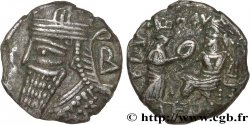
Beau portrait stylisé sur un flan un peu court. Joli revers, bien centré pour ce type. Pièce de haut relief
Catalogue references :
Predigree :
Cet exemplaire provient de la collection Delorme
Obverse
Obverse legend : ANÉPIGRAPHE.
Obverse description : Buste diadémé et drapé de Vologèse IV à gauche avec la barbe longue, coiffé de la tiare avec crête ; le vêtement est richement orné ; dans le champ derrière, B.
Reverse
Reverse description : Vologèse IV assis à droite, tourné à gauche sur un trône à dossier, recevant une couronne de Niké debout à gauche, tournée à droite.
Reverse legend : BASILEWS// BASILEWN// ARSAKOU// OLAGASOU// EPIFANOUS// FILELLHNOS// QPU// DUSTROU
Reverse translation : (Roi des rois Arsace, juste, glorieux, philhellène).
Commentary
Cet exemplaire est illustré dans l’article de P. Delorme (N&C 321, p. 39, fig. 37). Notre exemplaire est daté de février 177 après J.-C (an 489 de l’ère arsacide), le mois est lisible à l’exergue, (Distros) pour février. L’ère parthe commençait en 312 avant J.-C., reposant sur l’ère séleucide et la dédicace de Séleucie du Tigre par son fondateur, Séleucus Nicator. Le début de l’année parthe était fixée au mois d’octobre (Dios) et l’année basée sur un calendrier lunaire avec un mois intercalaire.
This example is illustrated in the article by P. Delorme (N&C 321, p. 39, fig. 37). Our example is dated February 177 AD (489 of the Arsacid era), the month is readable in the exergue, (Distros) for February. The Parthian era began in 312 BC, based on the Seleucid era and the dedication of Seleucia on the Tigris by its founder, Seleucus Nicator. The beginning of the Parthian year was fixed in October (Dios) and the year based on a lunar calendar with an intercalary month
This example is illustrated in the article by P. Delorme (N&C 321, p. 39, fig. 37). Our example is dated February 177 AD (489 of the Arsacid era), the month is readable in the exergue, (Distros) for February. The Parthian era began in 312 BC, based on the Seleucid era and the dedication of Seleucia on the Tigris by its founder, Seleucus Nicator. The beginning of the Parthian year was fixed in October (Dios) and the year based on a lunar calendar with an intercalary month
Historical background
PARTHIAN KINGDOM - VOLOGESE IV
(147-191)
Vologèse IV, who seems to be the son of Mithridates IV, succeeded Vologèse III in 147. The beginning of his reign was happy. Vologèse IV invaded Armenia and part of Syria in 162. War broke out between Romans and Parthians. Marcus Aurelius sent Lucius Verus to the East with a very important military command. Lucius Verus reconquered Armenia and invaded Mesopotamia. The co-emperor seized Seleucia and Ctesiphon and ravaged Parthia. Marc Aurèle and Lucius Vérus received the titles of "Armeniacus", then of "Parthicus Maximus". The power and prestige of the Arsacids were altered. Vologesis IV abandoned his claims to Armenia in 166 and did not live long enough to witness another capture of Ctesiphon in 198.
 Report a mistake
 Print the page
 Share my selection
 Ask a question
 Consign / sell
Related articles

 Full data

Your Recently Viewed Items

5 Francs BERGER FRANCE 1943 F.05.04 UNC
30.00 €
Refonte des monnaies de cuivre, essai au module de 5 centimes en bronze 1847 - V
180.00 €
BOLIVIA 8 Soles Simon Bolivar 1833 Potosi
150.00 €

GREAT-BRITAIN - GEORGE V Demi souverain 1914 Londres AU
89.64 €

MAURETANIA - MAURETANIAN KINGDOM - JUBA II and CLEOPATRA Denier AU
270.00 €

40 lires en or, 2e type, tranche en creux 1814 Milan VG.1394 XF
220.00 €
cgbfr.com numismatists


