


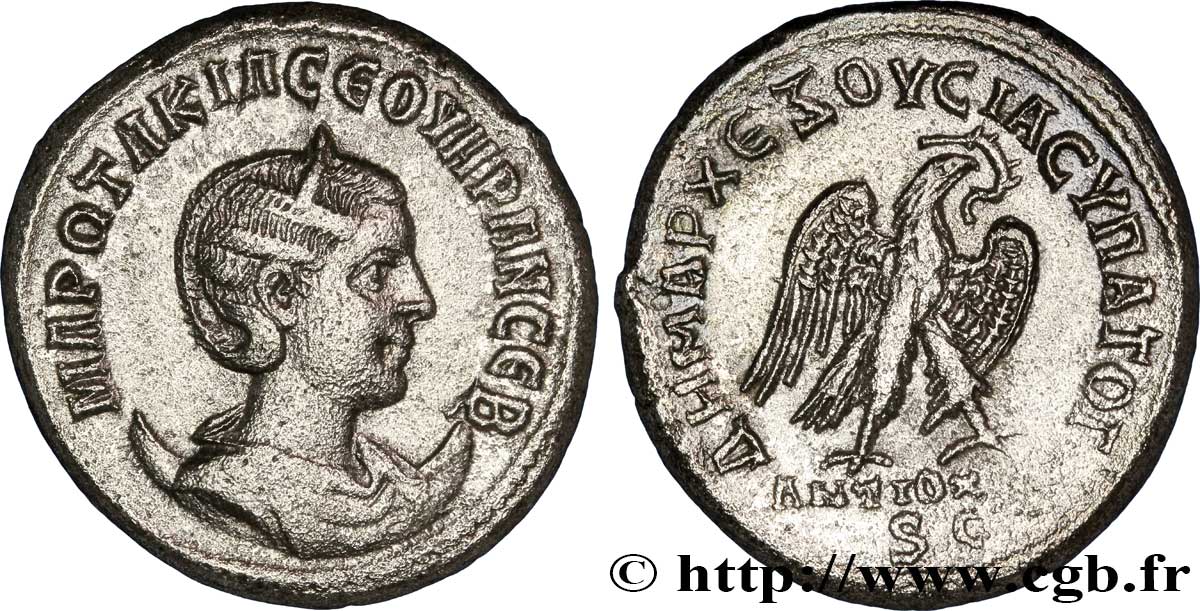
bpv_192781 - OTACILIA SEVERA Tétradrachme syro-phénicien
Not available.
Item sold on our e-shop (2017)
Price : 240.00 €
Item sold on our e-shop (2017)
Price : 240.00 €
Type : Tétradrachme syro-phénicien
Date: 248
Mint name / Town : Antioche, Syrie, Séleucie et Piérie
Metal : billon
Diameter : 25,00 mm
Orientation dies : 1 h.
Weight : 13,26 g.
Rarity : R1
Coments on the condition:
Frappe correctement centrée sur un flan un peu large, très faible usure uniquement apparente sur le drapé de l’épaule
Catalogue references :
Predigree :
C’est cet exemplaire, qui provient de la collection de Richard McAlee, qui illustre le type dans Coins of Roman Antioch de Richard McAlee ; c’est le 0383_010 de la base TSP
Obverse
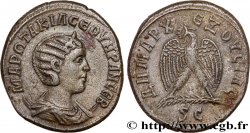
Obverse description : Buste drapé et diadémé d’Otacilia Sévéra à droite, les cheveux remontés en tresse sur la tête, posé sur un croissant de lune, vu de trois quarts en avant (L15).
Obverse legend : MAR WTAKIL SEOUHRAN SEB
Obverse translation : (Marcia Otacilia Severa augusta).
Reverse
Reverse legend : ANTIOXIA / S|C À L’EXERGUE.
Reverse description : Aigle debout à droite, les ailes déployées, aile gauche derrière patte gauche, tête à droite et queue à gauche, tenant une couronne feuillée dans son bec.
Reverse legend : DHMARC - EX OUSIAS UPATOG
Reverse translation : (Revêtu de la puissance tribunitienne / Consul pour la troisième fois / avec l’accord du Sénat d’Antioche).
Commentary
Les frappes de Philippe II datées du troisième consulat, comme celles d’Otacilie Sévère d’ailleurs, portent les titres de Philippe Père. Elles se distinguent entre elles par différents aigles de revers et un portrait à droite ou à gauche.
Il faut noter que si Philippe affectionne particulièrement la couronne radiée solaire dans ses frappes de tétradrachmes (sans que cela ait la moindre influence sur la valeur faciale de la monnaie, contrairement à ce qui se produit pour les antoniniens), tous les bustes de son épouse sont posés sur un croissant lunaire.
En abordant les frappes du 3e consulat, on remarque l’absence complète de frappes datées du deuxième consulat, bien que le deuxième consulat de Philippe et de sa famille existe indubitablement à Rome, y compris sur les émissions monétaires. Interruption des frappes ou comput différent à Antioche qu’à Rome ? Nous penchons pour la deuxième solution, pour deux raisons.
Tout d’abord la continuité stylistique : tant pour les revers que pour les droits, il n’y a pas de rupture, alors que l’on aurait pu présumer une certaine normalisation après une interruption des frappes. De plus, celle-ci se produira effectivement pour les frappes datées du quatrième consulat avec un style d’aigle unique, suivie à la fin par une nouveauté encore plus marquante, l’introduction d’officines indiquées sur les monnaies.
Ensuite, il existe à Antioche de très nombreuses frappes datées d’un quatrième consulat de Philippe l’Arabe dont nous ne trouvons pas trace à Rome. Il est extrêmement regrettable que les quelques informations dont nous disposons sur le Sénat d’Antioche soient largement plus tardives (4e et 5e siècle) car les émissions de tétradrachmes laissent à penser que non seulement le Sénat d’Antioche manifestait son indépendance envers Rome en frappant de l’argent avec la titulature “SC / ANTIOXIA” mais encore qu’il avait son propre comput impérial sous Philippe.
L’apparition de cette exergue et la disparition de la palme sont caractéristiques des 3e et 4e consulat mais les styles des aigles ne se normaliseront qu’au 4e.
On note que les sigma sont gravés en C.
Dans la base TSP maintenue par Michel Prieur, vingt-quatre exemplaires sont maintenant répertoriés pour ce type, dont plusieurs en musées, ANS (2), Paris, Bonn, Yale, Gaziantep et British Museum.
The coins of Philip II dated from the third consulate, like those of Otacilia Severus, bear the titles of Philip the Father. They are distinguished from each other by different reverse eagles and a portrait on the right or left..
It should be noted that while Philip was particularly fond of the radiating solar crown in his tetradrachm strikes (without this having the slightest influence on the face value of the coin, unlike what happens for the antoninianus), all the busts of his wife are placed on a lunar crescent..
When approaching the strikes of the 3rd consulate, we notice the complete absence of strikes dated from the second consulate, although the second consulate of Philip and his family undoubtedly existed in Rome, including on monetary issues.. Was the minting interrupted or was the calculation different in Antioch than in Rome? We are leaning towards the second solution, for two reasons..
First of all, stylistic continuity: for both the backhands and the forehands, there is no break, whereas one could have assumed a certain standardization after an interruption in the strokes. Furthermore, this will actually occur for the strikes dated from the fourth consulate with a unique eagle style, followed at the end by an even more striking novelty, the introduction of offices indicated on the coins..
Then, in Antioch there are many dated strikes from a fourth consulate of Philip the Arab, of which we find no trace in Rome.. It is extremely regrettable that the little information we have on the Senate of Antioch is much later (4th and 5th century) because the issues of tetradrachms suggest that not only did the Senate of Antioch demonstrate its independence from Rome by minting coin with the title “SC / ANTIOXIA” but also that it had its own imperial computus under Philip..
The appearance of this exergue and the disappearance of the palm are characteristic of the 3rd and 4th consulate but the styles of the eagles will not become standardized until the 4th..
Note that the sigmas are engraved in C.
In the TSP database maintained by Michel Prieur, twenty-four examples are now listed for this type, including several in museums, ANS (2), Paris, Bonn, Yale, Gaziantep and the British Museum
Il faut noter que si Philippe affectionne particulièrement la couronne radiée solaire dans ses frappes de tétradrachmes (sans que cela ait la moindre influence sur la valeur faciale de la monnaie, contrairement à ce qui se produit pour les antoniniens), tous les bustes de son épouse sont posés sur un croissant lunaire.
En abordant les frappes du 3e consulat, on remarque l’absence complète de frappes datées du deuxième consulat, bien que le deuxième consulat de Philippe et de sa famille existe indubitablement à Rome, y compris sur les émissions monétaires. Interruption des frappes ou comput différent à Antioche qu’à Rome ? Nous penchons pour la deuxième solution, pour deux raisons.
Tout d’abord la continuité stylistique : tant pour les revers que pour les droits, il n’y a pas de rupture, alors que l’on aurait pu présumer une certaine normalisation après une interruption des frappes. De plus, celle-ci se produira effectivement pour les frappes datées du quatrième consulat avec un style d’aigle unique, suivie à la fin par une nouveauté encore plus marquante, l’introduction d’officines indiquées sur les monnaies.
Ensuite, il existe à Antioche de très nombreuses frappes datées d’un quatrième consulat de Philippe l’Arabe dont nous ne trouvons pas trace à Rome. Il est extrêmement regrettable que les quelques informations dont nous disposons sur le Sénat d’Antioche soient largement plus tardives (4e et 5e siècle) car les émissions de tétradrachmes laissent à penser que non seulement le Sénat d’Antioche manifestait son indépendance envers Rome en frappant de l’argent avec la titulature “SC / ANTIOXIA” mais encore qu’il avait son propre comput impérial sous Philippe.
L’apparition de cette exergue et la disparition de la palme sont caractéristiques des 3e et 4e consulat mais les styles des aigles ne se normaliseront qu’au 4e.
On note que les sigma sont gravés en C.
Dans la base TSP maintenue par Michel Prieur, vingt-quatre exemplaires sont maintenant répertoriés pour ce type, dont plusieurs en musées, ANS (2), Paris, Bonn, Yale, Gaziantep et British Museum.
The coins of Philip II dated from the third consulate, like those of Otacilia Severus, bear the titles of Philip the Father. They are distinguished from each other by different reverse eagles and a portrait on the right or left..
It should be noted that while Philip was particularly fond of the radiating solar crown in his tetradrachm strikes (without this having the slightest influence on the face value of the coin, unlike what happens for the antoninianus), all the busts of his wife are placed on a lunar crescent..
When approaching the strikes of the 3rd consulate, we notice the complete absence of strikes dated from the second consulate, although the second consulate of Philip and his family undoubtedly existed in Rome, including on monetary issues.. Was the minting interrupted or was the calculation different in Antioch than in Rome? We are leaning towards the second solution, for two reasons..
First of all, stylistic continuity: for both the backhands and the forehands, there is no break, whereas one could have assumed a certain standardization after an interruption in the strokes. Furthermore, this will actually occur for the strikes dated from the fourth consulate with a unique eagle style, followed at the end by an even more striking novelty, the introduction of offices indicated on the coins..
Then, in Antioch there are many dated strikes from a fourth consulate of Philip the Arab, of which we find no trace in Rome.. It is extremely regrettable that the little information we have on the Senate of Antioch is much later (4th and 5th century) because the issues of tetradrachms suggest that not only did the Senate of Antioch demonstrate its independence from Rome by minting coin with the title “SC / ANTIOXIA” but also that it had its own imperial computus under Philip..
The appearance of this exergue and the disappearance of the palm are characteristic of the 3rd and 4th consulate but the styles of the eagles will not become standardized until the 4th..
Note that the sigmas are engraved in C.
In the TSP database maintained by Michel Prieur, twenty-four examples are now listed for this type, including several in museums, ANS (2), Paris, Bonn, Yale, Gaziantep and the British Museum
Historical background
OTACILIA SEVERA
(+249)
Wife of Philippus I, mother of Philippus II - Augusta
Otacilie, daughter of Severus, governor of Pannonia, married Philip around 234. Philip II, their son, was born around 237. She seems to have sympathy for Christians, who enjoyed relative security under Philip's reign before the great persecution. by Trajan Decius. Her fate after the death of her husband and son is unknown. Is she murdered or does she retreat into private life? She disappears from history.
 Report a mistake
 Print the page
 Share my selection
 Ask a question
 Consign / sell
Related articles
 Full data
Your Recently Viewed Items

HAITI 25 Gourdes Proof Christophe Colomb 1973 MS
45.00 €
CHARLES V LE SAGE / THE WISE Franc à pied 20/04/1365 XF
411.61 €

GALLIA BELGICA - MELDI (Area of Meaux) Bronze ROVECA, classe IIIc VF
99.00 €

LOUIS XVI Demi-thaler 1789 Vienne XF
100.00 €

TOWN OF BESANCON - COINAGE STRUCK IN THE NAME OF CHARLES V Daldre AU
985.00 €
cgbfr.com numismatists


