


fjt_010541 - 19TH CENTURY NOTARIES (SOLICITORS AND ATTORNEYS) Corps notarial 1979

Not available.
Item sold on our e-shop (2014)
Price : 38.00 €
Item sold on our e-shop (2014)
Price : 38.00 €
Type : Corps notarial
Date: 1979
Metal : bronze
Diameter : 31,5 mm
Orientation dies : 12 h.
Puncheon : Corne (1880 -)
Catalogue references :
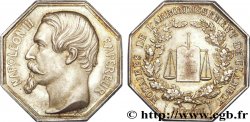
Obverse
Obverse legend : UNION INTERNATIONALE DU NOTARIAT LATIN. PARIS. MAI 1979. L'ENTREPRISE ET LE DROIT.
Obverse description : Armes de Paris accostées d'une branche de laurier et d'une branche d'olivier.
Reverse
Reverse legend : SCRIBA. NOTARIUS. TABELLIO. EXCEPTOR. TABULARIUS. LEX EST QUODCUMQUE NOTAMUS.
Reverse description : Balance derrière un gnomon.
Commentary
Frappe médaille. Jeton référencé dans le complément du "LEROUGE", paru dans la revue "LE GNOMON", bulletin n° 47, janvier 1986.
La devise "Lex est quodcumque notamus" est une création du père Ménestrier en 1686 pour les secrétaires du roi qui ne s'en sont jamais servi. L'invention fut reprise par les notaires de Paris puis ensuite par les notaires de Province.
Medal strike. Token referenced in the supplement to \\\"LEROUGE\\\", published in the magazine \\\"LE GNOMON\\\", bulletin no. 47, January 1986. The motto \\\"Lex est quodcumque notamus\\\" was created by Father Ménestrier in 1686 for the king's secretaries who never used it. The invention was taken up by the notaries of Paris and then by the provincial notaries
La devise "Lex est quodcumque notamus" est une création du père Ménestrier en 1686 pour les secrétaires du roi qui ne s'en sont jamais servi. L'invention fut reprise par les notaires de Paris puis ensuite par les notaires de Province.
Medal strike. Token referenced in the supplement to \\\"LEROUGE\\\", published in the magazine \\\"LE GNOMON\\\", bulletin no. 47, January 1986. The motto \\\"Lex est quodcumque notamus\\\" was created by Father Ménestrier in 1686 for the king's secretaries who never used it. The invention was taken up by the notaries of Paris and then by the provincial notaries
Historical background
19TH CENTURY NOTARIES (SOLICITORS AND ATTORNEYS)
The Le Chapelier law of June 17, 1791, which dissolves the corporations, therefore the companies of notaries, then the law of October 6, 1791 suppresses the royal, apostolic and seigneurial notaries as well as the venality and the inheritance of their offices. However, the authors of this second law, recognizing the need for the authentication of deeds and the duty to advise, institute public notaries. Thus notaries remain in practice by changing quality. However, after a decade of legislative trial and error, the First Consul Bonaparte reorganized and modernized the notariat by the organic law of 25 Ventôse of the year XI (March 16, 1803). This veritable "notarial code" remains today the reference text of the profession.. The 19th century notary is an emblematic figure that can be found in literature but also in opera. One of the most famous figures is in the third act of Puccini's opera, "Il Trittico", performed for the first time in 1918, and whose action takes place in the 19th century.. The most famous aria is that of Gianni Schicchi: “Si corre dal notaio!” (“Let’s go to the notary!”) [http://www. Youtube. com/watch?v=0OjuOxOCFVI].
 Report a mistake
 Print the page
 Share my selection
 Ask a question
 Consign / sell
Related articles

 Full data



cgbfr.com numismatists


