


Live auction - fjt_477962 - NORMANDY - 19TH CENTURY JETONS OR TOKENS Jeton octogonal Ar 34, Chambre de commerce du Havre n.d.
You must signin and be an approved bidder to bid, LOGIN TO BID. Accounts are subject to approval and the approval process takes place within 48 hours. Do not wait until the day a sale closes to register. Clicking on "BID" constitutes acceptance of the terms of use of cgb.fr private live auctions.
Bids must be placed in whole Euro amounts only. The sale will start closing at the time stated on the item description; any bids received at the site after the closing time will not be executed. Transmission times may vary and bids could be rejected if you wait until the last second. For further information check the Live auction FAQ
All winning bids are subject to a 18% buyer’s fee.
All winning bids are subject to a 18% buyer’s fee.
| Estimate : | 80 € |
| Price : | 40 € |
| Maximum bid : | 55 € |
| End of the sale : | 10 April 2018 17:36:55 |
| bidders : | 1 bidder |
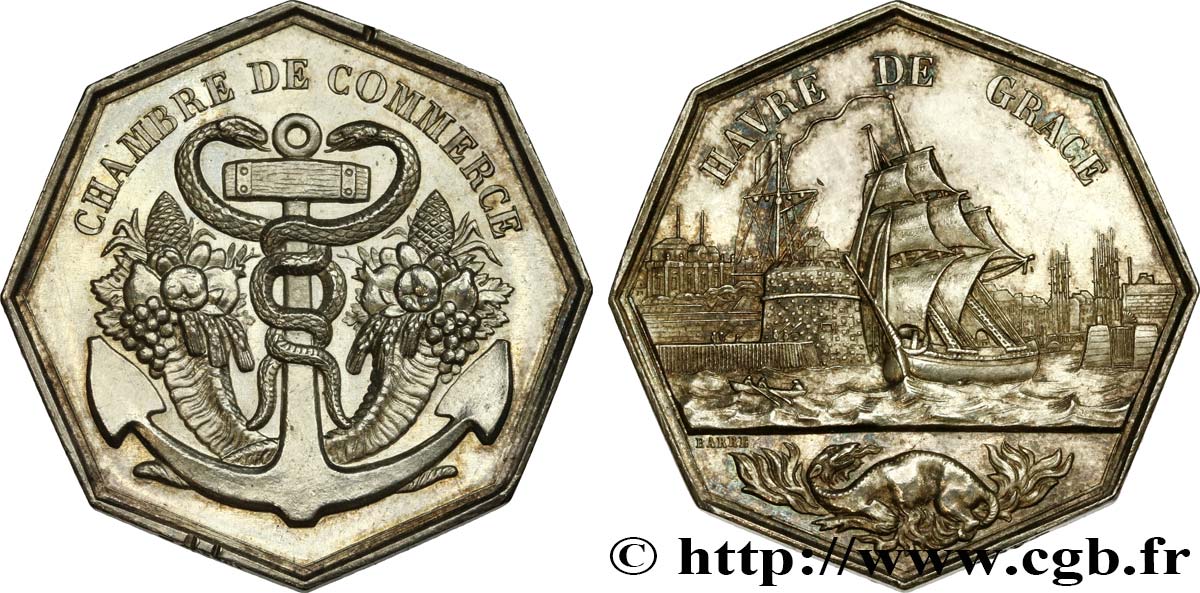
Type : Jeton octogonal Ar 34, Chambre de commerce du Havre
Date: (1845-1860)
Date: n.d.
Metal : silver
Diameter : 34 mm
Orientation dies : 12 h.
Weight : 14,02 g.
Edge : lisse
Puncheon : (main) ARGENT
Coments on the condition:
Exemplaire superbe
Obverse
Obverse legend : CHAMBRE DE COMMERCE.
Obverse description : Ancre enlacée de deux serpents posée sur deux cornes d’abondance.
Reverse
Reverse legend : HAVRE DE GRACE.
Reverse description : Navire de face sortant du port du Havre ; à l’exergue une salamandre et signature BARRE.
Commentary
Original jeton octogonal posé sur la pointe. La première chambre de commerce fut celle de Marseille créée à la fin du XVIe siècle. Pour Paris, les six corps des marchands et les juges-consuls avaient un rôle similaire à celui d'une chambre de commerce : une association de commerçants réunis pour délibérer sur les intérêts de leur ville ou de leur région et donner leur avis au gouvernement. Colbert les légalisent en 1664 en instaurant que chaque place de commerce choisira deux d'entre eux pour les représenter. L'institution ne fut toutefois établie réellement que par l'arrêt du Conseil du 30 août 1701 et de nombreuses chambres de commerce apparaissent au XVIIIe siècle à Lyon, Rouen, Toulouse, Montpellier, Bordeaux, etc.. La plus importante d'entre elles est Marseille qui avait des attributions dans tout le commerce du Levant et était du département des Affaires étrangères, les autres relevaient du Contrôle général des Finances. Supprimées par la Constituante en 1791, les chambres de commerce sont rétablies sous le Consulat. Depuis 1832, leur recrutement se fait pas élections, elles sont devenues chambres de commerce et d'industrie depuis 1898, regroupées en 21 chambres régionales.
Original octagonal token placed on the tip. The first chamber of commerce was that of Marseille, created at the end of the 16th century.. For Paris, the six merchant corps and the consul judges had a role similar to that of a chamber of commerce: an association of merchants gathered to deliberate on the interests of their city or region and give their opinion to the government.. Colbert legalized them in 1664 by establishing that each trading place would choose two of them to represent them.. The institution was, however, only actually established by the Council's decree of 30 August 1701 and numerous chambers of commerce appeared in the 18th century in Lyon, Rouen, Toulouse, Montpellier, Bordeaux, etc.. . The most important of these was Marseille, which had responsibilities in all Levantine trade and was part of the Department of Foreign Affairs; the others came under the General Control of Finance.. Abolished by the Constituent Assembly in 1791, the chambers of commerce were reestablished under the Consulate. Since 1832, their recruitment has been done by elections, they have become chambers of commerce and industry since 1898, grouped into 21 regional chambers
Original octagonal token placed on the tip. The first chamber of commerce was that of Marseille, created at the end of the 16th century.. For Paris, the six merchant corps and the consul judges had a role similar to that of a chamber of commerce: an association of merchants gathered to deliberate on the interests of their city or region and give their opinion to the government.. Colbert legalized them in 1664 by establishing that each trading place would choose two of them to represent them.. The institution was, however, only actually established by the Council's decree of 30 August 1701 and numerous chambers of commerce appeared in the 18th century in Lyon, Rouen, Toulouse, Montpellier, Bordeaux, etc.. . The most important of these was Marseille, which had responsibilities in all Levantine trade and was part of the Department of Foreign Affairs; the others came under the General Control of Finance.. Abolished by the Constituent Assembly in 1791, the chambers of commerce were reestablished under the Consulate. Since 1832, their recruitment has been done by elections, they have become chambers of commerce and industry since 1898, grouped into 21 regional chambers
Historical background
NORMANDY - 19TH CENTURY JETONS OR TOKENS
 Report a mistake
 Print the page
 Share my selection
 Ask a question
 Consign / sell
Related articles

 Full data



cgbfr.com numismatists


