


bpv_297295 - NERO Tétradrachme syro-phénicien
Not available.
Item sold on our e-shop (2015)
Price : 240.00 €
Item sold on our e-shop (2015)
Price : 240.00 €
Type : Tétradrachme syro-phénicien
Date: an 9/ 111
Mint name / Town : Antioche, Syrie, Séleucie et Piérie
Metal : silver
Diameter : 24 mm
Orientation dies : 12 h.
Weight : 14,48 g.
Coments on the condition:
Portrait caractéristique de cette année, bien centré mais sur un flan très court, comme très fréquemment
Catalogue references :
Predigree :
Cet exemplaire, qui provient de la trouvaille dite de Cisjordanie, est le 0084_012 de la base TSP
Obverse
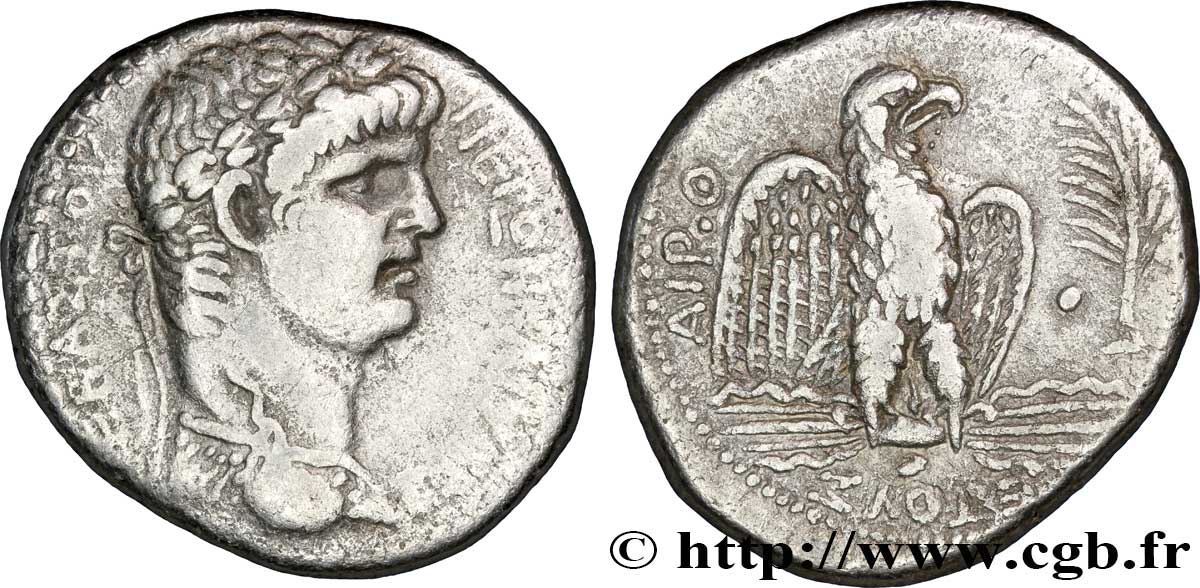
Obverse description : Buste lauré de Néron jeune homme à droite avec l'égide sur le cou (O*4).
Obverse legend : NERWN KAISAR - SEBASTOU, (Nerwn Kaisaros Sebastou)
Obverse translation : (Néron césar auguste).
Reverse
Reverse description : Aigle debout à droite sur un foudre ailé, les ailes déployées ; dans le champ à droite, une palme verticale.
Reverse legend : ETOUS AIR . Q
Reverse translation : (An 9 du règne / An 111 de l’ère césarienne).
Commentary
On constate, dès cette année, la neuvième du règne, l’adjonction d’un point dans le champ du revers et une permutation complète de celui-ci, l’aigle se tournant de gauche à droite et la palme passant de gauche à droite ; cette disposition restera la même pendant cinq ans. Peut-on en déduire un changement de titre ou de politique monétaire ? On semble avoir cherché à permettre de distinguer facilement les émissions du début du règne de celles qui suivirent.
Les portraits sont toujours naturalistes et sans vouloir prédire le visage qu’aura Néron à la fin de son règne, on voit déjà que le fils d’Agrippine s’empâte.
Cette variante de légende est rare et souvent difficilement lisible ; dans la base TSP maintenue par Michel Prieur, seuls vingt-quatre exemplaires sont maintenant répertoriés. On note d’ailleurs qu’aucun exemplaire de cette variante n’est présent dans les collections nationales françaises, mais seulement à Vienne, Munich et au British Museum.
We note, from this year, the ninth of the reign, the addition of a dot in the field of the reverse and a complete permutation of it, the eagle turning from left to right and the palm passing from left to right; this arrangement will remain the same for five years. Can we deduce a change of title or monetary policy? It seems that an attempt was made to allow easy distinction between the issues of the beginning of the reign and those that followed. The portraits are always naturalistic and without wanting to predict the face that Nero will have at the end of his reign, we can already see that the son of Agrippina is getting fatter. This variant of legend is rare and often difficult to read; in the TSP database maintained by Michel Prieur, only twenty-four examples are now listed. It should also be noted that no example of this variant is present in the French national collections, but only in Vienna, Munich and the British Museum
Les portraits sont toujours naturalistes et sans vouloir prédire le visage qu’aura Néron à la fin de son règne, on voit déjà que le fils d’Agrippine s’empâte.
Cette variante de légende est rare et souvent difficilement lisible ; dans la base TSP maintenue par Michel Prieur, seuls vingt-quatre exemplaires sont maintenant répertoriés. On note d’ailleurs qu’aucun exemplaire de cette variante n’est présent dans les collections nationales françaises, mais seulement à Vienne, Munich et au British Museum.
We note, from this year, the ninth of the reign, the addition of a dot in the field of the reverse and a complete permutation of it, the eagle turning from left to right and the palm passing from left to right; this arrangement will remain the same for five years. Can we deduce a change of title or monetary policy? It seems that an attempt was made to allow easy distinction between the issues of the beginning of the reign and those that followed. The portraits are always naturalistic and without wanting to predict the face that Nero will have at the end of his reign, we can already see that the son of Agrippina is getting fatter. This variant of legend is rare and often difficult to read; in the TSP database maintained by Michel Prieur, only twenty-four examples are now listed. It should also be noted that no example of this variant is present in the French national collections, but only in Vienna, Munich and the British Museum
Historical background
NERO
(13/10/54-9/06/68)
Augustus
Nero is certainly one of the best-known emperors, thanks to Tacitus and Suetonius, but also one of the most decried. He is the last representative of the Julio-Claudian dynasty. Son of Agrippina, Claudius' second wife, and Cneius Domitius Ahenobarbus, he was born in 37. He descends from both Augustus through his mother and Julie through his maternal grandfather, Germanicus. After the assassination of Claude by Agrippina with the help of Locuste in 54, aged 17, he began his reign under good auspices. Aided by Seneca, his tutor, and Burrus, prefect of the Praetorium, he governed intelligently with the Senate. He married Octavie, daughter of Claudius and Messalina. Octavie's brother, Britannicus, dies under mysterious conditions in AD 55 (poisoned?). After the "quinquennum aureum" (54-59), the emperor had or allowed his mother to be murdered. The last nine years of the reign will destabilize the principate.
 Report a mistake
 Print the page
 Share my selection
 Ask a question
 Consign / sell
Related articles
 Full data


cgbfr.com numismatists


