


v32_0922 - NAMNETES (Area of Nantes) Statère d'électrum à l'hippophore, au profil luniforme

MONNAIES 32 (2007)
Starting price : 1 200.00 €
Estimate : 2 500.00 €
unsold lot
Starting price : 1 200.00 €
Estimate : 2 500.00 €
unsold lot
Type : Statère d'électrum à l'hippophore, au profil luniforme
Date: c.80-50 AC.
Mint name / Town : Nantes (44)
Metal : electrum
Diameter : 22,5 mm
Orientation dies : 7 h.
Weight : 6,76 g.
Rarity : UNIQUE
Coments on the condition:
Bel exemplaire en or pâle, avec une faiblesse de frappe sur la partie supérieure du droit et sur la périphérie du revers. Très fine patine avec d'infimes concrétions sombres au revers
Obverse
Obverse legend : ANÉPIGRAPHE.
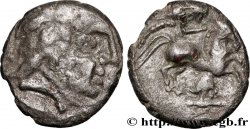
Obverse description : Grosse tête à droite, la chevelure en cinq grosses mèches, entourée de cordons perlés (terminés par de petites têtes coupées).
Reverse
Reverse legend : ANÉPIGRAPHE.
Reverse description : Cheval androcéphale galopant à gauche conduit par un aurige levant la main gauche et tenant les rênes de la droite ; entre les jambes du cheval, hippophore.
Commentary
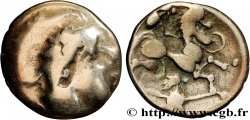
Les auteurs du Nouvel Atlas ont bien distingué les différentes variantes du monnayage namnète, selon le métal et les types de droits et de revers. Ce statère correspondrait presque à celui avec le profil luniforme, mais l'exemplaire illustré est dans un triste état. Cet exemplaire constitue à lui seul la classe II du monnayage et était considéré comme original lors de la parution du Nouvel Atlas. Aucun statère de ce type ne figure dans la publication du trésor de Chevanceaux.
Si le droit de notre statère correspond au DT. 2202, le revers a la particularité unique d'avoir un cheval androcéphale à gauche ! Trouvée en Angleterre, cette monnaie pourrait être une copie outre-Manche, le phénomène étant attesté pour d'autres monnayages....
The authors of the New Atlas clearly distinguished the different variants of the Namnete coinage, according to the metal and the obverse and reverse types. This stater would almost correspond to the one with the lunar profile, but the illustrated example is in a sad state. This example alone constitutes Class II of the coinage and was considered original when the New Atlas was published. No stater of this type appears in the publication of the Chevanceaux treasure. If the obverse of our stater corresponds to DT. 2202, the reverse has the unique characteristic of having a man-headed horse on the left! Found in England, this coin could be a example from across the Channel, the phenomenon being attested for other coinages...
Si le droit de notre statère correspond au DT. 2202, le revers a la particularité unique d'avoir un cheval androcéphale à gauche ! Trouvée en Angleterre, cette monnaie pourrait être une copie outre-Manche, le phénomène étant attesté pour d'autres monnayages....
The authors of the New Atlas clearly distinguished the different variants of the Namnete coinage, according to the metal and the obverse and reverse types. This stater would almost correspond to the one with the lunar profile, but the illustrated example is in a sad state. This example alone constitutes Class II of the coinage and was considered original when the New Atlas was published. No stater of this type appears in the publication of the Chevanceaux treasure. If the obverse of our stater corresponds to DT. 2202, the reverse has the unique characteristic of having a man-headed horse on the left! Found in England, this coin could be a example from across the Channel, the phenomenon being attested for other coinages...
Historical background
NAMNETES (Area of Nantes)
(2nd - 1st century BC)
Armorican people, the Namnètes were installed at the mouth of the Loire whose course separated them from the Pictons. Their name is retained by that of the city of Nantes. Their maritime role seems to have been important and they participated in the operations against the Romans in 56 BC and supported the Venetian fleet. It is among the Veneti that Strabo places the port of tin, Corbilo. Caesar (BG. III, 9). Strabo (G. IV, 2, 1).
 Report a mistake
 Print the page
 Share my selection
 Ask a question
 Consign / sell
Related articles
 Full data



cgbfr.com numismatists


