


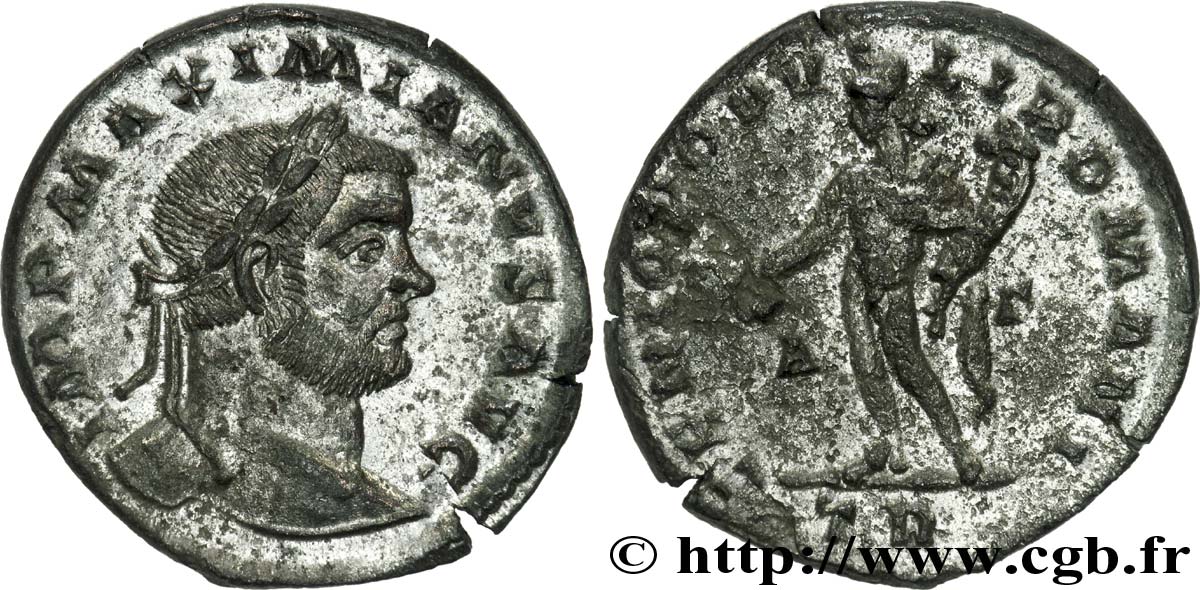
v31_0563 - MAXIMIANUS HERCULIUS Follis ou nummus
MONNAIES 31 (2007)
Starting price : 145.00 €
Estimate : 200.00 €
unsold lot
Starting price : 145.00 €
Estimate : 200.00 €
unsold lot
Type : Follis ou nummus
Date: 296-297
Mint name / Town : Trèves
Metal : copper
Diameter : 25,5 mm
Orientation dies : 12 h.
Weight : 9,91 g.
Officine: 1re
Emission: 3e
Coments on the condition:
Exemplaire sur un petit flan épais, bien centré des deux côtés. Portrait de qualité exceptionnelle. Frappe un peu molle au revers, le flan légèrement taché. Patine grise avec des reflets métalliques
Obverse
Obverse legend : IMP MAXIMIANVS AVG.
Obverse description : Tête laurée de Maximien Hercule à droite (O*).
Obverse translation : "Imperator Maximianus Augustus", (L'empereur Maximien auguste).
Reverse
Reverse legend : GENIO POPV-LI ROMANI/ A|(GAMMA)// TR.
Reverse description : Genius (le Génie) debout à gauche, le manteau sur l'épaule gauche, coiffé du modius, tenant une patère de la main droite et une corne d'abondance de la main gauche.
Reverse translation : “Genio Populi Romani”, (Au Génie du Peuple romain).
Commentary
Les folles étaient saucés. L’argenture superficielle devait aider les consommateurs à l’accepter plus facilement. Aujourd’hui, un follis comme le nôtre avec argenture est toujours rare. Rubans de type 2.
The Folies were sauced. The superficial silver plating was intended to make it easier for consumers to accept. Today, a Follis like ours with silver plating is still rare. Type 2 ribbons
The Folies were sauced. The superficial silver plating was intended to make it easier for consumers to accept. Today, a Follis like ours with silver plating is still rare. Type 2 ribbons
Historical background
MAXIMIANUS HERCULIUS
(10/12/285-02/310)
Auguste I
Maximian was born in Sirmium around 250. He has "a low forehead, a wrinkled face, a trumpet nose, a thick chin and neck, a shaggy beard" according to "The Roman Emperors", op. cit., p. 119. This description does not look so much like the portraits of the argentei, which are stereotyped and not necessarily recognizable. He is chosen by Diocletian to assist him. He was first Caesar, then Augustus from April 286, and it was the foundation of the Diarchy. Maximien settles in Trèves and must fight against the barbarian invasions and the usurpation of Carausius in Brittany. In 293, when the Tetrarchy was created, he was assisted by Constantius Chlorus. Diocletian forces Maximian to abdicate on May 1, 305. He resents retirement and goes to support his son Maxentius when he seizes Rome on October 28, 306. He resumes service as august in 307 and helps Constantine to whom he gives his daughter Fausta in marriage. Maximian is forced to abdicate at the conference of Carnuntum, November 11, 308. One last time, he resumes the purple at the beginning of 310 in Marseilles before committing suicide or being assassinated.
 Report a mistake
 Print the page
 Share my selection
 Ask a question
 Consign / sell
Related articles

 Full data



Your Recently Viewed Items
CHAMPAGNE - ARCHBISHOPRIC OF MEAUX - PIERRE I Denier XF
120.00 €

GALLIA BELGICA - REMI (Area of Reims) Bronze REMO/REMO VF
25.00 €

FRENCH INDOCHINA 1 Centième 1892 Paris VF
11.00 €

50 centimes Semeuse 1902 F.190/9 AU58
80.00 €

1 centime Épi 1983 Pessac F.106/40 MS60
3.00 €
Les monnaies romaines PRIEUR M., SCHMITT L.
22.00 €
cgbfr.com numismatists


