


Live auction - brm_173838 - MAXIMIANUS HERCULIUS Aurelianus
You must signin and be an approved bidder to bid, LOGIN TO BID. Accounts are subject to approval and the approval process takes place within 48 hours. Do not wait until the day a sale closes to register. Clicking on "BID" constitutes acceptance of the terms of use of cgb.fr private live auctions.
Bids must be placed in whole Euro amounts only. The sale will start closing at the time stated on the item description; any bids received at the site after the closing time will not be executed. Transmission times may vary and bids could be rejected if you wait until the last second. For further information check the Live auction FAQ
All winning bids are subject to a 18% buyer’s fee.
All winning bids are subject to a 18% buyer’s fee.
| Estimate : | 200 € |
| Price : | no bid |
| Maximum bid : | no bid |
| End of the sale : | 08 October 2024 14:33:31 |
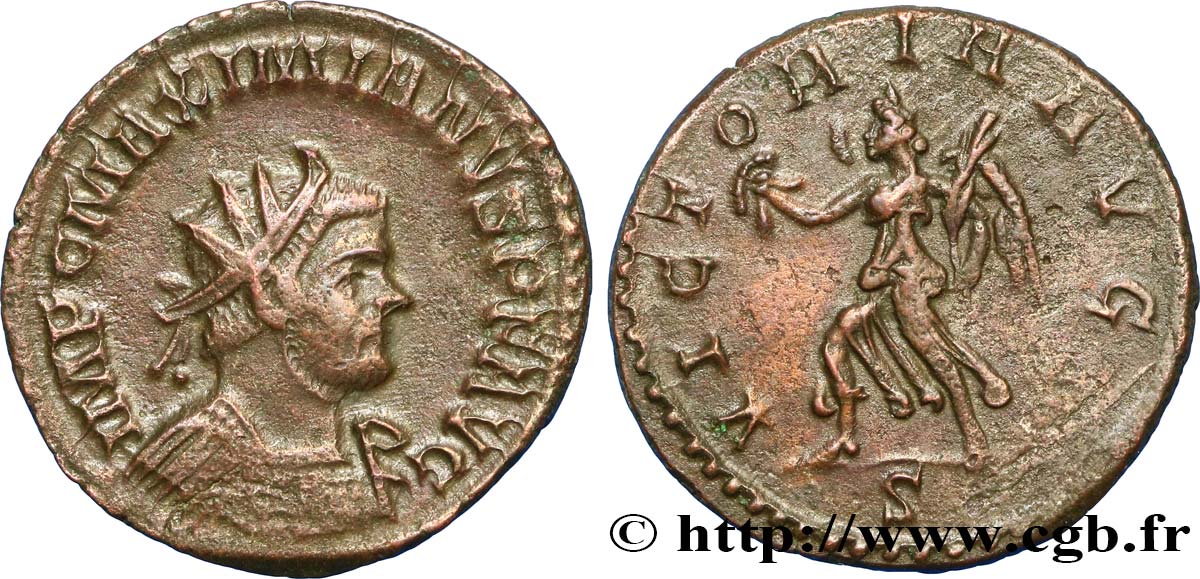
Type : Aurelianus
Date: automne 289 - début 290
Date: 289-290
Mint name / Town : Lyon
Metal : billon
Millesimal fineness : 50 ‰
Diameter : 22 mm
Orientation dies : 1 h.
Weight : 3,48 g.
Rarity : R3
Officine: 2e
Coments on the condition:
Exemplaire sur un flan bien centré à l’usure régulière. Beau portrait. Revers tout à fait exceptionnel dans le monnayage lyonnais. Jolie patine marron foncé
Catalogue references :
Obverse
Obverse legend : IMP C MAXIMIANVS P F AVG.
Obverse description : Buste radié et cuirassé de Maximien Hercule à droite avec pan de paludamentum, vu de trois quarts en avant (B01).
Obverse translation : “Imperator Cæsar Maximianus Pius Felix Augustus”, (L’empereur césar Maximien pieux heureux auguste).
Reverse
Reverse legend : VICTORIA AVGC/ -|-// S (SIC !).
Reverse description : Victoria (la Victoire) drapée marchant à gauche, tenant une couronne de la main droite et une palme de la main gauche.
Reverse translation : “Victoria Augustorum”, (La Victoire des augustes).
Commentary
Poids léger. Sans argenture. Rubans de type 3 aux extrémités bouletées. Cuirasse et épaulière cloutées. Ptéryges fines et tombantes. Orientation des coins inhabituelle. Coin arasé au revers sur le deuxième G de AVGG. Même coins que l’exemplaire du Cabinet des médailles de la BnF, n° 13.663, Bastien, n° 291a, pl. XX. Sur cet exemplaire les lettres de MAXIM semblent regravées sur DIOCLET en particulier les trois premières lettres comme le faisait remarquer D. Gricourt dans son magistral article, “Aureliani de l’atelier de Lyon sous l’empereur Dioclétien : enquête et données nouvelles, RBN. CXXX, 1984, loc. cit., p. 98 : “De fait, en reconstituant de la sorte cette légende antérieure, nous pouvons deviner, sinon reconnaître, respectivement le E de DIOCLETIANVS sous la première partie du 1er M de MAXIMIANVS, le I repris par le dernier jambage de cette lettre M, le O sous le 1er A, le C sous le X, le L habilement transformé en I, le E sous la première moitié du deuxième M et le T sous la seconde fraction de cette même lettre.” “Nous pouvons reconstituer, sans grand risque d’erreur d’interprétation, semble-t-il, le processus qui a abouti à un tel résultat. Comme ce doit être usuellement le cas, dans un premier temps, le scalptor grave sur le coin un portrait, ici de Maximien. Le signator, dans un second temps, poinçonne une titulature, ici de Dioclétien, autour de l’effigie impériale. Dans un troisième temps, la faute est remarquée par l’un des ouvriers en question (le signator lui-même ? le scalptor ?) ou, plus vraisemblablement, par un fonctionnaire de l’autorité impériale chargé de surveiller le déroulement correct des émissions de l’atelier. Dans un quatrième et dernier temps, l’erreur est rectifiée et, pour le cas qui nous concerne, de façon judicieuse et très habile”. Pour ce type, seuls sont connus des aureliani de Maximien Hercule, mais des types pour Dioclétien ont peut-être été prévus et restent toujours à découvrir aujourd’hui.
Lightweight. Without silvering. Type 3 ribbons with pelleted ends. Studded Breastplate and Shoulder Pad. Thin, drooping pteryga. Unusual corner orientation. Flattened corner on the reverse on the second G of AVGG. Same corners as the example of the BnF Medal Cabinet, n° 13. 663, Bastien, n° 291a, pl. XX. On this example the letters of MAXIM seem re-engraved on DIOCLET in particular the first three letters as D pointed out. Gricourt in his masterful article, “Aureliani from the Lyon workshop under the Emperor Diocletian: investigation and new data, RBN. CXXX, 1984, location. quote. ,p. 98: “In fact, by reconstructing this earlier legend in this way, we can guess, if not recognize, respectively the E of DIOCLETIANVS under the first part of the 1st M of MAXIMIANVS, the I taken up by the last leg of this letter M, the O under the 1st A, the C under the X, the L cleverly transformed into I, the E under the first half of the second M and the T under the second fraction of this same letter. ” “We can reconstruct, without much risk of error of interpretation, it seems, the process which led to such a result. As is usually the case, firstly, the scalptor engraves a portrait on the corner, here of Maximian. The signator, in a second step, punches a title, here of Diocletian, around the imperial effigy. Thirdly, the error is noticed by one of the workers in question (the signator himself? the scalptor?) or, more likely, by an official of the imperial authority responsible for monitoring the correct progress of the issues of the workshop. In a fourth and final step, the error is rectified and, in the case that concerns us, in a judicious and very skilful way”. For this type, only aureliani of Maximian Hercules are known, but types for Diocletian may have been planned and still remain to be discovered today
Lightweight. Without silvering. Type 3 ribbons with pelleted ends. Studded Breastplate and Shoulder Pad. Thin, drooping pteryga. Unusual corner orientation. Flattened corner on the reverse on the second G of AVGG. Same corners as the example of the BnF Medal Cabinet, n° 13. 663, Bastien, n° 291a, pl. XX. On this example the letters of MAXIM seem re-engraved on DIOCLET in particular the first three letters as D pointed out. Gricourt in his masterful article, “Aureliani from the Lyon workshop under the Emperor Diocletian: investigation and new data, RBN. CXXX, 1984, location. quote. ,p. 98: “In fact, by reconstructing this earlier legend in this way, we can guess, if not recognize, respectively the E of DIOCLETIANVS under the first part of the 1st M of MAXIMIANVS, the I taken up by the last leg of this letter M, the O under the 1st A, the C under the X, the L cleverly transformed into I, the E under the first half of the second M and the T under the second fraction of this same letter. ” “We can reconstruct, without much risk of error of interpretation, it seems, the process which led to such a result. As is usually the case, firstly, the scalptor engraves a portrait on the corner, here of Maximian. The signator, in a second step, punches a title, here of Diocletian, around the imperial effigy. Thirdly, the error is noticed by one of the workers in question (the signator himself? the scalptor?) or, more likely, by an official of the imperial authority responsible for monitoring the correct progress of the issues of the workshop. In a fourth and final step, the error is rectified and, in the case that concerns us, in a judicious and very skilful way”. For this type, only aureliani of Maximian Hercules are known, but types for Diocletian may have been planned and still remain to be discovered today
Historical background
MAXIMIANUS HERCULIUS
(10/12/285-02/310)
Auguste I
Maximian was born in Sirmium around 250. He has "a low forehead, a wrinkled face, a trumpet nose, a thick chin and neck, a shaggy beard" according to "The Roman Emperors", op. cit., p. 119. This description does not look so much like the portraits of the argentei, which are stereotyped and not necessarily recognizable. He is chosen by Diocletian to assist him. He was first Caesar, then Augustus from April 286, and it was the foundation of the Diarchy. Maximien settles in Trèves and must fight against the barbarian invasions and the usurpation of Carausius in Brittany. In 293, when the Tetrarchy was created, he was assisted by Constantius Chlorus. Diocletian forces Maximian to abdicate on May 1, 305. He resents retirement and goes to support his son Maxentius when he seizes Rome on October 28, 306. He resumes service as august in 307 and helps Constantine to whom he gives his daughter Fausta in marriage. Maximian is forced to abdicate at the conference of Carnuntum, November 11, 308. One last time, he resumes the purple at the beginning of 310 in Marseilles before committing suicide or being assassinated.
 Report a mistake
 Print the page
 Share my selection
 Ask a question
 Consign / sell
Related articles
 Full data


Your Recently Viewed Items

THRACE - BYZANTION Statère d’or AU
5000.00 €
CARIA - KNIDOS Drachme AU
1180.00 €
DOMITIANUS Obole XF
75.00 €
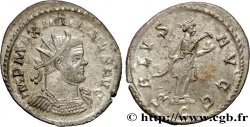
MAXIMIANUS HERCULIUS Aurelianus MS/AU
41.00 €
SEPTIMIUS SEVERUS Denier XF
30.00 €

VESPASIAN Denier AU/XF
250.00 €
cgbfr.com numismatists


