


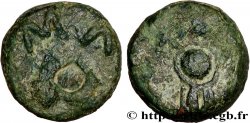
bga_951073 - MASSALIA - MARSEILLE Obole ou litra

Not available.
Item sold on our e-shop (2024)
Price : 380.00 €
Item sold on our e-shop (2024)
Price : 380.00 €
Type : Obole ou litra
Date: c. 470-450 AC.
Mint name / Town : Provence
Metal : silver
Diameter : 9,5 mm
Orientation dies : 7 h.
Weight : 0,80 g.
Rarity : R2
Coments on the condition:
Exemplaire centré des deux côtés. Joli portrait. Patine grise
Obverse
Obverse legend : ANÉPIGRAPHE.
Obverse description : Tête d'Apollon au krobylos à gauche.
Reverse
Reverse legend : M À SIX HEURES.
Reverse description : Crabe vu de dessus ; grènetis.
Commentary
Cet exemplaire appartient à la seconde catégorie, avec l'M.
This example belongs to the second category, with the M
This example belongs to the second category, with the M
Historical background
MASSALIA - MARSEILLE
(5th - 1st century BC)
Marseille, the "Massalia" of the Greeks, founded by the Phocaeans in 600 BC. -VS. , was born from the desire of the Greeks to promote trading posts in order to compete with the Carthaginians and the Etruscans for the domination of the western Mediterranean. Marseille is absolutely not a Celtic or Gallic creation and belongs to the Greek world. Between the 5th and 1st centuries BC, Marseille and its hinterland experienced unprecedented development. The rise of Rome from the First Punic War (268-241 BC). -VS. ), and the strategic choice of Marseilles, which plays Rome against Carthage, will restore, in the second half of the third century BC, a preponderant role to Massalia in the international trade of the western Mediterranean.. The second century BC marks the decline of the Phocaean city. Privileged ally of the Romans, Marseille has, thanks to them, succeeded in imposing its power in the Marseille hinterland. The Romans, by stopping the Cimbri and the Teutons, saved southern Gaul from invasions. From 118 BC. -VS. , the situation changes and the Provincia becomes a Roman province. Marseille merchants compete with Roman traders in Spain, Corsica, Sardinia and Sicily. Nevertheless, they remain the allies of the Romans until the 1st century BC.. This is the beginning of the civil war between Caesar and Pompey in 49 BC.. -VS. which will be fatal to the city. Marseille did not know how to choose between the two protagonists. Caesar besieged and took the city, not being able to allow his lines of communication between Gaul and Italy to be cut off.. Marseille's fleet was still too large to fall into the hands of his mortal enemy, Pompey. Conquered, the city was nevertheless not plundered and remained an important port at the beginning of the Roman domination. Remaining Hellenic, it was never really assimilated to Roman Gaul and kept a sort of independent status, mixed with cosmopolitanism where all religions crossed paths with all peoples for the greater benefit of Marseille trade..
 Report a mistake
 Print the page
 Share my selection
 Ask a question
 Consign / sell
Related articles
 Full data


Your Recently Viewed Items
10 Pesetas SPAIN 1935 P.086a XF
6.00 €

MASSALIA - MARSEILLE Obole ou litra AU
380.00 €

GALERIUS Follis ou nummus VG
4.00 €

CONSTANTINE II Centenionalis ou nummus VF/XF
12.00 €

SECOND EMPIRE Médaille de récompense, Exposition universelle XF
29.00 €
POLAND 50 Groszy 1923 Varsovie AU
3.00 €
cgbfr.com numismatists


