


v23_0059 - MACEDONIA - KINGDOM OF MACEDONIA - PHILIP III ARRHIDAEUS Tétradrachme
MONNAIES 23 (2004)
Starting price : 220.00 €
Estimate : 350.00 €
Realised price : 301.00 €
Number of bids : 3
Maximum bid : 305.00 €
Starting price : 220.00 €
Estimate : 350.00 €
Realised price : 301.00 €
Number of bids : 3
Maximum bid : 305.00 €
Type : Tétradrachme
Date: c. 323-320 AC.
Mint name / Town : Macédoine, Amphipolis
Metal : silver
Diameter : 26 mm
Orientation dies : 9 h.
Weight : 16,34 g.
Rarity : R2
Coments on the condition:
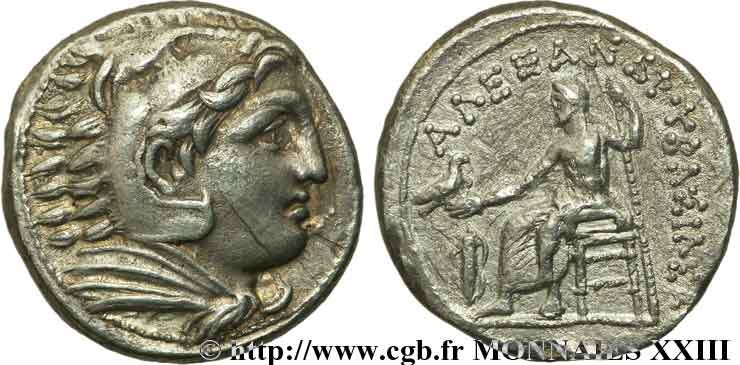
Flan large avec un très beau portrait. A été légèrement nettoyé anciennement. Très joli revers, de haut relief
Obverse
Obverse legend : ANÉPIGRAPHE.
Obverse description : Tête d'Héraklès à droite, coiffée de la léonté.
Reverse
Reverse description : Zeus aétophore, les jambes parallèles, assis à gauche sur un siège sans dossier, nu jusqu'à la ceinture, tenant un aigle posé sur sa main droite et un long sceptre de la main gauche ; dans le champ à gauche, un arc dans son carquois.
Reverse legend : ALEXANDROU BASILEWS
Commentary
Poids léger. La légende au revers est plutôt inhabituelle et n’est pas forcément distinguée par M. Price dans son corpus. Normalement, le titre de basileos est devant le nom du roi, la tête de Zeus coupant la légende. Sur notre exemplaire, la légende est continue, sans césure et vient se placer au-dessus du sujet, suivant le contour du flan. L’exemplaire du British Museum décrit dans l’ouvrage de M. Price provient du trésor de Demanhour (IGCH. 1664) enfoui vers 317 avant J.-C..
Lightweight. The legend on the reverse is rather unusual and is not necessarily distinguished by Mr. Price in his corpus. Normally, the title of basileos is before the king's name, with the head of Zeus cutting through the legend. In our example, the legend is continuous, without a caesura, and is placed above the subject, following the outline of the flan. The British Museum example described in Mr. Price's work comes from the Demanhour hoard (IGCH. 1664) buried around 317 BC.
Lightweight. The legend on the reverse is rather unusual and is not necessarily distinguished by Mr. Price in his corpus. Normally, the title of basileos is before the king's name, with the head of Zeus cutting through the legend. In our example, the legend is continuous, without a caesura, and is placed above the subject, following the outline of the flan. The British Museum example described in Mr. Price's work comes from the Demanhour hoard (IGCH. 1664) buried around 317 BC.
Historical background
MACEDONIA - KINGDOM OF MACEDONIA - PHILIP III ARRHIDAEUS
(323-316 BC)
Coinage in the name and Alexander III the Great type
Philip, son of Philip II and the half-brother of Alexander, was not entirely in his right mind. On the death of the conqueror and faced with the lack of power, in order to maintain the fiction of the unity of the Empire, he was proclaimed king, but in fact he had no power. He was assassinated at the instigation of Olympias, Alexander's mother, in 316 BC.
 Report a mistake
 Print the page
 Share my selection
 Ask a question
 Consign / sell
Related articles

 Full data


cgbfr.com numismatists


