


E-auction 2-212 - fjt_079426 - LYON AND THE LYONNAIS AREA (JETONS AND MEDALS OF...) Jeton octogonal Ar 31, éclairage par le gaz 1836

You must signin and be an approved bidder to bid, LOGIN TO BID. Accounts are subject to approval and the approval process takes place within 48 hours. Do not wait until the day a sale closes to register. Clicking on « bid » constitutes acceptance of the terms of use of cgb.fr private e-auctions.
Bids must be placed in whole Euro amounts only. The sale will start closing at the time stated on the item description; any bids received at the site after the closing time will not be executed. Transmission times may vary and bids could be rejected if you wait until the last second. For further information ckeck the E-auctions F.A.Q.
NO BUYER'S FEE.
NO BUYER'S FEE.
| Estimate : | 90 € |
| Price : | 30 € |
| Maximum bid : | 30 € |
| End of the sale : | 21 March 2013 15:45:30 |
| bidders : | 6 bidders |
Type : Jeton octogonal Ar 31, éclairage par le gaz
Date: 1836
Metal : silver
Diameter : 31 mm
Orientation dies : 12 h.
Edge : lisse
Puncheon : lampe
Rarity : R1
Coments on the condition:
Petites marques de manipulation sinon un très bel exemplaire
Obverse
Obverse legend : * SOCIÉTÉ ANONYME D’ÉCLAIRAGE PAR LE GAZ POUR LA VILLE DE LYON / NON SOLUM GLADIO FULGET.
Obverse description : Lion debout à droite et tenant un flambeau ; au-dessous bandeau inscrit.
Reverse
Reverse legend : À L’EXERGUE : ORDCE. ROYLE. 24 OCTBRE. 1836.
Reverse description : Vue d’une usine de production de gaz naturel ; signature Dd A LYON.
Commentary
Le gaz naturel était connu depuis l'Antiquité notamment en Perse mais ce n'est qu'à la fin du XVIIIe siècle que l'idée d'un éclairage au gaz apparut. Le procédé ne se répandit que dans la première moitié du XIXe siècle notamment à partir de 1820. Le gaz utilisé était obtenu par distillation de la houille et servait à éclairer les rues puis les logements. Il servit par la suite comme chauffage mais disparut pour l'éclairage en raison de la diffusion de l'éclairage électrique dès 1880. La Société Anonyme d'Éclairage par le Gaz hydrogène pour la Ville de Lyon qui deviendra la Compagnie du Gaz de Lyon.
Natural gas had been known since Antiquity, particularly in Persia, but it was not until the end of the 18th century that the idea of gas lighting appeared. The process only became widespread in the first half of the 19th century, particularly from 1820 onwards. The gas used was obtained by distilling coal and was used to light streets and then homes. It was later used for heating but disappeared for lighting due to the spread of electric lighting from 1880 onwards. The Société Anonyme d'Éclairage par le Gaz hydrogène pour la Ville de Lyon, which would become the Compagnie du Gaz de Lyon
Natural gas had been known since Antiquity, particularly in Persia, but it was not until the end of the 18th century that the idea of gas lighting appeared. The process only became widespread in the first half of the 19th century, particularly from 1820 onwards. The gas used was obtained by distilling coal and was used to light streets and then homes. It was later used for heating but disappeared for lighting due to the spread of electric lighting from 1880 onwards. The Société Anonyme d'Éclairage par le Gaz hydrogène pour la Ville de Lyon, which would become the Compagnie du Gaz de Lyon
Historical background
LYON AND THE LYONNAIS AREA (JETONS AND MEDALS OF...)
 Report a mistake
 Print the page
 Share my selection
 Ask a question
 Consign / sell
 Full data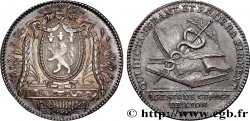


Your Recently Viewed Items

Deux centimes Napoléon III, tête laurée 1862 Strasbourg F.108A/6 MS60
27.00 €
cgbfr.com numismatists


