


bgr_461717 - LUCANIA - VELIA Nomos, statère ou didrachme

Not available.
Item sold on our e-shop (2020)
Price : 420.00 €
Item sold on our e-shop (2020)
Price : 420.00 €
Type : Nomos, statère ou didrachme
Date: c. 340-334 AC.
Mint name / Town : Vélia
Metal : silver
Diameter : 22 mm
Orientation dies : 6 h.
Weight : 7,31 g.
Rarity : R1
Coments on the condition:
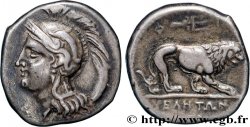
Exemplaire sur un flan ovale et irrégulier bien centré des deux côtés avec le grènetis visible au revers. Usure importante, mais parfaitement lisible et identifiable. Belle tête d’Athéna. Lion élégant. Patine de collection avec des reflets dorés
Catalogue references :
Predigree :
Cet exemplaire a été acquis en juin 1994 et provient de Conseils Placements
Obverse
Obverse description : Tête d'Athéna à gauche, coiffée du casque attique à cimier avec triple aigrette, orné d’un griffon.
Obverse legend : Q
Reverse
Reverse description : Lion passant à droite ; caducée tourné à droite, au-dessus.
Reverse legend : UELHTWN/ C
Reverse translation : (de Vélia).
Commentary
Très tôt, le monnayage de Vélia a été décrit comme ayant inspiré la drachme lourde de Marseille (LT. 785-791). Certains l’ont même décrit comme un monnayage symmachique : un lion de Vélia étant l’équivalent de deux lions de Marseille. Aujourd’hui, cette théorie est remise en cause, par G. Depeyrot, non sans arguments, mais avec une certaine acrimonie. Le lion de Vélia a pu servir de modèle à celui de Marseille, mais à quelle date ? La frappe à Vélia commence dans la seconde moitié du Ve siècle avant J.-C. pour se poursuivre jusqu’en 281 avant J.-C. À quel moment les Massaliotes auraient-ils emprunté le lion de Vélia ?.
Very early on, the coinage of Velia was described as having inspired the heavy drachma of Marseille (LT. 785-791). Some have even described it as a symmachic coinage: one lion of Velia being the equivalent of two lions of Marseille. Today, this theory is challenged, by G. Depeyrot, not without arguments, but with a certain acrimony. The lion of Velia could have served as a model for that of Marseille, but at what date? Minting at Velia began in the second half of the 5th century BC and continued until 281 BC. At what point might the Massaliotes have borrowed the lion of Velia?
Very early on, the coinage of Velia was described as having inspired the heavy drachma of Marseille (LT. 785-791). Some have even described it as a symmachic coinage: one lion of Velia being the equivalent of two lions of Marseille. Today, this theory is challenged, by G. Depeyrot, not without arguments, but with a certain acrimony. The lion of Velia could have served as a model for that of Marseille, but at what date? Minting at Velia began in the second half of the 5th century BC and continued until 281 BC. At what point might the Massaliotes have borrowed the lion of Velia?
Historical background
LUCANIA - VELIA
(350-281 BC)
Velia, Elea for the Greeks, was founded around 540 BC by Phocaeans who had left Asia Minor after the fall of Sardis in 546 BC. Velia became an ally of the Romans from 275 BC The lion was the symbol of the city hence its use on the coinage of Marseille because the Marseille metropolis had close ties with Velia.
 Report a mistake
 Print the page
 Share my selection
 Ask a question
 Consign / sell
Related articles
 Full data


Your Recently Viewed Items

LOVE AND MARRIAGE Médaille, Amour XF
8.00 €
cgbfr.com numismatists


