


E-auction 488-399453 - fme_412461 - LOUIS XVIII Médaille, Restauration du trône d’Espagne
You must signin and be an approved bidder to bid, LOGIN TO BID. Accounts are subject to approval and the approval process takes place within 48 hours. Do not wait until the day a sale closes to register. Clicking on « bid » constitutes acceptance of the terms of use of cgb.fr private e-auctions.
Bids must be placed in whole Euro amounts only. The sale will start closing at the time stated on the item description; any bids received at the site after the closing time will not be executed. Transmission times may vary and bids could be rejected if you wait until the last second. For further information ckeck the E-auctions F.A.Q.
NO BUYER'S FEE.
NO BUYER'S FEE.
| Estimate : | 150 € |
| Price : | 46 € |
| Maximum bid : | 56 € |
| End of the sale : | 22 August 2022 17:52:00 |
| bidders : | 10 bidders |
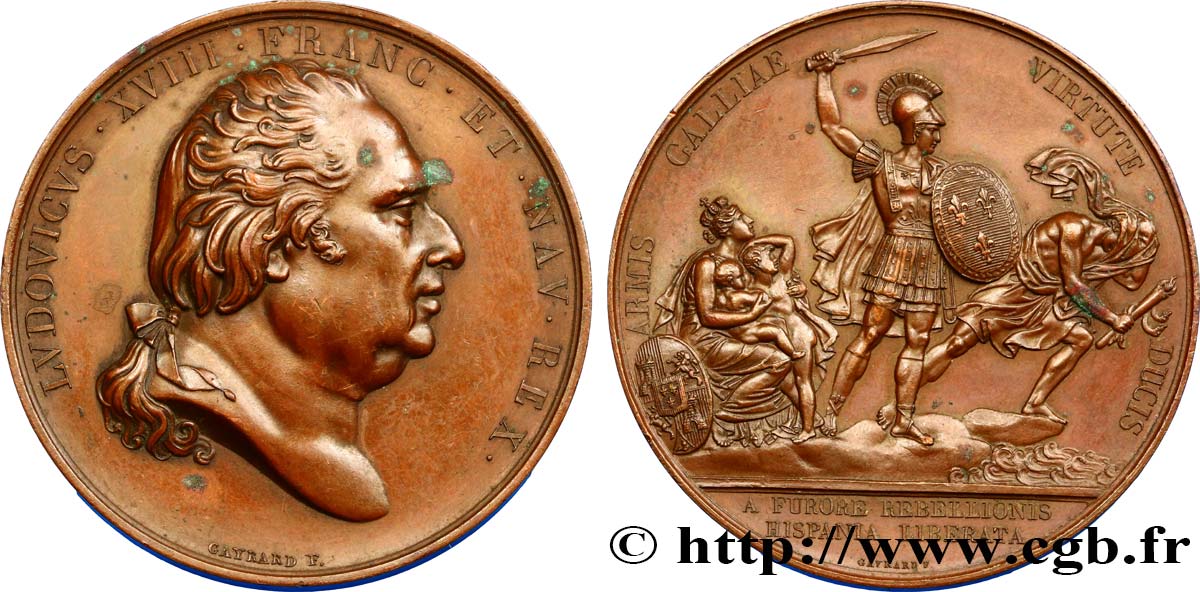
Type : Médaille, Restauration du trône d’Espagne
Date: 1823
Mint name / Town : Espagne
Metal : bronze
Diameter : 51 mm
Orientation dies : 12 h.
Engraver GAYRARD Raymond (1777-1858)
Weight : 68 g.
Edge : lisse
Puncheon : sans poinçon
Coments on the condition:
Patine marron hétérogène avec des concrétions vertes. Légère usure. Présence d equelques coups
Catalogue references :
Obverse
Obverse legend : LVDOVICVS. XVIII. FRANC. ET. NAV. REX..
Obverse description : Tête de Louis XVIII à droite, signé GAYRARD F. .
Reverse
Reverse legend : ARMIS GALLIAE - VIRTUTE DUCIS // A FURORE REBELLIONIS/ HISPANIA LIBERATA.
Reverse description : Guerrier debout vêtu à l'antique brandissant le glaive, le bouclier timbré de trois lys, repoussant l'ennemi vers la mer ; à gauche, l'Espagne assise retenant deux enfants, à ses pieds un bouclier timbré aux armes de Castille et de Léon, signé GAYRARD F. .
Commentary
Médaille signe GAYRARD F.
Raymond Gayrard, sculpteur-graveur, (Rodez, 25 octobre 1777-1858), est l'élève de François Rude et David d'Angers. Il expose au salon de Paris en 1827 et poursuit ses expositions tout au long de sa vie. En 1834, il obtient la deuxième place au concours et la médaille de première classe en 1846 et 1848. Il expose pour la dernière fois en 1855. Apprécié de la haute société française, il exécute beaucoup de bustes de personnalités contemporaines. Il est est également sculpteur animalier.
Paul Joseph Raymond Gayrard, dit Raymond Gayrard, né le 3 septembre 1807 à Clermont-Ferrand (Puy-de-Dôme) et mort en 1855 à Enghien-les-Bains (Val-d'Oise), est un sculpteur et graveur-médailleur français. Il étudie à un âge précoce avec son père.
La restauration absolutiste en Espagne, s'étendant de 1814 à 1833, est une période au cours de laquelle le pays connaît un rétablissement de la monarchie absolue des Bourbons.
Après la guerre d'indépendance contre l'occupant français, les Cortès se réunissent à Madrid en octobre 1813. Peu après, Napoléon reconnaît Ferdinand VII comme roi d'Espagne par le traité de Valençay. Fort du soutien de la majeure partie de la population espagnole, celui-ci rentre dans sa capitale, le 22 mars 1814, par le chemin de Valence. Il reçoit alors, de la main d'un groupe de fidèles de la monarchie le manifeste des Perses, une déclaration favorable à une restauration absolutiste.
Début 1823, la Sainte Alliance décide d'intervenir en Espagne, ainsi qu'elle l'a déjà fait à Naples et au Piémont. Le 22 janvier un traité secret est signé qui permet à la France d'envahir l'Espagne pour rétablir Ferdinand VII en monarque absolu.
Medal signed GAYRARD F.
Raymond Gayrard, sculptor-engraver, (Rodez, October 25, 1777-1858), was a student of François Rude and David d'Angers. He exhibited at the Paris Salon in 1827 and continued to exhibit throughout his life.. In 1834 he obtained second place in the competition and the first class medal in 1846 and 1848.. He exhibited for the last time in 1855. Appreciated by French high society, he executed many busts of contemporary personalities. He is also an animal sculptor.
Paul Joseph Raymond Gayrard, known as Raymond Gayrard, born on September 3, 1807 in Clermont-Ferrand (Puy-de-Dôme) and died in 1855 in Enghien-les-Bains (Val-d'Oise), was a French sculptor and engraver-medalist. He studied at an early age with his father.
The absolutist restoration in Spain, lasting from 1814 to 1833, was a period during which the country experienced a reestablishment of the absolute Bourbon monarchy..
After the war of independence against the French occupiers, the Cortes met in Madrid in October 1813.. Shortly after, Napoleon recognized Ferdinand VII as King of Spain by the Treaty of Valençay. With the support of the majority of the Spanish population, he returned to his capital on March 22, 1814, via Valencia.. He then received, from the hand of a group of loyalists of the monarchy, the manifesto of the Persians, a declaration in favor of an absolutist restoration.
At the beginning of 1823, the Holy Alliance decided to intervene in Spain, as it had already done in Naples and Piedmont.. On January 22, a secret treaty was signed that allowed France to invade Spain and reinstate Ferdinand VII as absolute monarch.
Raymond Gayrard, sculpteur-graveur, (Rodez, 25 octobre 1777-1858), est l'élève de François Rude et David d'Angers. Il expose au salon de Paris en 1827 et poursuit ses expositions tout au long de sa vie. En 1834, il obtient la deuxième place au concours et la médaille de première classe en 1846 et 1848. Il expose pour la dernière fois en 1855. Apprécié de la haute société française, il exécute beaucoup de bustes de personnalités contemporaines. Il est est également sculpteur animalier.
Paul Joseph Raymond Gayrard, dit Raymond Gayrard, né le 3 septembre 1807 à Clermont-Ferrand (Puy-de-Dôme) et mort en 1855 à Enghien-les-Bains (Val-d'Oise), est un sculpteur et graveur-médailleur français. Il étudie à un âge précoce avec son père.
La restauration absolutiste en Espagne, s'étendant de 1814 à 1833, est une période au cours de laquelle le pays connaît un rétablissement de la monarchie absolue des Bourbons.
Après la guerre d'indépendance contre l'occupant français, les Cortès se réunissent à Madrid en octobre 1813. Peu après, Napoléon reconnaît Ferdinand VII comme roi d'Espagne par le traité de Valençay. Fort du soutien de la majeure partie de la population espagnole, celui-ci rentre dans sa capitale, le 22 mars 1814, par le chemin de Valence. Il reçoit alors, de la main d'un groupe de fidèles de la monarchie le manifeste des Perses, une déclaration favorable à une restauration absolutiste.
Début 1823, la Sainte Alliance décide d'intervenir en Espagne, ainsi qu'elle l'a déjà fait à Naples et au Piémont. Le 22 janvier un traité secret est signé qui permet à la France d'envahir l'Espagne pour rétablir Ferdinand VII en monarque absolu.
Medal signed GAYRARD F.
Raymond Gayrard, sculptor-engraver, (Rodez, October 25, 1777-1858), was a student of François Rude and David d'Angers. He exhibited at the Paris Salon in 1827 and continued to exhibit throughout his life.. In 1834 he obtained second place in the competition and the first class medal in 1846 and 1848.. He exhibited for the last time in 1855. Appreciated by French high society, he executed many busts of contemporary personalities. He is also an animal sculptor.
Paul Joseph Raymond Gayrard, known as Raymond Gayrard, born on September 3, 1807 in Clermont-Ferrand (Puy-de-Dôme) and died in 1855 in Enghien-les-Bains (Val-d'Oise), was a French sculptor and engraver-medalist. He studied at an early age with his father.
The absolutist restoration in Spain, lasting from 1814 to 1833, was a period during which the country experienced a reestablishment of the absolute Bourbon monarchy..
After the war of independence against the French occupiers, the Cortes met in Madrid in October 1813.. Shortly after, Napoleon recognized Ferdinand VII as King of Spain by the Treaty of Valençay. With the support of the majority of the Spanish population, he returned to his capital on March 22, 1814, via Valencia.. He then received, from the hand of a group of loyalists of the monarchy, the manifesto of the Persians, a declaration in favor of an absolutist restoration.
At the beginning of 1823, the Holy Alliance decided to intervene in Spain, as it had already done in Naples and Piedmont.. On January 22, a secret treaty was signed that allowed France to invade Spain and reinstate Ferdinand VII as absolute monarch.
Historical background
LOUIS XVIII
(04/06/1814-09/16/1824)
Louis-Stanislas-Xavier was born in Versailles in 1755 from the union of Dauphin Louis (son of Louis XV) and Marie-Josèphe Louise de Savoie. He first received the title of Count of Provence and was called Monsieur when his older brother, Louis XVI, became king in 1774.. Married to Louise Marie-Joséphine de Savoie in 1771, he had no children. Often in opposition to the Court, he did not initially condemn the movement of 1789 but the evolution of events decided him to leave Paris in the company of his wife, the very day of Louis XVI's flight to Varennes, but by another way. Refugee in Koblenz with his brother, the Count of Artois, he took the title of regent after the execution of Louis XVI then, on the death of his nephew Louis XVII, that of king. He began to work on the restoration despite the weak support at his disposal and had to change residence several times in the face of the victories of the Revolution and of Bonaparte.. With the First Empire, the monarchical cause seemed hopeless and Louis XVIII settled in England in a period of exile and financial embarrassment.. During the first defeats of Napoleon I, Louis XVIII resumed his diplomatic activity which, on the initiative of Talleyrand and thanks to English support, enabled him to return to France in May 1814.. Forced to flee to Ghent during the Hundred Days, Louis XVIII, during the second Restoration, tried to carry out the same policy of reconciliation as that defined on his first return to France.. After the White Terror (execution of Marshal Ney), the regime softened and fell asleep. Duke Decazes replaces Richelieu from 1818. Despite royalist pressure, Louis XVIII strongly supported the moderate policy of Decazes in the early years. France is reintegrated into the concert of Nations after the Congress of Aix-la-Chapelle. Occupation forces leave France. The law on censorship is relaxed in 1819. That year, Géricault presented the Raft of the Medusa. The policy of conciliation ceases after the assassination of the Duke of Berry on February 13, 1820 by Louvel. Overwhelmed by the reaction of the ultras after this assassination, Decazes resigned on February 20 and the Duke of Richelieu was recalled, thus marking the triumph of the right for the end of the reign and for the following reign.. The child of the miracle, Henri, Duke of Bordeaux, posthumous son of Charles Duke of Berry and Marie-Caroline de Bourbon, was born on September 29, 1820. Napoleon I died in Saint Helena on May 5, 1821.. Villele replaces Richelieu on December 14, 1821. The end of the reign is marked by the expedition to Spain, commanded by the Duke of Angoulême, organized in order to restore Ferdinand VII, driven out by the liberals. The French took Madrid on May 23, Fort Trocadéro on August 31, and Cadiz on September 30, 1823.. Louis XVIII, ill and crippled (gout), died September 16, 1824. He is buried in Saint-Denis on September 23.
 Report a mistake
 Print the page
 Share my selection
 Ask a question
 Consign / sell
Related articles

 Full data


cgbfr.com numismatists


