


E-auction 571-516060 - fme_504140 - LOUIS XVIII Médaille, Naissance de Henri, duc de Bordeaux, futur comte de Chambord
You must signin and be an approved bidder to bid, LOGIN TO BID. Accounts are subject to approval and the approval process takes place within 48 hours. Do not wait until the day a sale closes to register. Clicking on « bid » constitutes acceptance of the terms of use of cgb.fr private e-auctions.
Bids must be placed in whole Euro amounts only. The sale will start closing at the time stated on the item description; any bids received at the site after the closing time will not be executed. Transmission times may vary and bids could be rejected if you wait until the last second. For further information ckeck the E-auctions F.A.Q.
NO BUYER'S FEE.
NO BUYER'S FEE.
| Estimate : | 80 € |
| Price : | 13 € |
| Maximum bid : | 32 € |
| End of the sale : | 25 March 2024 20:19:40 |
| bidders : | 4 bidders |
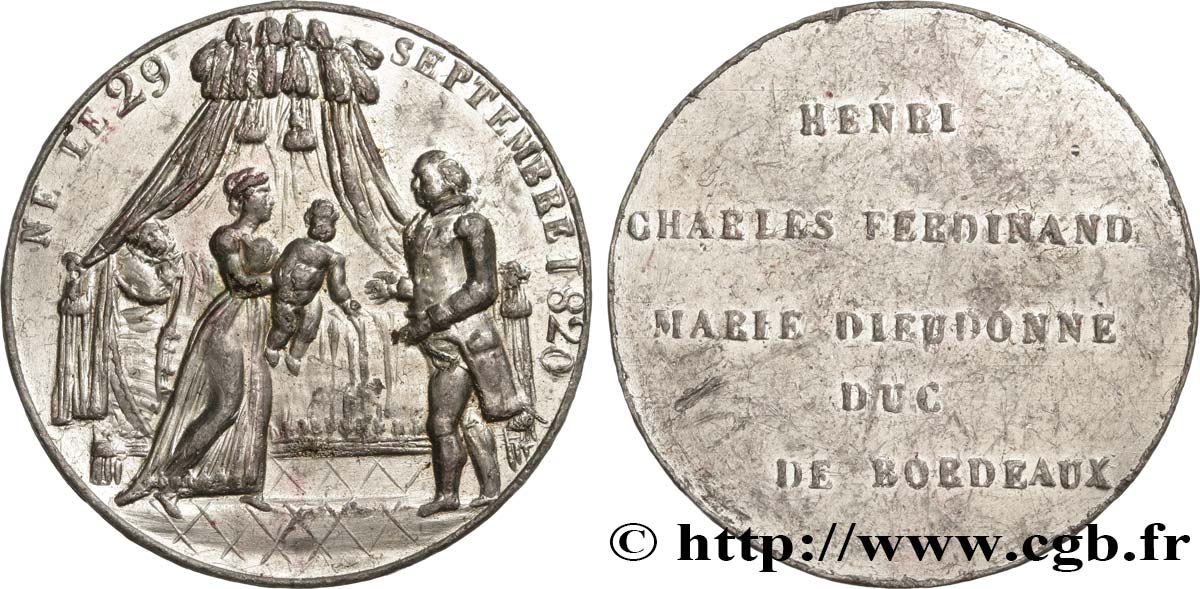
Type : Médaille, Naissance de Henri, duc de Bordeaux, futur comte de Chambord
Date: 1820
Metal : tin
Diameter : 39,5 mm
Orientation dies : 12 h.
Engraver ANDRIEU Jean-Bertrand (1761-1822)
Weight : 12,77 g.
Edge : lisse
Puncheon : sans poinçon
Coments on the condition:
Traces de manipulation. Présence de coups dans les champs, en particulier au revers
Catalogue references :
Obverse
Obverse legend : NE LE 29 - SEPTEMBRE 1820.
Obverse description : Scène de naissance, la duchesse de Berry est couchée dans un lit à voilages à l’arrière plan. Devant, femme debout à gauche, présentant l’enfant à un personnage en habit de cour à droite. Sol strié en losanges.
Reverse
Reverse legend : HENRI / CHARLES FERDINAND / MARIE DIEUDONNE / DUC / DE BORDEAUX.
Reverse description : Légende en 5 lignes.
Commentary
Henri d’Artois, petit-fils de France, duc de Bordeaux, est un prince de la famille royale de France, né le 29 septembre 1820 au palais des Tuileries à Paris, et mort le 24 août 1883 au château de Frohsdorf à Lanzenkirchen en Autriche. Petit-fils du roi Charles X, il est prétendant à la Couronne de France de 1844 à sa mort.
Le nom d'Henri d'Artois, qui est celui qui figure sur son acte de naissance, n'était pas son nom d'usage et n'a été utilisé ni par lui, ni par les Français. Sous la Restauration, il portait le titre de duc de Bordeaux, que lui donna Louis XVIII en hommage à la première ville qui se rallia aux Bourbons en 1814. De 1830 à sa mort, il prit le titre de courtoisie de « comte de Chambord », du nom du château qui lui avait été offert par une souscription nationale. Ses partisans le considérèrent comme le roi « Henri V ».
Il est le dernier descendant légitime en ligne masculine de Louis XV et de Marie Leszczyńska. Sa mort sans enfants en 1883 marque l'extinction de la branche Artois de la maison capétienne de Bourbon et le début d'une querelle (toujours d'actualité) entre les maisons de Bourbon d’Espagne et d'Orléans pour savoir laquelle a le plus de légitimité à la Couronne de France.
Henri d'Artois, grandson of France, Duke of Bordeaux, was a prince of the royal family of France, born on September 29, 1820 at the Tuileries Palace in Paris, and died on August 24, 1883 at the Frohsdorf Castle in Lanzenkirchen, Austria.. Grandson of King Charles X, he was a pretender to the Crown of France from 1844 until his death..
The name Henri d'Artois, which is the one that appears on his birth certificate, was not his usual name and was not used by him or by the French.. During the Restoration, he held the title of Duke of Bordeaux, given to him by Louis XVIII in homage to the first city to ally with the Bourbons in 1814.. From 1830 until his death, he took the courtesy title of \\\"Count of Chambord\\\", from the name of the château which had been given to him by a national subscription.. His supporters considered him King \\\"Henry V\\\".
He is the last legitimate descendant in the male line of Louis XV and Marie Leszczyńska. His childless death in 1883 marked the extinction of the Artois branch of the Capetian House of Bourbon and the beginning of a quarrel (still current) between the Houses of Bourbon of Spain and Orléans to determine which had the most legitimacy to the Crown of France.
Le nom d'Henri d'Artois, qui est celui qui figure sur son acte de naissance, n'était pas son nom d'usage et n'a été utilisé ni par lui, ni par les Français. Sous la Restauration, il portait le titre de duc de Bordeaux, que lui donna Louis XVIII en hommage à la première ville qui se rallia aux Bourbons en 1814. De 1830 à sa mort, il prit le titre de courtoisie de « comte de Chambord », du nom du château qui lui avait été offert par une souscription nationale. Ses partisans le considérèrent comme le roi « Henri V ».
Il est le dernier descendant légitime en ligne masculine de Louis XV et de Marie Leszczyńska. Sa mort sans enfants en 1883 marque l'extinction de la branche Artois de la maison capétienne de Bourbon et le début d'une querelle (toujours d'actualité) entre les maisons de Bourbon d’Espagne et d'Orléans pour savoir laquelle a le plus de légitimité à la Couronne de France.
Henri d'Artois, grandson of France, Duke of Bordeaux, was a prince of the royal family of France, born on September 29, 1820 at the Tuileries Palace in Paris, and died on August 24, 1883 at the Frohsdorf Castle in Lanzenkirchen, Austria.. Grandson of King Charles X, he was a pretender to the Crown of France from 1844 until his death..
The name Henri d'Artois, which is the one that appears on his birth certificate, was not his usual name and was not used by him or by the French.. During the Restoration, he held the title of Duke of Bordeaux, given to him by Louis XVIII in homage to the first city to ally with the Bourbons in 1814.. From 1830 until his death, he took the courtesy title of \\\"Count of Chambord\\\", from the name of the château which had been given to him by a national subscription.. His supporters considered him King \\\"Henry V\\\".
He is the last legitimate descendant in the male line of Louis XV and Marie Leszczyńska. His childless death in 1883 marked the extinction of the Artois branch of the Capetian House of Bourbon and the beginning of a quarrel (still current) between the Houses of Bourbon of Spain and Orléans to determine which had the most legitimacy to the Crown of France.
Historical background
LOUIS XVIII
(04/06/1814-09/16/1824)
Louis-Stanislas-Xavier was born in Versailles in 1755 from the union of Dauphin Louis (son of Louis XV) and Marie-Josèphe Louise de Savoie. He first received the title of Count of Provence and was called Monsieur when his older brother, Louis XVI, became king in 1774.. Married to Louise Marie-Joséphine de Savoie in 1771, he had no children. Often in opposition to the Court, he did not initially condemn the movement of 1789 but the evolution of events decided him to leave Paris in the company of his wife, the very day of Louis XVI's flight to Varennes, but by another way. Refugee in Koblenz with his brother, the Count of Artois, he took the title of regent after the execution of Louis XVI then, on the death of his nephew Louis XVII, that of king. He began to work on the restoration despite the weak support at his disposal and had to change residence several times in the face of the victories of the Revolution and of Bonaparte.. With the First Empire, the monarchical cause seemed hopeless and Louis XVIII settled in England in a period of exile and financial embarrassment.. During the first defeats of Napoleon I, Louis XVIII resumed his diplomatic activity which, on the initiative of Talleyrand and thanks to English support, enabled him to return to France in May 1814.. Forced to flee to Ghent during the Hundred Days, Louis XVIII, during the second Restoration, tried to carry out the same policy of reconciliation as that defined on his first return to France.. After the White Terror (execution of Marshal Ney), the regime softened and fell asleep. Duke Decazes replaces Richelieu from 1818. Despite royalist pressure, Louis XVIII strongly supported the moderate policy of Decazes in the early years. France is reintegrated into the concert of Nations after the Congress of Aix-la-Chapelle. Occupation forces leave France. The law on censorship is relaxed in 1819. That year, Géricault presented the Raft of the Medusa. The policy of conciliation ceases after the assassination of the Duke of Berry on February 13, 1820 by Louvel. Overwhelmed by the reaction of the ultras after this assassination, Decazes resigned on February 20 and the Duke of Richelieu was recalled, thus marking the triumph of the right for the end of the reign and for the following reign.. The child of the miracle, Henri, Duke of Bordeaux, posthumous son of Charles Duke of Berry and Marie-Caroline de Bourbon, was born on September 29, 1820. Napoleon I died in Saint Helena on May 5, 1821.. Villele replaces Richelieu on December 14, 1821. The end of the reign is marked by the expedition to Spain, commanded by the Duke of Angoulême, organized in order to restore Ferdinand VII, driven out by the liberals. The French took Madrid on May 23, Fort Trocadéro on August 31, and Cadiz on September 30, 1823.. Louis XVIII, ill and crippled (gout), died September 16, 1824. He is buried in Saint-Denis on September 23.
 Report a mistake
 Print the page
 Share my selection
 Ask a question
 Consign / sell
Related articles
 Full data


cgbfr.com numismatists


