


Back 1/1
Live auction - fme_519545 - LOUIS XVIII Médaille, Marie-Thérèse Charlotte de France
You must signin and be an approved bidder to bid, LOGIN TO BID. Accounts are subject to approval and the approval process takes place within 48 hours. Do not wait until the day a sale closes to register. Clicking on "BID" constitutes acceptance of the terms of use of cgb.fr private live auctions.
Bids must be placed in whole Euro amounts only. The sale will start closing at the time stated on the item description; any bids received at the site after the closing time will not be executed. Transmission times may vary and bids could be rejected if you wait until the last second. For further information check the Live auction FAQ
All winning bids are subject to a 18% buyer’s fee.
All winning bids are subject to a 18% buyer’s fee.
| Estimate : | 150 € |
| Price : | 75 € |
| Maximum bid : | 75 € |
| End of the sale : | 29 January 2019 17:36:32 |
| bidders : | 1 bidder |
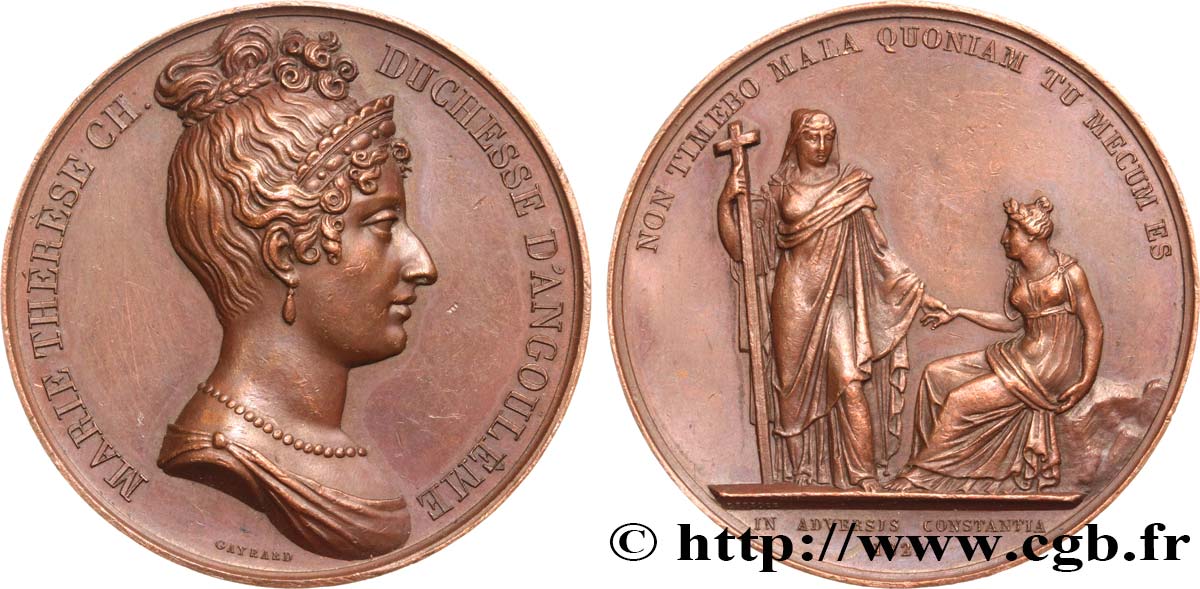
Type : Médaille, Marie-Thérèse Charlotte de France
Date: 1821
Metal : bronze
Diameter : 40,5 mm
Orientation dies : 12 h.
Engraver GAYRARD Raymond (1777-1858)
Weight : 38,1 g.
Edge : lisse
Puncheon : sans poinçon
Coments on the condition:
Patine hétérogène. Présence de coups et rayures suite à un léger nettoyage dans les champs
Obverse
Obverse legend : MARIE THÉRÈSE CH. - DUCHESSE D’ANGOULÊME.
Obverse description : Buste à droite de la duchesse d’Angoulême. Signé : GAYRARD.
Reverse
Reverse legend : NON TIMEBO MALA QUONIAM TU MECUM ES // À L’EXERGUE : IN ADVERSIS CONSTANTIA / 1821..
Reverse description : La Religion tenant la main d'une femme assise. Signé sur la plinthe : LEVEQUE.
Commentary
Marie-Thérèse Charlotte de France, surnommée « Madame Royale », née le 19 décembre 1778 à Versailles et morte le 19 octobre 1851 à Frohsdorf en Autriche, est le premier enfant de Louis XVI et Marie-Antoinette. Après une enfance passée à la Cour, elle est la seule des enfants royaux à survivre à la Révolution française. Condamnée par les insurgés puis réduite à l’exil, Marie-Thérèse Charlotte, devenue Dauphine de France en 1824, et qui aurait pu devenir reine de France lors des journées de 1830, reste attachée à la monarchie jusqu’à la fin de sa vie. C'est en exil sous le titre de courtoisie de “comtesse de Marnes” qu'elle décède le 19 octobre 1851 à Frohsdorf en Autriche.
En tant qu'unique rescapée de la famille royale stricto sensu, la timide princesse devint alors bien malgré elle, une véritable « célébrité ». Pour tous c'est « l'Orpheline du Temple », nom qui ne la quitte plus. Ses admirateurs vont ainsi jusqu’à louer un appartement en face du Temple : on la scrute pour rendre compte de ses faits et gestes quotidiens et mieux la réinventer. Plus largement, on en fait l’héroïne de chansons, de poèmes et de récits au goût du jour, qui ont sa souffrance et son histoire, et non son rang, pour principal ressort. Elle devient alors le meilleur agent de propagande des royalistes, instrument politique, certes, mais un instrument révéré et adoré de ses partisans et ce durant toute sa vie.
Marie-Thérèse Charlotte of France, nicknamed \\\"Madame Royale\\\", born on December 19, 1778 in Versailles and died on October 19, 1851 in Frohsdorf in Austria, is the first child of Louis XVI and Marie-Antoinette. After a childhood spent at Court, she was the only royal child to survive the French Revolution.. Condemned by the insurgents and then reduced to exile, Marie-Thérèse Charlotte, who became Dauphine of France in 1824, and who could have become Queen of France during the events of 1830, remained attached to the monarchy until the end of her life.. It was in exile under the courtesy title of “Countess of Marnes” that she died on October 19, 1851 in Frohsdorf, Austria..
As the only survivor of the royal family in the strict sense, the shy princess then became, in spite of herself, a real \\\"celebrity\\\".. For everyone she is \\\"the Orphan of the Temple\\\", a name that never leaves her.. Her admirers even go so far as to rent an apartment opposite the Temple: she is scrutinized to report on her daily actions and better reinvent her.. More broadly, she is made the heroine of songs, poems and stories in the style of the day, which have her suffering and her story, and not her rank, as their main driving force.. She then became the best propaganda agent of the royalists, a political instrument, certainly, but an instrument revered and adored by her supporters throughout her life.
En tant qu'unique rescapée de la famille royale stricto sensu, la timide princesse devint alors bien malgré elle, une véritable « célébrité ». Pour tous c'est « l'Orpheline du Temple », nom qui ne la quitte plus. Ses admirateurs vont ainsi jusqu’à louer un appartement en face du Temple : on la scrute pour rendre compte de ses faits et gestes quotidiens et mieux la réinventer. Plus largement, on en fait l’héroïne de chansons, de poèmes et de récits au goût du jour, qui ont sa souffrance et son histoire, et non son rang, pour principal ressort. Elle devient alors le meilleur agent de propagande des royalistes, instrument politique, certes, mais un instrument révéré et adoré de ses partisans et ce durant toute sa vie.
Marie-Thérèse Charlotte of France, nicknamed \\\"Madame Royale\\\", born on December 19, 1778 in Versailles and died on October 19, 1851 in Frohsdorf in Austria, is the first child of Louis XVI and Marie-Antoinette. After a childhood spent at Court, she was the only royal child to survive the French Revolution.. Condemned by the insurgents and then reduced to exile, Marie-Thérèse Charlotte, who became Dauphine of France in 1824, and who could have become Queen of France during the events of 1830, remained attached to the monarchy until the end of her life.. It was in exile under the courtesy title of “Countess of Marnes” that she died on October 19, 1851 in Frohsdorf, Austria..
As the only survivor of the royal family in the strict sense, the shy princess then became, in spite of herself, a real \\\"celebrity\\\".. For everyone she is \\\"the Orphan of the Temple\\\", a name that never leaves her.. Her admirers even go so far as to rent an apartment opposite the Temple: she is scrutinized to report on her daily actions and better reinvent her.. More broadly, she is made the heroine of songs, poems and stories in the style of the day, which have her suffering and her story, and not her rank, as their main driving force.. She then became the best propaganda agent of the royalists, a political instrument, certainly, but an instrument revered and adored by her supporters throughout her life.
Historical background
LOUIS XVIII
(04/06/1814-09/16/1824)
Louis-Stanislas-Xavier was born in Versailles in 1755 from the union of Dauphin Louis (son of Louis XV) and Marie-Josèphe Louise de Savoie. He first received the title of Count of Provence and was called Monsieur when his older brother, Louis XVI, became king in 1774.. Married to Louise Marie-Joséphine de Savoie in 1771, he had no children. Often in opposition to the Court, he did not initially condemn the movement of 1789 but the evolution of events decided him to leave Paris in the company of his wife, the very day of Louis XVI's flight to Varennes, but by another way. Refugee in Koblenz with his brother, the Count of Artois, he took the title of regent after the execution of Louis XVI then, on the death of his nephew Louis XVII, that of king. He began to work on the restoration despite the weak support at his disposal and had to change residence several times in the face of the victories of the Revolution and of Bonaparte.. With the First Empire, the monarchical cause seemed hopeless and Louis XVIII settled in England in a period of exile and financial embarrassment.. During the first defeats of Napoleon I, Louis XVIII resumed his diplomatic activity which, on the initiative of Talleyrand and thanks to English support, enabled him to return to France in May 1814.. Forced to flee to Ghent during the Hundred Days, Louis XVIII, during the second Restoration, tried to carry out the same policy of reconciliation as that defined on his first return to France.. After the White Terror (execution of Marshal Ney), the regime softened and fell asleep. Duke Decazes replaces Richelieu from 1818. Despite royalist pressure, Louis XVIII strongly supported the moderate policy of Decazes in the early years. France is reintegrated into the concert of Nations after the Congress of Aix-la-Chapelle. Occupation forces leave France. The law on censorship is relaxed in 1819. That year, Géricault presented the Raft of the Medusa. The policy of conciliation ceases after the assassination of the Duke of Berry on February 13, 1820 by Louvel. Overwhelmed by the reaction of the ultras after this assassination, Decazes resigned on February 20 and the Duke of Richelieu was recalled, thus marking the triumph of the right for the end of the reign and for the following reign.. The child of the miracle, Henri, Duke of Bordeaux, posthumous son of Charles Duke of Berry and Marie-Caroline de Bourbon, was born on September 29, 1820. Napoleon I died in Saint Helena on May 5, 1821.. Villele replaces Richelieu on December 14, 1821. The end of the reign is marked by the expedition to Spain, commanded by the Duke of Angoulême, organized in order to restore Ferdinand VII, driven out by the liberals. The French took Madrid on May 23, Fort Trocadéro on August 31, and Cadiz on September 30, 1823.. Louis XVIII, ill and crippled (gout), died September 16, 1824. He is buried in Saint-Denis on September 23.
 Report a mistake
 Print the page
 Share my selection
 Ask a question
 Consign / sell
Related articles

 Full data

Your Recently Viewed Items

500 Nouveaux Francs MOLIÈRE FRANCE 1959 F.60.01 F
174.00 €

MACEDONIA - KINGDOM OF MACEDONIA - PHILIP III ARRHIDAEUS Drachme AU
480.00 €
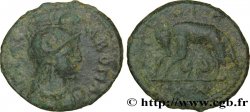
OSTROGOTHIC KINGDOM - ODOVACER Demi follis municipal à la louve, 20 nummi VF/XF
94.00 €

LOUIS XVIII Médaille, Marie-Thérèse Charlotte de France AU
75.00 €

RUSSIA 3 Roubles Proof 50e anniversaire de la victoire sur la Volga 1993 Moscou
25.00 €

50 Francs RACINE FRANCE 1962 F.64.01 UNC
155.00 €
cgbfr.com numismatists


