


fme_369950 - LOUIS XVIII Médaille de la chapelle expiatoire de Louis XVI et Marie-Antoinette
Not available.
Item sold on our e-shop (2017)
Price : 125.00 €
Item sold on our e-shop (2017)
Price : 125.00 €
Type : Médaille de la chapelle expiatoire de Louis XVI et Marie-Antoinette
Date: 1826
Mint name / Town : 75 - Paris
Metal : bronze
Diameter : 51 mm
Orientation dies : 12 h.
Weight : 47 g.
Edge : lisse
Coments on the condition:
Superbe médaille en excellent état avec une très belle patine brune
Obverse
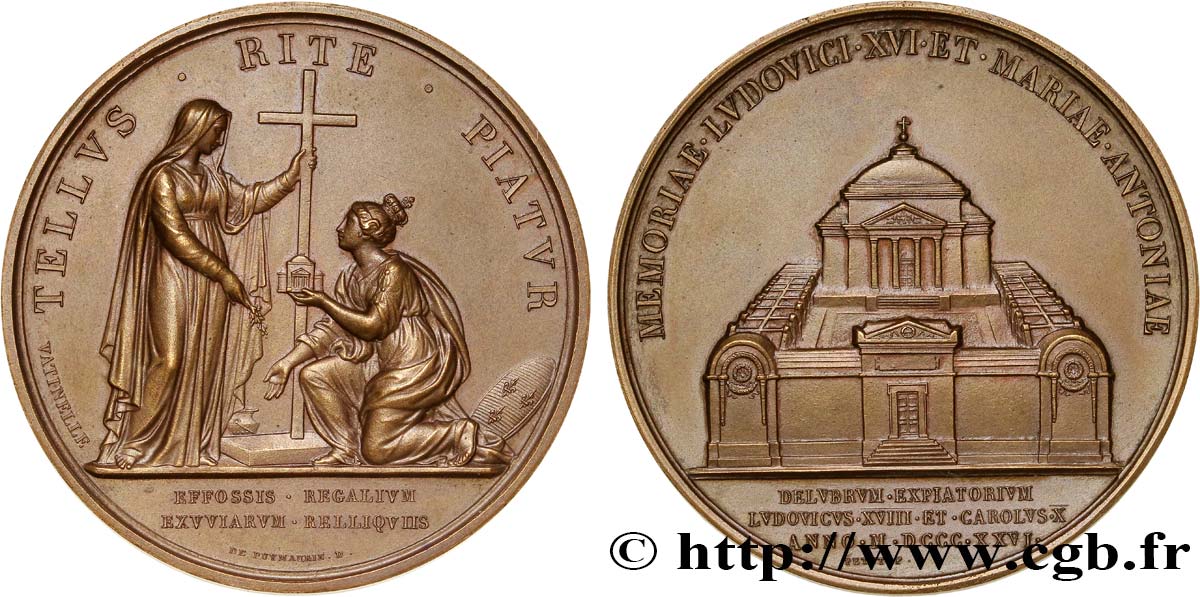
Obverse legend : TELLVS . RITE . PIATVR.
Obverse description : La France présente la maquette de la chapelle à la Religion. Signé : VATINELLE et DE PUYMAURIN D..
Reverse
Reverse legend : MEMORIAE. LVDOVICI. XVI. ET. MARIAE. ANTONIAE // À L’EXERGUE : DELVBRVM. EXPIATORIVM. / LVDOVICVS. XVIII. ET. CAROLVS. X. / ANNO. M.DCCC.XXVI..
Reverse description : Vue de la chapelle expiatoire ; à l'exergue, légende en 3 lignes. Signé : PETIT F..
Commentary
Médaille avec aucun poinçon sur tranche.
La chapelle est située sur l'emplacement de l'ancien cimetière de la Madeleine, où furent inhumés en 1793 les corps de Louis XVI et de Marie-Antoinette. Cette chapelle est l'œuvre de l'architecte Fontaine et se trouve à l'angle de la rue d'Anjou dans le square Louis XVI (VIIIe arrondissement).
Usrin Jules VATINELLE serait un graveur né à Paris en 1798 ; il auait été l’élève de Gatteaux ; il est 1er Grand Prix de Rome en médaille en 1819.
Jean-Pierre-Casimir Marcassus, Baron de Puymaurin, (1757-1841 Toulouse) était un chimiste, et membre de l'Académie des Sciences Inscriptions et Belles-Lettres de Toulouse. Nommé le 1er mai 1816 directeur de la Monnaie Royale des Médailles, c'est lui qui proposa et fit adopter l'inscription qui figure sur le monument expiatoire de Louis XVI.
Louis-Michel PETIT (1791-1844) Michel Petit, qui avait alors conquis une place honorable parmi les graveurs en médailles, obtint plusieurs commandes du gouvernement. En 1826, il fut chargé de faire le revers de la médaille exécutée à l'occasion de l'inauguration de la chapelle expiatoire élevée rue d'Anjou, à Paris, en l'honneur de Louis XVI et de Marie-Antoinette.
L'année suivante, il fut choisi par le roi pour graver la médaille commémorative du rétablissement de la statue de Louis XIV sur une des places publiques de la ville de Caen.
.
Medal with no hallmark on the edge.
The chapel is located on the site of the former Madeleine cemetery, where the bodies of Louis XVI and Marie-Antoinette were buried in 1793.. This chapel is the work of the architect Fontaine and is located at the corner of rue d'Anjou in square Louis XVI (8th arrondissement).
Usrin Jules VATINELLE was an engraver born in Paris in 1798; he was a student of Gatteaux; he won the 1st Grand Prix de Rome medal in 1819.
Jean-Pierre-Casimir Marcassus, Baron de Puymaurin, (1757-1841 Toulouse) was a chemist, and member of the Academy of Sciences, Inscriptions and Belles-Lettres of Toulouse. Appointed on May 1, 1816, director of the Royal Mint of Medals, it was he who proposed and had adopted the inscription which appears on the expiatory monument of Louis XVI..
Louis-Michel PETIT (1791-1844) Michel Petit, who had then achieved an honorable place among medal engravers, obtained several government commissions. In 1826, he was commissioned to make the reverse of the medal executed on the occasion of the inauguration of the expiatory chapel built on rue d'Anjou, in Paris, in honor of Louis XVI and Marie-Antoinette..
The following year, he was chosen by the king to engrave the commemorative medal for the restoration of the statue of Louis XIV in one of the public squares of the city of Caen..
La chapelle est située sur l'emplacement de l'ancien cimetière de la Madeleine, où furent inhumés en 1793 les corps de Louis XVI et de Marie-Antoinette. Cette chapelle est l'œuvre de l'architecte Fontaine et se trouve à l'angle de la rue d'Anjou dans le square Louis XVI (VIIIe arrondissement).
Usrin Jules VATINELLE serait un graveur né à Paris en 1798 ; il auait été l’élève de Gatteaux ; il est 1er Grand Prix de Rome en médaille en 1819.
Jean-Pierre-Casimir Marcassus, Baron de Puymaurin, (1757-1841 Toulouse) était un chimiste, et membre de l'Académie des Sciences Inscriptions et Belles-Lettres de Toulouse. Nommé le 1er mai 1816 directeur de la Monnaie Royale des Médailles, c'est lui qui proposa et fit adopter l'inscription qui figure sur le monument expiatoire de Louis XVI.
Louis-Michel PETIT (1791-1844) Michel Petit, qui avait alors conquis une place honorable parmi les graveurs en médailles, obtint plusieurs commandes du gouvernement. En 1826, il fut chargé de faire le revers de la médaille exécutée à l'occasion de l'inauguration de la chapelle expiatoire élevée rue d'Anjou, à Paris, en l'honneur de Louis XVI et de Marie-Antoinette.
L'année suivante, il fut choisi par le roi pour graver la médaille commémorative du rétablissement de la statue de Louis XIV sur une des places publiques de la ville de Caen.
.
Medal with no hallmark on the edge.
The chapel is located on the site of the former Madeleine cemetery, where the bodies of Louis XVI and Marie-Antoinette were buried in 1793.. This chapel is the work of the architect Fontaine and is located at the corner of rue d'Anjou in square Louis XVI (8th arrondissement).
Usrin Jules VATINELLE was an engraver born in Paris in 1798; he was a student of Gatteaux; he won the 1st Grand Prix de Rome medal in 1819.
Jean-Pierre-Casimir Marcassus, Baron de Puymaurin, (1757-1841 Toulouse) was a chemist, and member of the Academy of Sciences, Inscriptions and Belles-Lettres of Toulouse. Appointed on May 1, 1816, director of the Royal Mint of Medals, it was he who proposed and had adopted the inscription which appears on the expiatory monument of Louis XVI..
Louis-Michel PETIT (1791-1844) Michel Petit, who had then achieved an honorable place among medal engravers, obtained several government commissions. In 1826, he was commissioned to make the reverse of the medal executed on the occasion of the inauguration of the expiatory chapel built on rue d'Anjou, in Paris, in honor of Louis XVI and Marie-Antoinette..
The following year, he was chosen by the king to engrave the commemorative medal for the restoration of the statue of Louis XIV in one of the public squares of the city of Caen..
Historical background
LOUIS XVIII
(04/06/1814-09/16/1824)
Louis-Stanislas-Xavier was born in Versailles in 1755 from the union of Dauphin Louis (son of Louis XV) and Marie-Josèphe Louise de Savoie. He first received the title of Count of Provence and was called Monsieur when his older brother, Louis XVI, became king in 1774.. Married to Louise Marie-Joséphine de Savoie in 1771, he had no children. Often in opposition to the Court, he did not initially condemn the movement of 1789 but the evolution of events decided him to leave Paris in the company of his wife, the very day of Louis XVI's flight to Varennes, but by another way. Refugee in Koblenz with his brother, the Count of Artois, he took the title of regent after the execution of Louis XVI then, on the death of his nephew Louis XVII, that of king. He began to work on the restoration despite the weak support at his disposal and had to change residence several times in the face of the victories of the Revolution and of Bonaparte.. With the First Empire, the monarchical cause seemed hopeless and Louis XVIII settled in England in a period of exile and financial embarrassment.. During the first defeats of Napoleon I, Louis XVIII resumed his diplomatic activity which, on the initiative of Talleyrand and thanks to English support, enabled him to return to France in May 1814.. Forced to flee to Ghent during the Hundred Days, Louis XVIII, during the second Restoration, tried to carry out the same policy of reconciliation as that defined on his first return to France.. After the White Terror (execution of Marshal Ney), the regime softened and fell asleep. Duke Decazes replaces Richelieu from 1818. Despite royalist pressure, Louis XVIII strongly supported the moderate policy of Decazes in the early years. France is reintegrated into the concert of Nations after the Congress of Aix-la-Chapelle. Occupation forces leave France. The law on censorship is relaxed in 1819. That year, Géricault presented the Raft of the Medusa. The policy of conciliation ceases after the assassination of the Duke of Berry on February 13, 1820 by Louvel. Overwhelmed by the reaction of the ultras after this assassination, Decazes resigned on February 20 and the Duke of Richelieu was recalled, thus marking the triumph of the right for the end of the reign and for the following reign.. The child of the miracle, Henri, Duke of Bordeaux, posthumous son of Charles Duke of Berry and Marie-Caroline de Bourbon, was born on September 29, 1820. Napoleon I died in Saint Helena on May 5, 1821.. Villele replaces Richelieu on December 14, 1821. The end of the reign is marked by the expedition to Spain, commanded by the Duke of Angoulême, organized in order to restore Ferdinand VII, driven out by the liberals. The French took Madrid on May 23, Fort Trocadéro on August 31, and Cadiz on September 30, 1823.. Louis XVIII, ill and crippled (gout), died September 16, 1824. He is buried in Saint-Denis on September 23.
 Report a mistake
 Print the page
 Share my selection
 Ask a question
 Consign / sell
Related articles
 Full data



cgbfr.com numismatists


