


Live auction - fme_923445 - LOUIS XVI Médaille, Canal du Centre

You must signin and be an approved bidder to bid, LOGIN TO BID. Accounts are subject to approval and the approval process takes place within 48 hours. Do not wait until the day a sale closes to register. Clicking on "BID" constitutes acceptance of the terms of use of cgb.fr private live auctions.
Bids must be placed in whole Euro amounts only. The sale will start closing at the time stated on the item description; any bids received at the site after the closing time will not be executed. Transmission times may vary and bids could be rejected if you wait until the last second. For further information check the Live auction FAQ
All winning bids are subject to a 18% buyer’s fee.
All winning bids are subject to a 18% buyer’s fee.
| Estimate : | 120 € |
| Price : | 62 € |
| Maximum bid : | 65 € |
| End of the sale : | 09 July 2024 17:23:10 |
| bidders : | 2 bidders |
Type : Médaille, Canal du Centre
Date: 1783
Metal : copper
Diameter : 50 mm
Orientation dies : 12 h.
Engraver DUVIVIER Benjamin (1730-1819)
Weight : 61,29 g.
Edge : lisse
Puncheon : sans poinçon
Coments on the condition:
Patine marron hétérogène présentant quelques coups et rayures, notamment sur la tranche. Restes de brillant de frappe au revers
Obverse
Obverse legend : LUDOVICO XVI. FR. ET NAVAR. REGI OPTIMO // À L’EXERGUE : COMITIA BURGUNDIAE.
Obverse description : Buste habillé et drapé de louis XVI à droite. Signé sous le buste : DU VIVIER.
Reverse
Reverse legend : UTRIUSQUE MARIS JUNCTIO TRIPLEX // À L’EXERGUE : FOSSIS AB ARARI / AD LIGERIM SEQUANAM ET RHENUM / SIMUL APERTIS / MDCCLXXXIII.
Reverse description : La Bourgogne personnifiée assise avec une corne d’abondance et de bouclier à ses pieds, tenant un caducée de la main droite ; autour d’elle les dieux fleuves du Rhin, de la Saône et de la Loire. Signé à l’exergue : DU VIVIER.
Commentary
Le canal du Centre relie les vallées de la Loire et de la Saône. Le canal est également connu comme canal du Charolais.
La Dheune, affluent de la Saône, et la Bourbince, affluent de la Loire, ont depuis longtemps (XVe-XVIe siècles) retenu l'attention des ingénieurs par l'orientation de leurs cours qui permettaient d'envisager une liaison entre le sillon rhodanien et la Méditerranée d'une part, et l'Atlantique ou la Manche, la Loire étant elle-même reliée à la Seine depuis 1642 par le canal de Briare. Le projet soutenu par l'ingénieur Thomassin est d'abord en concurrence avec le canal de Bourgogne mais les deux canaux seront finalement réalisés.Le grand artisan du canal du Centre est Émiland Gauthey (1732-1806), ingénieur des États de Bourgogne : son projet élaboré et modifié pendant plusieurs années est approuvé en 1782 par le Parlement de Bourgogne et réalisé de 1784 à 1791/1793 sous son autorité. Appelé à l'origine « canal du Charolais », l'ouvrage, alimenté par les étangs et les divers cours d'eau des bassins versants, comprend un canal latéral à la Bourbince de Digoin à Montceau-les-Mines, un canal à bief de partage de Montceau à Saint-Julien-sur-Dheune, un canal latéral à la Dheune de Saint-Julien à Chagny, un canal de jonction par dérivation de la Dheune vers la Thalie par la tranchée de Chagny à Rully et un canal latéral à la Thalie de Rully à Chalon-sur-Saône. À l'initiative d’Émiland Gauthey, on a préféré le tracé le plus court en ne suivant pas le cours inférieur de la Dheune : celui-ci manquait de profondeur et présentait de grandes variations de débit (sécheresse et inondations) avec de nombreux méandres et parfois plusieurs bras, de plus la rivière n'aboutissait pas à un port.
The Canal du Centre links the Loire and Saône valleys. The canal is also known as the Charolais Canal.
The Dheune, a tributary of the Saône, and the Bourbince, a tributary of the Loire, have long (15th-16th centuries) attracted the attention of engineers due to the orientation of their courses which made it possible to envisage a link between the Rhone valley and the Mediterranean on the one hand, and the Atlantic or the Channel, the Loire itself being linked to the Seine since 1642 by the Briare Canal. The project supported by engineer Thomassin was initially in competition with the Burgundy Canal, but both canals were ultimately completed.. The main architect of the Canal du Centre was Émiland Gauthey (1732-1806), engineer of the States of Burgundy: his project, developed and modified over several years, was approved in 1782 by the Parliament of Burgundy and carried out from 1784 to 1791/1793 under his authority.. Originally called the \\\"Charolais Canal\\\", the structure, fed by the ponds and various watercourses in the watersheds, includes a lateral canal to the Bourbince from Digoin to Montceau-les-Mines, a canal with a watershed from Montceau to Saint-Julien-sur-Dheune, a lateral canal to the Dheune from Saint-Julien to Chagny, a junction canal by diversion from the Dheune to the Thalie via the Chagny trench to Rully and a lateral canal to the Thalie from Rully to Chalon-sur-Saône. At the initiative of Émiland Gauthey, the shorter route was preferred by not following the lower course of the Dheune: this lacked depth and presented large variations in flow (drought and floods) with numerous meanders and sometimes several arms, moreover the river did not end at a port
La Dheune, affluent de la Saône, et la Bourbince, affluent de la Loire, ont depuis longtemps (XVe-XVIe siècles) retenu l'attention des ingénieurs par l'orientation de leurs cours qui permettaient d'envisager une liaison entre le sillon rhodanien et la Méditerranée d'une part, et l'Atlantique ou la Manche, la Loire étant elle-même reliée à la Seine depuis 1642 par le canal de Briare. Le projet soutenu par l'ingénieur Thomassin est d'abord en concurrence avec le canal de Bourgogne mais les deux canaux seront finalement réalisés.Le grand artisan du canal du Centre est Émiland Gauthey (1732-1806), ingénieur des États de Bourgogne : son projet élaboré et modifié pendant plusieurs années est approuvé en 1782 par le Parlement de Bourgogne et réalisé de 1784 à 1791/1793 sous son autorité. Appelé à l'origine « canal du Charolais », l'ouvrage, alimenté par les étangs et les divers cours d'eau des bassins versants, comprend un canal latéral à la Bourbince de Digoin à Montceau-les-Mines, un canal à bief de partage de Montceau à Saint-Julien-sur-Dheune, un canal latéral à la Dheune de Saint-Julien à Chagny, un canal de jonction par dérivation de la Dheune vers la Thalie par la tranchée de Chagny à Rully et un canal latéral à la Thalie de Rully à Chalon-sur-Saône. À l'initiative d’Émiland Gauthey, on a préféré le tracé le plus court en ne suivant pas le cours inférieur de la Dheune : celui-ci manquait de profondeur et présentait de grandes variations de débit (sécheresse et inondations) avec de nombreux méandres et parfois plusieurs bras, de plus la rivière n'aboutissait pas à un port.
The Canal du Centre links the Loire and Saône valleys. The canal is also known as the Charolais Canal.
The Dheune, a tributary of the Saône, and the Bourbince, a tributary of the Loire, have long (15th-16th centuries) attracted the attention of engineers due to the orientation of their courses which made it possible to envisage a link between the Rhone valley and the Mediterranean on the one hand, and the Atlantic or the Channel, the Loire itself being linked to the Seine since 1642 by the Briare Canal. The project supported by engineer Thomassin was initially in competition with the Burgundy Canal, but both canals were ultimately completed.. The main architect of the Canal du Centre was Émiland Gauthey (1732-1806), engineer of the States of Burgundy: his project, developed and modified over several years, was approved in 1782 by the Parliament of Burgundy and carried out from 1784 to 1791/1793 under his authority.. Originally called the \\\"Charolais Canal\\\", the structure, fed by the ponds and various watercourses in the watersheds, includes a lateral canal to the Bourbince from Digoin to Montceau-les-Mines, a canal with a watershed from Montceau to Saint-Julien-sur-Dheune, a lateral canal to the Dheune from Saint-Julien to Chagny, a junction canal by diversion from the Dheune to the Thalie via the Chagny trench to Rully and a lateral canal to the Thalie from Rully to Chalon-sur-Saône. At the initiative of Émiland Gauthey, the shorter route was preferred by not following the lower course of the Dheune: this lacked depth and presented large variations in flow (drought and floods) with numerous meanders and sometimes several arms, moreover the river did not end at a port
Historical background
LOUIS XVI
(05/10/1774-01/21/1793)
In 1789, events will accelerate and cause the fall of royalty. If on May 5, the King opened the meeting of the States General in front of 1,200 deputies (doubling of the third), in the face of the stagnation of the debates, the Third Estate proclaimed itself in the National Assembly with certain deputies of the two other Orders, the Nobility and the Clergy. On June 20, it is the Oath of the Jeu de Paume of Versailles. On June 23, the King wants to suspend the debates, (intervention of Mirabeau: "we are here by the will of the people, we will only get out by the force of bayonets"). The National Constituent Assembly is formed by the three Orders on July 9. The King dismisses Necker on July 11, but will recall him after the storming of the Bastille on July 14, 1789. Bailly is the first mayor of Paris, appointed on July 15. Following the Great Fear which spreads in the countryside, on the night of August 4, it is the abolition of privileges and feudal rights. The Declaration of the Rights of Man and of the Citizen is voted on August 26, 1789.
 Report a mistake
 Print the page
 Share my selection
 Ask a question
 Consign / sell
Related articles

 Full data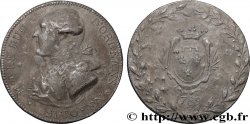


Your Recently Viewed Items
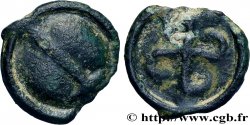
GALLIA - RHONE VALLEY Potin au swastika, petit module VF/XF
150.00 €
cgbfr.com numismatists


