


E-auction 339-253858 - fme_412455 - LOUIS-PHILIPPE I Médaille, inauguration de la colonne de Juillet (Bastille)
You must signin and be an approved bidder to bid, LOGIN TO BID. Accounts are subject to approval and the approval process takes place within 48 hours. Do not wait until the day a sale closes to register. Clicking on « bid » constitutes acceptance of the terms of use of cgb.fr private e-auctions.
Bids must be placed in whole Euro amounts only. The sale will start closing at the time stated on the item description; any bids received at the site after the closing time will not be executed. Transmission times may vary and bids could be rejected if you wait until the last second. For further information ckeck the E-auctions F.A.Q.
NO BUYER'S FEE.
NO BUYER'S FEE.
| Estimate : | 200 € |
| Price : | 72 € |
| Maximum bid : | 99 € |
| End of the sale : | 14 October 2019 18:21:00 |
| bidders : | 8 bidders |
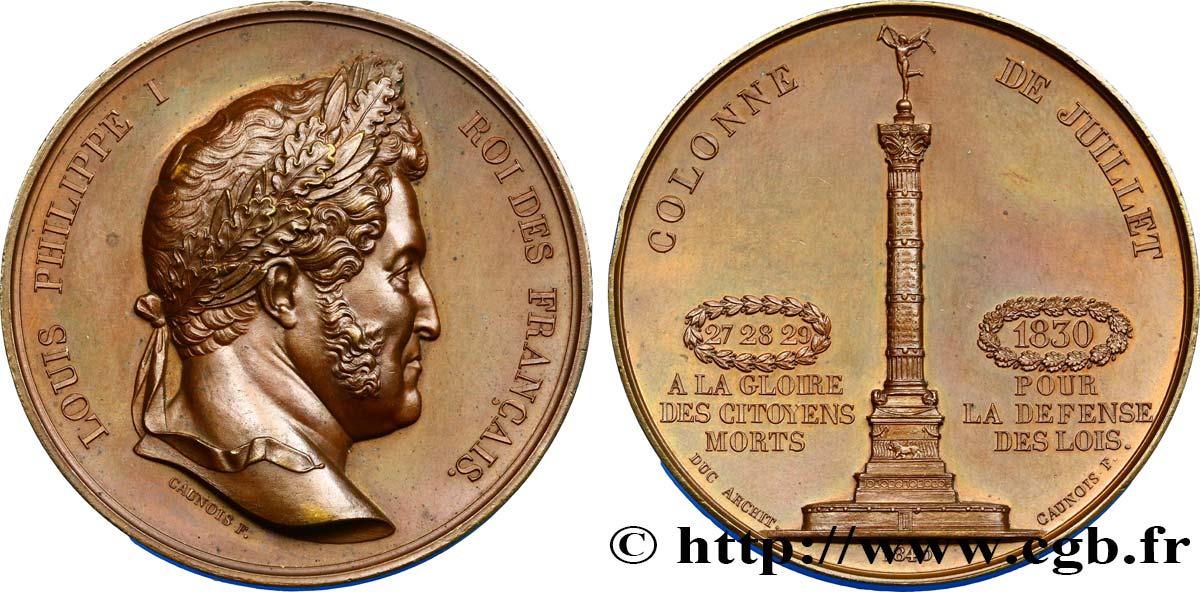
Type : Médaille, inauguration de la colonne de Juillet (Bastille)
Date: 1845
Mint name / Town : 75 - Paris
Metal : bronze
Diameter : 51 mm
Orientation dies : 12 h.
Engraver CAUNOIS François Augustin (1787-1859)
Weight : 63 g.
Edge : lisse
Coments on the condition:
Magnifique médaille avec de très beaux reliefs et une agréable patine lisse et brillante, bien homogène
Obverse
Obverse legend : LOUIS-PHILIPPE IER - ROI DES FRANÇAIS.
Obverse description : Tête laurée de Louis-Philippe à droite.
Reverse
Reverse legend : COLONNE - DE JUILLET // 27 28 29 - 1830 // A LA GLOIRE / DES CITOYENS / MORTS - POUR / LA DÉFENSE / DES LOIS/.
Reverse description : Colonne de juillet .
Commentary
Médaille signée CAUNOIS F. François Augustin Caunois est un sculpteur et médailleur français, né le 13 juin 1787 à Bar-le-Duc et mort en 1859 à Paris.
En tant que médailleur, Caunois participa à plusieurs concours monétaires. On connait de lui un essai pour le concours de 1830 (pièce de 100 Francs à l’effigie de Louis-Philippe Ier). De même, il fit partie des 25 graveurs qui participèrent au concours monétaire de 1848. Il s'agissait de créer de nouvelles pièces de 20 francs, 5 francs, et 10 centimes. François Augustin Caunois proposa une pièce de 5 francs, mais le projet d'Eugène-André Oudiné fut retenu.
La colonne de Juillet est une colonne élevée sur la place de la Bastille à Paris, entre 1835 et 1840 en commémoration des Trois Glorieuses. Ces trois journées de la révolution de juillet 1830 amenèrent la chute de Charles X et du régime de restauration, puis l'instauration de la monarchie de juillet, avec le règne de Louis-Philippe Ier, duc d'Orléans, devenu roi des Français.
Sur une plaque, au bas de la colonne, il est écrit :
« À la gloire des citoyens français qui s'armèrent et combattirent pour la défense des libertés publiques dans les mémorables journées des 27, 28, 29 juillet 1830. »
Le fût de la colonne porte le nom des victimes des journées révolutionnaires de juillet 1830 et le sommet est orné d'une sculpture en bronze doré d'Auguste Dumont : Le Génie de la Liberté. Enfin, la colonne est construite au-dessus d'une nécropole accueillant les corps de révolutionnaires tombés pendant les journées de juillet.
Le 27 juillet 1831, Louis-Philippe posa la première pierre de la Colonne, en l'honneur des Trois Glorieuses. Elle fut inspirée par la colonne Trajane de Rome. Elle fut dessinée par l'architecte Jean-Antoine Alavoine, et les travaux ne commencèrent qu'en 1835, où l'on procéda à la fonte des pièces en bronze. La décoration fut réalisée en 1839 par l'architecte Joseph-Louis Duc et la colonne fut terminée en 1840 pour célébrer les dix ans de la révolution.
Medal signed CAUNOIS F. François Augustin Caunois was a French sculptor and medalist, born on June 13, 1787 in Bar-le-Duc and died in 1859 in Paris..
As a medalist, Caunois participated in several monetary competitions. We know of an attempt by him for the 1830 competition (100 Franc coin bearing the image of Louis-Philippe I). He was also one of the 25 engravers who participated in the 1848 monetary competition.. The idea was to create new coins of 20 francs, 5 francs, and 10 centimes.. François Augustin Caunois proposed a 5 franc coin, but Eugène-André Oudiné's project was retained..
The July Column is a column erected on the Place de la Bastille in Paris, between 1835 and 1840 in commemoration of the Three Glorious Days. These three days of the July Revolution of 1830 brought about the fall of Charles X and the Restoration regime, then the establishment of the July Monarchy, with the reign of Louis-Philippe I, Duke of Orleans, who became King of the French..
On a plaque at the bottom of the column, it is written: \\\"To the glory of the French citizens who armed themselves and fought for the defense of public liberties in the memorable days of July 27, 28, 29, 1830. » The shaft of the column bears the names of the victims of the revolutionary days of July 1830 and the top is decorated with a gilded bronze sculpture by Auguste Dumont: The Genius of Liberty. Finally, the column is built above a necropolis housing the bodies of revolutionaries who fell during the July Days..
On July 27, 1831, Louis-Philippe laid the first stone of the Column, in honor of the Three Glorious Days. It was inspired by Trajan's Column in Rome. It was designed by the architect Jean-Antoine Alavoine, and work only began in 1835, when the bronze pieces were cast.. The decoration was carried out in 1839 by the architect Joseph-Louis Duc and the column was completed in 1840 to celebrate the tenth anniversary of the revolution.
En tant que médailleur, Caunois participa à plusieurs concours monétaires. On connait de lui un essai pour le concours de 1830 (pièce de 100 Francs à l’effigie de Louis-Philippe Ier). De même, il fit partie des 25 graveurs qui participèrent au concours monétaire de 1848. Il s'agissait de créer de nouvelles pièces de 20 francs, 5 francs, et 10 centimes. François Augustin Caunois proposa une pièce de 5 francs, mais le projet d'Eugène-André Oudiné fut retenu.
La colonne de Juillet est une colonne élevée sur la place de la Bastille à Paris, entre 1835 et 1840 en commémoration des Trois Glorieuses. Ces trois journées de la révolution de juillet 1830 amenèrent la chute de Charles X et du régime de restauration, puis l'instauration de la monarchie de juillet, avec le règne de Louis-Philippe Ier, duc d'Orléans, devenu roi des Français.
Sur une plaque, au bas de la colonne, il est écrit :
« À la gloire des citoyens français qui s'armèrent et combattirent pour la défense des libertés publiques dans les mémorables journées des 27, 28, 29 juillet 1830. »
Le fût de la colonne porte le nom des victimes des journées révolutionnaires de juillet 1830 et le sommet est orné d'une sculpture en bronze doré d'Auguste Dumont : Le Génie de la Liberté. Enfin, la colonne est construite au-dessus d'une nécropole accueillant les corps de révolutionnaires tombés pendant les journées de juillet.
Le 27 juillet 1831, Louis-Philippe posa la première pierre de la Colonne, en l'honneur des Trois Glorieuses. Elle fut inspirée par la colonne Trajane de Rome. Elle fut dessinée par l'architecte Jean-Antoine Alavoine, et les travaux ne commencèrent qu'en 1835, où l'on procéda à la fonte des pièces en bronze. La décoration fut réalisée en 1839 par l'architecte Joseph-Louis Duc et la colonne fut terminée en 1840 pour célébrer les dix ans de la révolution.
Medal signed CAUNOIS F. François Augustin Caunois was a French sculptor and medalist, born on June 13, 1787 in Bar-le-Duc and died in 1859 in Paris..
As a medalist, Caunois participated in several monetary competitions. We know of an attempt by him for the 1830 competition (100 Franc coin bearing the image of Louis-Philippe I). He was also one of the 25 engravers who participated in the 1848 monetary competition.. The idea was to create new coins of 20 francs, 5 francs, and 10 centimes.. François Augustin Caunois proposed a 5 franc coin, but Eugène-André Oudiné's project was retained..
The July Column is a column erected on the Place de la Bastille in Paris, between 1835 and 1840 in commemoration of the Three Glorious Days. These three days of the July Revolution of 1830 brought about the fall of Charles X and the Restoration regime, then the establishment of the July Monarchy, with the reign of Louis-Philippe I, Duke of Orleans, who became King of the French..
On a plaque at the bottom of the column, it is written: \\\"To the glory of the French citizens who armed themselves and fought for the defense of public liberties in the memorable days of July 27, 28, 29, 1830. » The shaft of the column bears the names of the victims of the revolutionary days of July 1830 and the top is decorated with a gilded bronze sculpture by Auguste Dumont: The Genius of Liberty. Finally, the column is built above a necropolis housing the bodies of revolutionaries who fell during the July Days..
On July 27, 1831, Louis-Philippe laid the first stone of the Column, in honor of the Three Glorious Days. It was inspired by Trajan's Column in Rome. It was designed by the architect Jean-Antoine Alavoine, and work only began in 1835, when the bronze pieces were cast.. The decoration was carried out in 1839 by the architect Joseph-Louis Duc and the column was completed in 1840 to celebrate the tenth anniversary of the revolution.
Historical background
LOUIS-PHILIPPE I
(7/08/1830-24/02/1848)
Born in Paris in 1773, Louis-Philippe is the eldest son of Louis-Philippe Joseph, Duke of Orléans (Philippe-Égalité), guillotined in 1793 for corruption after having voted for the death of his cousin Louis XVI. He successively bears the titles of Duke of Valois, Chartres and Orleans from 1793. Favorable to the Revolution, like his father, he nevertheless had to take refuge in Switzerland then he traveled to Scandinavia, the United States and finally settled in England in 1801.. The Restoration allows him to find the immense possessions of his family but he remains considered as a potential rival by Louis XVIII who receives him coldly. Refugee in England during the Hundred Days, he returned to France in 1817. Greedy for gain, he gave his support to the opposition represented by the liberal party while relying on the possessing upper middle class.. The days of 1830 gave him the opportunity to come to power after having adhered to the tricolor flag and multiplied the promises. He became on July 31, 1830 lieutenant general of the kingdom then king of the French on August 7. His reign, under a liberal appearance, will become that of the bourgeoisie and business circles while the oppositions (Legitimists, Bonapartists, Republicans and Socialists) are maintained illegally.. His peace policy and his authority then earned him significant prestige with the European courts.. The banker Laffitte is Prime Minister. La Fayette is one of the architects of this "bourgeois revolution". On March 13, 1831, Casimir Périer replaced Laffitte. France intervenes in Belgium in August 1831 to counter the Dutch. The Legitimists, with the rue des Prouvaires plot, try to establish Henry V as king while his mother tries to raise the Vendée. She was arrested on December 3, 1832 in Nantes.. The cholera epidemic kills more than ten thousand people in Paris, including Casimir Périer. General Lamarque's funeral was the occasion for an attempted republican uprising, crushed in blood (see. Wretched). The French occupy Antwerp on December 23, 1832.. Fieschi's attack of July 28, 1835 against Louis-Philippe kills eighteen people including Marshal Mortier. The first Paris-Orléans railway line and the July column were inaugurated on October 24, 1837 and July 28, 1840 respectively.. The year 1840 marked a turning point in the regime, with great ministerial instability before having the Guizot ministry ("Get rich!").. Prince Louis-Napoleon Bonaparte, after a second putsch attempt, was sentenced to life imprisonment and locked up in Fort Ham from which he escaped in 1846. Napoleon's ashes are brought from Saint Helena and transferred to Les Invalides. From 1841, Louis-Philippe committed France to the path of the total conquest of Algeria, already begun under Charles X, while a major economic boom developed in Metropolitan France.. A law in 1841 limits child labor to 12 hours. The first serious railway accident took place on the Paris-Versailles line and caused 45 deaths on May 8, 1842. On July 13, the Duke of Orleans, the king's eldest son, died accidentally. On May 16, 1843, the Duke of Aumale took the smala of Abd-el-Kader who managed to escape. Bugeaud, Governor of Algeria, is made Marshal. 1843 is also the beginning of the Entente Cordiale and the visit of Queen Victoria to France. The French beat the Moroccans at Isly. Abd-el-Kader surrenders on December 23, 1847. The refusal of reforms leads to the fall of the regime during the Banquet Campaign and Louis-Philippe, dethroned on February 24, 1848, takes refuge in England after having abdicated in favor of his grandson..
 Report a mistake
 Print the page
 Share my selection
 Ask a question
 Consign / sell
Related articles

 Full data


Your Recently Viewed Items
GALLIA - ARMORICA - OSISMII (Area of Carhaix - Finistère) Quart de statère dit
600.00 €

LOUIS XIV "THE SUN KING" Lis d’argent 1656 Paris AU
3800.00 €
cgbfr.com numismatists


